|
|
 |
|
|
|
|
|
|
|
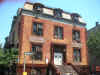
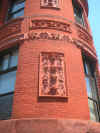
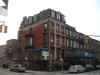
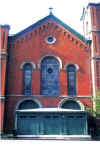
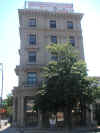
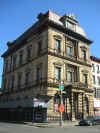
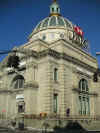
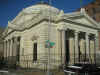
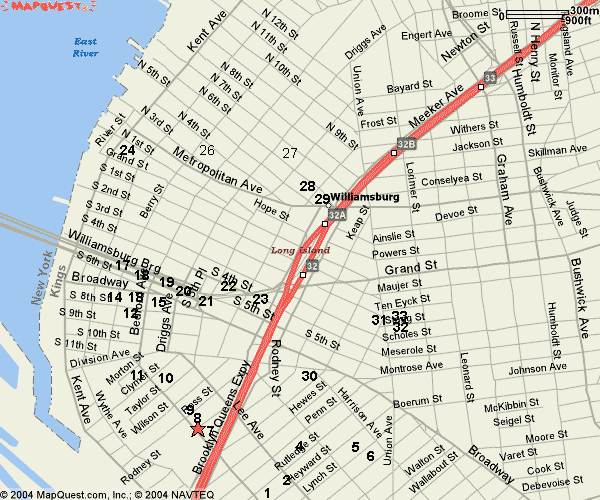
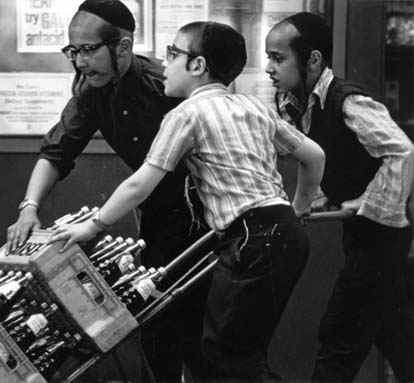
Without the final "h;" even though the Williamsburgh Savings Bank spells its name the old way (the "h" fell when it consolidated with the City of Brooklyn in i855). Though it shares its current spelling with the well-known restoration in Virginia, the resemblance ends there. This Williamsburg, formerly part of the Town of Bushwick, later a village and city in its own right, was named after Col. Jonathan Williams, its surveyor and grandnephew of Benjamin Franklin. Richard M. Woodhull started the community when he purchased thirteen acres of land at the foot of today's South 2nd Street, in 1802. He commissioned Williams to survey it, established a ferry to New York (Manhattan), and quickly went bankrupt (1811). Thomas Morrell and James Hazard picked up where Woodhull had left off. They also established a ferry, this time to the Grand Street Market at Corlear's Hook, providing an outlet for the farmers of Bushwick to sell their produce in New York. The impetus to the area's growth, however, was the establishment of a distillery in 1819. The distillery is gone (as is the Schaefer brewery that followed it on the same site). Booze and - beer helped build Williamsburg but now are only drunk here, not distilled or brewed (except at the now famous but small Williamsburg brewery). The most telling impact on the community came from the opening of the Williamsburg Bridge in 1903. Overnight the community changed from a fashionable resort with hotels catering to such sportsmen as Commodore Vanderbilt, Jim Fisk, and William C. Whitney to an immigrant district absorbing the overflow from New York's Lower East Side. (The New York Tribune of the period characterised the bridge as "The Jews' Highway:') Its elegant families moved away, and its mansions and handsome brownstones from the post-Civil War era fell into disuse and then were converted to multiple dwellings. Hasidic community: Along Bedford Avenue are arrayed a group of brownstones, mansions, and apartment houses such as described above: one of New York's most concentrated Hasidic Jewish communities. This unique settlement of the Satmarer Hasidim, recalling late medieval Jewish life in dress and customs, is a result of the overflow of Jews from the Lower East Side (made possible by the opening of the Williamsburg Bridge) joined by Jews fleeing persecution of the Eastern European Jewish community during World War II. In 1946, Rebbe Joel Teitelbaum and several of his flock reached Williamsburg -even then a heavily Orthodox area-as their home. At the end of the war, the remaining survivors from Poland and Hungary migrated to the new settlement and reestablished their lives there. As the community grew, parts of it split off and moved to other parts of Brooklyn and to the suburbs. Beards and uncut earlocks identify the men; shaved but wigged heads identify the women. Long frock coats and skullcaps are in evidence everywhere among its male population, young and old; and in the winter, the fur trimmed hat, the shtreiml, is certain to make its appearance. Evidence of its residents' heritage is everywhere apparent, from the proliferation of Yiddish signs on the mansions to the identification of small business establishments catering to the group. |
| with thanks to "The AIA Guide to New York", |
|
|
| First imported from China about 1840, the tree was intended for use as the grazing ground of the cynthia moth's caterpillar, a great, green, purpleheaded, horned monster (3/ inch in diameter, 3 inches long) that spins a cocoon prized for its silk threads. The mills of Paterson, N.J., were to be its beneficiaries. Its grazing role proved uneconomical (the grazing still goes on, however, without cocoon collection), but the tree was believed to have another virtue for the locals: supposedly providing power to dispel the "disease-producing vapors" presumed to come from swampy lands. See Betty Smith's 1943 novel of Williamsburg life, A Tree Grows in Brooklyn. |
|
Subway kiosks: the late-lamented cast-iron IRT subway kiosks were cast in
the Hecla Iron Works on Berry Street in the northern part of Williamsburg.
The recent reconstruction of one at Astor Place near Cooper Union, in
Manhattan, is a wondrous revival of these great glass and metal canopies. |
 -click
here for some notes on the different Orthodox
Jewish sects. -click
here for some notes on the different Orthodox
Jewish sects. |
 -click
here for a more detailed Williamsburg history. -click
here for a more detailed Williamsburg history. |
 -click
here for some early Williamsburg
photographs. -click
here for some early Williamsburg
photographs. |

-click here for the Williamsburg Land Use and Waterfront Plan |
|
Byline: Blair Golson Now that renovations are nearly complete on the East 62nd Street mansion that the Japanese government purchased in 1998 for its ambassador to the United Nations, the ambassador's current residence at 740 Park Avenue is set to hit the market for about $20 million. "We plan to sell it," confirmed a spokesman for the Japanese mission to the U.N. "We're in the final stages of our internal conversation, but we haven't decided yet [about the price]." The 18-room duplex apartment sits on the fourth and fifth floors of the ultra-exclusive Park Avenue co-op building. The Japanese government, which has owned the space since 1962, has yet to finish negotiating with brokerage agency Brown Harris Stevens to bring the property to the market, but the government's spokesman said the move was imminent. "We haven't formally decided to sign a contract with Brown Harris Stevens," he said. "But the ambassador is moving out to his new residence." And what a residence: In December of 1998, the Japanese government paid $21.5 million for the 22,000-square-foot Beaux-Arts mansion at 11 East 62nd Street, then the highest price ever paid for a Manhattan townhouse. For the last 55 years, it had been the headquarters of the Johnson O'Connor Research Foundation, an aptitude-testing center. Michael Jackson was the only individual who seriously considered buying it. Despite the record-breaking price tag, the 1898 property was a real fixer-upper, and the ongoing renovations now stretch back over three years. Asked about the ordeal, the Japanese spokesman pointed to the city's stringent construction regulations. "You really need to renovate it properly," he said. "We want to preserve the beauty of this Beaux-Arts building, and at the same time, it's necessary to meet the requirements of current landmark building rules." The spokesman said it still isn't clear when the Japanese ambassador, Koichi Haraguchi, and his wife will be able to move into their new home. But the apartment they leave behind is in one of the Upper East Side's most storied buildings. Over the years, 740 Park--located on the corner of 71st Street--has been home to John D. Rockefeller Jr., Edgar Bronfman, Ronald Lauder, Henry Kravis, Marshall Field, Faith Golding (the first Mrs. Ronald Perelman), and Steve Ross' widow, Courtney Sale Ross. It was also home to the most expensive co-op sale in New York history: financier Steven Schwartzman's $37 million purchase, in March 2000, of Saul Steinberg's 34-room triplex penthouse--part of the spread originally built for Rockefeller. The Japanese ambassador's current residence has six bedrooms, two libraries, seven maid's rooms, and eight and a half baths. Brokers at Brown Harris Stevens declined to comment on any aspect of their expected exclusive. Dentist Shakes Astronaut Hero's Hand in $400 K. Upper East Side Closing As one of the original seven right-stuff Mercury astronauts, NASA pilot Scott Carpenter was the second American to orbit Earth. But he's through orbiting Manhattan for a while, now that his wife's Upper East Side pied-a-terre has been sold to a dentist from Florida. And, as is often the case with real estate like this, hero-worship played a role in sealing this deal. The apartment's new owners, Dr. Charles and Sheila Haas, who have been married for almost 40 years, started their search for a retirement home in New York at No. 4A East 87th Street--a large, white-brick co-op building off Madison Avenue. Mrs. Haas liked the apartment they saw there, but her husband wanted to keep looking. They both left without realizing that the pied-a-terre was home to the NASA astronaut and his wife, who live primarily in Vail, Colo. The dentist and his wife then embarked on an eight-month odyssey of apartment hunting with Coldwell Banker Hunt Kennedy broker Rob Kuhar. After two particularly frustrating deals fell apart, the dentist's wife inquired again about No. 5 East 87th Street. It was still available. "Sheila loved it even more than the first time she saw it," said Mr. Kuhar. "[And] as we were walking through the apartment, Dr. Haas noticed some of the photos on the mantle--they were of Scott Carpenter, the astronaut. Soon after, any reservations Dr. Haas had melted away." According to Mr. Kuhar, Dr. Haas "was glued to his TV set" during the early days of the Mercury program, and he has always looked up to Mr. Carpenter as something of a personal hero. "They spent about an hour together talking about the space program," said Mr. Kuhar, "and Dr. Haas now has a signed photo of him shaking hands with Scott, which he hangs on the wall of his dental practice." After some brief negotiations, they agreed on a price of $418,500, all in cash, for the mint-condition 750-square-foot, one-bedroom, one-bathroom co-op. She's Embedded in Williamsburg: Leslie Cockburn's Southside Loft In pursuit of the story, television news producer Leslie Cockburn has spent time in war-torn places like Nicaragua, Colombia, Cambodia, the Persian Gulf, Somalia and Afghanistan. Her book about Russian nuclear smugglers was made into the movie The Peacemaker. With that kind of track record, it's no surprise that the battle-tested journalist felt comfortable buying an artist's loft in the somewhat less-than-gentrified neighborhood of South Williamsburg. Several weeks ago, Ms. Cockburn paid $800,000 for a 2,500-square-foot co-op on South Eighth Street, between Driggs and Bedford avenues. "It's a real neighborhood," Ms. Cockburn said when asked about the locale. "Yes, there are problems, there are burnt-out buildings ... but because of my experiences, and what I do for a living, I'm less bothered by what other people might regard as scary." Ms. Cockburn, a frequent segment producer for 60 Minutes, among other investigative programs, will be sharing the loft with her 24-year-old daughter, Chloe, a recent Harvard grad who plans to use the loft's studio space to create abstract paintings. The building they will both inhabit is a former 1860's schoolhouse that a group of artists, led by a Swedish poet-cum-business consultant, converted into loft spaces in 1985. The building is still inhabited almost entirely by artists, and the trail-blazing Swede, a 37-year New York resident named Lars Cederholm, recalled what the neighborhood was like when he and his fellow artists set up shop. "There were shooting galleries everywhere. Packs of dogs were running around making life dangerous, and people were shooting up heroin all around," he said. A Hispanic biker gang ran the neighborhood, but Mr. Cederholm, who speaks Spanish, was able to broker a truce with the gang that kept the resident artists safe. "Even when it was downtown Beirut, it was very safe," he said of life after the agreement. "It's counterintuitive, but that's the way it was." Mr. Cederholm sold his own unit in the building last year. He owns a house in an upstate New York Buddhist colony, and wants to make that his primary residence. The unit that the two Cockburns bought belonged to Mr. Cederholm's ex-wife. It has 16-foot ceilings, two bedrooms, 10 south-facing windows and hardwood floors. Chloe Cockburn, an Upper West Side native who recently left San Francisco because "the art scene was terrible--the cool hip thing is graffiti-based stuff," saw the loft on the Internet and soon concluded that there was no reason to be apprehensive about the neighborhood. Her mother, Leslie, will be splitting her time between the Williamsburg loft and Washington, D.C., where she lives with her husband and longtime journalistic partner, Andrew Cockburn. She echoed her daughter's sentiments about living south of the Williamsburg Bridge. "The other morning I woke up in Williamsburg, and I was going to the L train, and there was a Hasidic family with a bunch of kids going to school, and also a gorgeous young woman in a pink petticoat, obviously on her way home," she said. "I like the feel of the place. It reminds me of when I was living in Notting Hill in the 70's. It has a lot of the qualities of downtown New York in 1974." |
|
From the (1939) WPA Guide to
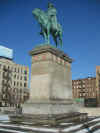
New York City: Williamsburg, the area extending fanwise from the Williamsburg Bridge to Flushing and Bushwick Avenues, has a large polyglot population. The neighborhood, formerly the most congested residential area in Brooklyn, has lost some sixty thousand inhabitants since the 1920'S. Here, with the erection in 1936-7 of Williamsburg Houses, a PWA construction project, began Brooklyn's first experiment in large-scale low-rent housing. Originally part of the town of Bushwick, Williamsburg was founded about 1810 and named for a Colonel Williams, the engineer who surveyed it. About 1819 Noah Waterbury established a distillery at the foot of South Second Street, the first industrial plant in the locality. Williamsburg in the middle nineteenth century was a popular resort; its hotels near the Brooklyn Ferry attracted a wealthy, cosmopolitan crowd, including such gourmets and sportsmen as Commodore Vanderbilt, Jim Fisk, and William C. Whitney. With the opening of the Williamsburg Bridge in 1903 and the resultant influx of immigrant families from overcrowded Manhattan, the district's affluence vanished. Statue Of George Washington, west side of Washington Plaza, Broadway and Havemeyer Street, is a bronze equestrian figure on a high granite pedestal. The work of Henry M. Shrady, it was presented to the city in 1901 by James R. Howe, a member of Congress. An enormous volume of traffic--el trains, surface cars, automobiles, wagons and pedestrians--streams by the statue, for the plaza is the formal Brooklyn terminus of the Williamsburg Bridge. Wallabout Market, Flushing and Clinton Avenues, Brooklyn's only public wholesale market, is a vast clearinghouse for produce from New York and New Jersey farms. The quaintness of buildings inspired by old Dutch prototypes lends an old-world atmosphere to the terminal The market is housed in blocks of two-story brick structures, each surmounted by a watchtower and a weathercock. The blocks arc grouped around a wide plaza called Farmers' Square. A relatively deserted region by day, from midnight to dawn the market bustles with noisy activity: Farmers' Square is a solid mass of vehicles, crates, and barrels, and truck drivers, jobbers, and farmers. The site of the market, once part of the large tract acquired by the United States for a navy yard, was sold to Brooklyn by Congress in July, 1890. Naval Hospital, Flushing Avenue and Ryerson Street, is separated from the Navy Yard by Wallabout Market. Its neatly landscaped grounds are enclosed by a high brick wall. Founded in 1834, the hospital has 508 beds, four emergency ambulances and a staff of more than two hundred. The patients--Navy men, war veterans, ECC and. lately, members of the CCC and WPA--have the use of a six-thousand volume library and may attend nightly movie shows. |







 \
\