|
|

 |
|
|
|
|
| New York Architecture Images- Notes | |||||||||||||||||||||||||||
| Williamsburg Land Use and Waterfront Plan | |||||||||||||||||||||||||||
|
|||||||||||||||||||||||||||
| New York Daily News -
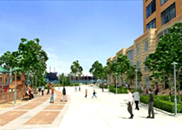
http://www.nydailynews.com Burden of leadership By MELISSA GRACE DAILY NEWS STAFF WRITER Sunday, October 12th, 2003 The skeptics didn't think anyone could do it - never mind a blue blood from Manhattan. No way could Amanda Burden, the wealthy daughter of Standard Oil heir Stanley Mortimer, cross the East River to Brooklyn and successfully push a redevelopment plan in Williamsburg and Greenpoint. They could not have been more wrong. Burden, chairwoman of the city's planning commission, is leading a bid to rezone the industrial waterfront neighborhoods to catch up with the residential conversion of the area's aging manufacturing buildings, many of which are illegally occupied by artists and hipsters. In the process, the quintessential New York socialite has turned many hard-boiled community activists into admirers. "She has considered this her project from the day she took over," said Julie Lawrence, a member of the local community board rezoning task force. "She's a real doer, and when she commits herself, she puts her whole heart into it." Burden - appointed nearly two years ago by Mayor Bloomberg to the planning commission's top post - has earned kudos for taking on a project that had been ignored for years. She pushed through decade-old plans drawn up by the two communities and has fought against building a power plant on the East River. And Burden also convinced big and small business owners that a residential overhaul will preserve existing manufacturing districts. Burden is now in the midst of a year-long process to push through her fine-tuned zoning plan. It calls for building 7,000 apartments in low-rise buildings inside a 170-block area, and the construction of a series of 15- to 35-story residential buildings along the waterfront. The controversial high-rises will be constructed by developers, who will pay to convert the waterfront into a park. "It's a lasting legacy for people to really value," Burden said. "It's a chance ... to reclaim the waterfront." It also is a chance to create affordable housing and new parkland, she said. Those are two issues that have Burden's admirers worried that their classic immigrant neighborhoods - now topped only by church steeples - will soon resemble Battery Park City. Open space debate "Is there a way to make this work for development without these tall buildings?" asked Joe Vance, who wants the waterfront turned into a park. "We need to make sure we're getting enough open space, and right now it's not really enough." Burden blanched at the suggestion that a 2-mile stretch of park along the now-inaccessible waterfront isn't enough. "Forty-nine acres, oh my God!" she exclaimed. "That is fantastic new acres of new parkland which we hope we get!" A debate also is raging over affordable housing, and many say they don't believe the city has done enough in the plan to ensure vulnerable tenants won't be forced out by new construction and a hot real estate market. While city officials insist affordable housing will not be neglected, Christine Holowacz, who lives in Greenpoint and is a member of the task force, said the amount provided in the plan is insufficient. "The [city's] programs ... show 20% affordable housing," she said. "That is not high enough. We're talking 40%." It's too early to know if Burden will keep her favored status - but these Brooklynites have begun to recognize this city planner as a tough mediator. "This is New York City, nobody gives their best offer first," said Vance. ------------------------ Greenpoint-Williamsburg Rezoning http://www.nyc.gov/html/dcp/html/greenpointwill/greenoverview.html ------------------------ August 1, 2004 THE CITY On the Waterfront in Brooklyn One of Mayor Bloomberg's great obsessions is promoting more housing, and one of the most intriguing projects he is championing is the rewriting of zoning codes on the city's waterfront areas to allow more residential construction. Some of his projects in Manhattan have gotten caught up in larger issues like downtown redevelopment or the ill-advised stadium on the West Side. But the situation in Brooklyn seems more promising. The mayor's plan is a smart one that deserves support, as long as what gets built includes a large number of housing units for low- and middle-income residents. Everybody understands the need. The city gained about a half million residents in the last decade but only 85,000 new houses and apartments. Studies show that almost half of renters pay more than 30 percent of their income for shelter, putting them above the maximum that is generally considered affordable. About one-fourth pay more than half their income. City workers like firefighters and police officers, who are required to live in the city, can't find housing that they can afford on city salaries as working class neighborhoods are swallowed, block by block, by more affluent residents. It's a familiar situation, and right now it is threatening longtime residents of neighborhoods like Greenpoint and Williamsburg in North Brooklyn, which have for generations been home to working families - Polish, Italian and more recently Hispanic. The area has also become a destination for artists, and professionals in search of more space than they could afford across the river. It's the right target for more housing development, especially since it has a long waterfront that is currently underused, with empty warehouses and factories, including the Domino sugar plant, that are legacies of an industrial past. The city's development plan involves rezoning the waterfront to allow for the construction of high-rise apartments on a new esplanade. Forty-nine acres in the area would become much-needed parks. The mixed-use, low-rise flavor of inland blocks would be retained. The vision seems great, but the city needs to make sure it isn't limited to wealthy newcomers. At least 20 percent of the units ought to be reserved for low- or moderate-income families. One solution, proposed by Councilman David Yassky, would give development rights only to builders who commit to including moderately priced units. Developers might be inspired to build more and the city would gain without having to pay extra subsidies that could further strain the budget. Mr. Yassky's idea could work, and could be applied to other areas marked for similar rezoning, including projects in Long Island City and Jamaica in Queens and Hunts Point and Port Morris in the Bronx. The city is considering a less ambitious version of the proposal, and the administration and Mr. Yassky may eventually have to compromise on how many lower-priced units would be required. Mayor Bloomberg's focus on housing is commendable, and he has already put together the most ambitious city plan in two decades, which aims ultimately to build or rehabilitate 65,000 units within financial reach of working class families. So far, work is under way on 10,000 of those, half of them new, the city says. But the city government, strapped for cash and limited in its ability to borrow money, can only do so much. The need far outstrips the government's resources, particularly given the sunset of the Mitchell-Lama program, which used to keep a ceiling on housing costs for thousands in the city. The waterfront projects offer a real opportunity to enlist the crucial help of private builders, so that in New York the term affordable housing doesn't become an oxymoron. Copyright 2004 The New York Times Company |
|||||||||||||||||||||||||||







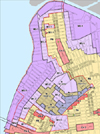
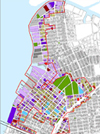
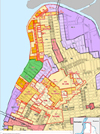
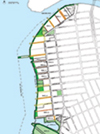
 In
its Greenpoint-Williamsburg Rezoning, the Department of City
Planning is proposing zoning changes to allow for housing
and open spaces, in tandem with light industry and
commercial uses, along two miles of Brooklyn’s East River
waterfront and upland neighborhoods. The proposed actions
include zoning map and zoning text changes to facilitate new
housing and local commercial development, and, in
conjunction with the Department of Parks and Recreation,
City Map changes to establish a new, 27.8-acre waterfront
park.
In
its Greenpoint-Williamsburg Rezoning, the Department of City
Planning is proposing zoning changes to allow for housing
and open spaces, in tandem with light industry and
commercial uses, along two miles of Brooklyn’s East River
waterfront and upland neighborhoods. The proposed actions
include zoning map and zoning text changes to facilitate new
housing and local commercial development, and, in
conjunction with the Department of Parks and Recreation,
City Map changes to establish a new, 27.8-acre waterfront
park.