|
|
 |
|
|
|
|
new york architecture walks- Battery
|
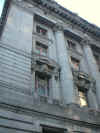
ALEXANDER HAMILTON CUSTOM HOUSE 1
Bowling Green, Cass Gilbert, [1899-1907]
One of the city's most splendid Beaux Arts
buildings. The monumental sculptures by French are very much part of
the architecture of the façade, their whiteness-and that of those at the
attic by other sculptors are a rich counterpoint to the structure's gray
granite. |
|
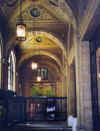
CUNARD BUILDING
25 Broadway, Benjamin Wistar Morris [1921]
Built as a ticket office for the Cunard Passenger Ship Line, the grand interior of the Great Hall shows how the popular Beaux Art style was adapted to a new use. The architect collaborated with muralist Ezra Winter to produce a decorative program focused on shipping themes, set within a huge vaulted space that recalls Roman bath buildings. In contrast to the ceremonial Great Hall, the exterior is a simple Renaissance facade topped with a relatively undistinguished high-rise. The Great Hall was converted into a branch of the U.S. Postal Service in 1977. |
|
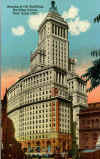
STANDARD OIL BUILDING 26 Broadway,
Carrere & Hastings and Shreve, Lamb & Blake [1922]
Built as the headquarters for John D. Rockefeller's Standard Oil Company, Carrere & Hastings' nine-story base follows the curve of Broadway. The very dignified Renaissance style lobby bespeaks the company's wealth and importance. Following the breakup of the company in 1911 due to anti-trust laws, Shreeve, Lamb & Blake added a massive tower squared to the grid of the uptown streets. |
|
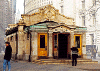
BOWLING GREEN IRT CONTROL HOUSE
Heins & Lafarge [1904-5]
Heins and Lafarge designed the control house at Bowling Green at the top of Battery Park. The third extant control house, now closed, is at Atlantic and Flatbush Avenues near the Long Island Rail Road Terminal. |
|
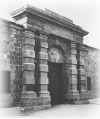
CASTLE CLINTON
Battery Park, John McComb Jr. [1807-11]
Until recently, one of the most vitally involved structures in the city's life and history. Built as West Battery for the War of 1812 to complement Castle Williams across the waters on Governors Island (it never fired a shot in anger), it was originally an island fortification some 300 feet offshore, connected to Manhattan by a combination causeway bridge. Twelve years after the war it was ceded to the city. As a civic monument it served for the reception of distinguished visitors at the very edge of the nation (General Lafayette, Louis Kossuth, President Jackson, Prince Albert). Remodeled as a concert hall and renamed Castle Garden, it enjoyed a moment of supreme glory in 1850 as the site of the P.T. Barnum-promoted American debut of the Swedish soprano Jenny Lind. Only five years later it was transformed into the Emigrant Landing Depot, run by N.Y. State, where some 7.7 million new Americans were processed. Scandal led to its closure, and the processing of immigrants was transferred to federal control, at the Barge Office in 1890 and at Ellis Island in 1892. Changed by McKim, Mead & White, it became the New York Aquarium until 1941. |
|
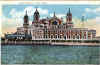
ELLIS ISLAND
Ellis Island,
Boring & Tilton [1900]
Today's visitors to Ellis Island, although unencumbered by bundled possessions and the harrowing memory of a transatlantic journey, retrace the steps of twelve million immigrants who approached America's "front doors to freedom" in the early twentieth century. Ellis Island receives today's arriving ferry passengers as it did hundreds of thousands of new arrivals between 1897 and 1938. In place of the business-like machinery of immigration inspection, the restored Main Hall now houses the Ellis Island Immigration Museum, dedicated to commemorating the immigrants' stories of trepidation and triumph, courage and rejection, and the lasting image of the American dream. |
|
STATUE OF LIBERTY
Liberty Island, Frederic-Auguste Bartholdi (sculptor), Richard Morris Hunt
(architect of base) and Alexandre Gustave Eiffel (engineer) [1874-1886]
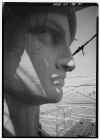
Sculptor Frederic Auguste Bartholdi was commissioned to design a sculpture with the year 1876 in mind for completion, to commemorate the centennial of the American Declaration of Independence. The Statue was a joint effort between America and France and it was agreed upon that the American people were to build the pedestal, and the French people were responsible for the Statue and its assembly here in the United States. |
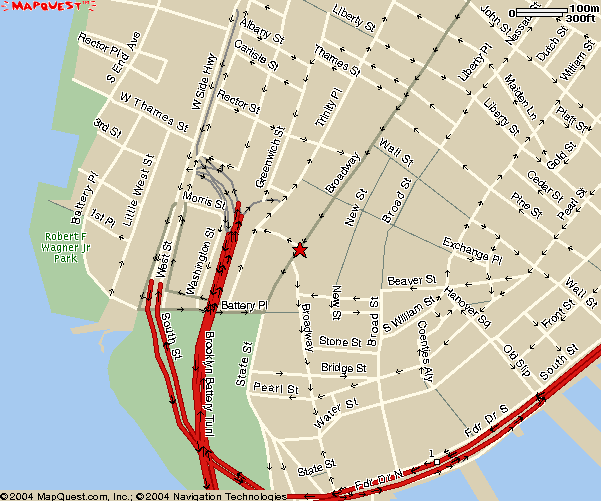
| The harbor is the key to the creation of New York City. Here on the site of the city's first buildings we study the role of the port from the founding of New York up to World War I. We also discuss the message a building can communicate by its elaboration of detail. As there is no remaining building of the early colony, we begin here speaking about the layers of growth in New York City through the present. The urban role of lower Manhattan is now changing as office buildings are given a residential and/or technology-oriented character. |