|
|
 |
|
|
|
|
|
New York Architecture Images-
Building Types
Diners / Restaurants |
||||||||||
| See also Top Ten Diners / Restaurants | ||||||||||
|
|
 |
|
 |
||||||
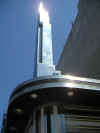
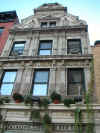
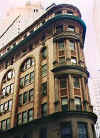
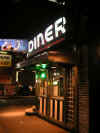
| 004-Empire Diner | 007 Scheffel Hall | 052
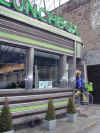
Lunchbox Diner |
044 DELMONICO’S | 091 Russian Tea Room | ||||||
|
|
|
|
|||||||
|
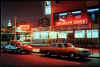
138 Cheyenne Diner |
139
Munson Diner |
140
Market Diner |
004-Tavern- on-the-Green | |||||||
| The main diner manufacturer was Kullman Diners, started by Samuel Kullman in Newark in 1927. | ||||||||||
|
From diners to
diplomacy Kullman Industries celebrates 75 years of building America
The diner industry provided turn-key, portable restaurants that served a market seeking fast, low-cost, home-cooked meals. Kullman Diners during this period earned a reputation within its industry for innovation and quality, placing it as a leader by the onset of World War II. The company consistently strove to introduce the latest materials into its product line, which then featured the earliest uses of stylized, fabricated stainless steel and Formica surface laminates - elements that still make the diner so immediately recognizable today. Returning from service in World War II, Sam's son Harold Kullman joined the company after having earned his own degrees in finance and engineering. In a time when the industry produced larger and more ornate diners, Kullman advanced the design and construction standards of the industry. Sam's direction would see Kullman build some of the roadside's most streamlined and soaring restaurant designs. Trends would prove fickle, however. By the mid-1960s, the spread of the "family restaurant" concept would induce Kullman's designers to reverse course. Suddenly, the diner experience would reflect a cozier setting drawing from colonial America - then all the rage in home decorating. Still, the decade would not bode well for the industry. With the rise of the fast-food industry encroaching on America's roadsides, the demand for large, multi-sectioned diners had seriously contracted. The spreading popularity of homey chains such as Howard Johnson's and their meticulous attention to operational consistency threatened the family-owned diner as never before.
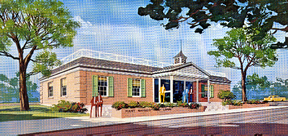
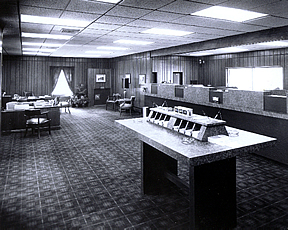
Kullman expands into other modular markets with this bank in
Marlbor, New Jersey. The result was America's first bank constructed in the modular process installed in Marlboro, New Jersey and still in use. This milestone coincided with the entry into the business of the Kullman family's third generation, Robert Kullman. Seeing a new direction for the family business, Robert set out to prove to the world of the benefits of modular construction. Strip a diner of its stainless steel, its restaurant equipment, furnishings and ornamentation, and what remains is a highly durable steel and concrete building module, that interconnects with other such modules to form a variety of building types. Kullman, with Robert's urging, aggressively pursued this new potential in the corrections, educational, institutional, and broader food service markets. The company coined the term "Accelerated Construction" to describe a building process free from the uncertainties of weather, site conditions, and contractor relations. Accelerated or factory construction utilizes the same building materials and labor found on any project site, but with an extra measure of quality control and predictability. With the explosive growth of wireless communications, equipment shelters have also become a core part of the company's business. Kullman's design-build capabilities and tight control over the manufacturing environment made it a logical candidate for mass-producing diminutive but vital structures to protect sensitive communications equipment against extreme weather and vandalism. If you don't use a cell phone, you don't eat at diners, you or your child may have attended one of the many school facilities Kullman has constructed. Kullman calculates over 60,000 students presently attend the over 2,500 classrooms built by the company in just the last 20 years. In 1994, Kullman made history yet again by building a United States embassy building at its plant in Avenel, New Jersey and shipping it to Bissau, Guinea-Bissau. This development marked the first construction of an American embassy in America, and its success led to projects for Ashgabat, Turkmenistan and Bishkek, Kyrgyzstan. Built, shipped, and assembled by American personnel with security clearances, Kullman helped the State Department avoid the security risks that often plague on-site construction by local labor in foreign countries. With all those old stainless steel diners disappearing off the landscape, the smart money betted on the diner's extinction. Yet, some individuals took notice and worked to elevate this unique architectural form into a new level of appreciation. In 1988, Jeffrey Gildenhorn's new restaurant in Washington, D.C. drew its inspiration from the style of a classic 1950s vintage Kullman diner. Gildenhorn asked the company to build the American City, a retro-styled diner that complied with all modern building codes. Kullman has since furthered this trend with new retro-styled diner construction and renovations across the northeast and overseas. In 1995, Kullman moved to its new facility in Lebanon, New Jersey, greatly expanding the company's capacity to produce an increasing variety of building types. In the past decade, Kullman constructed hospitals and a college campus, while its food service division has branched out to build double drive-thru hamburger restaurants and stylish drive-up businesses for coffee vendors. In 2003, the company expanded its presence in the correctional facility market by acquiring the key assets of Mark Solutions, Inc., the leading manufacturer of galvannealed steel jail and prison cells. Chief Operating Officer John Lefkus proudly acknowledges the company's diner heritage, while pointing to the company's successful transformation and its role in our society: "The next time you talk on a cell phone, leave your child at school, call a police dispatch for emergency services or wonder how Americans are being protected in overseas embassies, think Kullman."
|
||||||||||
|
America Returns to the Diner
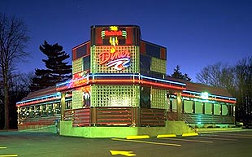
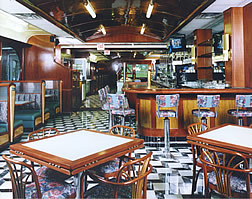
Unlike all other family style restaurants, people feel good just stepping in the door. Who can resist the aroma of the fresh coffee brewing or the sight of fresh-baked pies in the dessert case? The lively, textured atmosphere of a real diner promises an experience that simply cannot be duplicated in any caricatured, slapped-together restaurant concept. The gleam of stainless steel, the color of the Formica surfaces, and the highly-detailed workmanship built into each diner all provides a visual feast as satisfying as anything on the menu. Who goes to the diner today? Just about everyone. The special at-home nature of a real diner appeals to people from all walks of life, from truckers to bankers; from students to their professors; from parents with fond childhood diner memories to teenagers discovering that good food doesn't come from a heat lamp. In fact, when given the choice of their local diner and the local hamburger franchise, kids increasingly will choose the diner. Thanks to this renewed appreciation, the diner remains the hottest trend in the restaurant industry. Savvy restaurateurs all over the country have attempted to duplicate this concept, and yet, anyone who's been to a classic diner will tell you that nothing beats the genuine article. Even today, years after its original golden age, people of all ages from all parts of the world instinctively recognize real diners as a good place to get a hot meal. You cannot purchase that kind of instant brand recognition at any price. And now, Kullman Industries, the diner industry's largest and most experienced builder comes full circle as well to meet the needs of this growing market The Kullman Custom-Built Diner With your business already established and growing, your current facility seems to be bursting at the seams, and at the same time, you also recognize the appeal of a classic diner. Or perhaps you're ready to establish a second or third location. Kullman fulfills your requirements. We will build for you a custom classic-styled diner to your specifications. Maybe you need a facility that seats 120, 200, even more. Kullman's expertise and experience in this area is unmatched, with many very popular examples in operation to prove it. In fact, once again Kullman led the way by reintroducing the custom-built classic diner in 1988. With the building and installation of the landmark American City Diner in Washington, D.C., we proved our ability to respond to a changing market. (quoted from the Kullman website) |
||||||||||
|
links |
http://www.kullman.com www.dinercity.com |
|||||||||







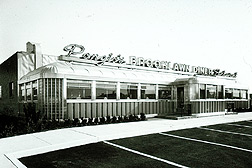 In
the same year Charles Lindbergh would make his solo crossing of the
Atlantic and Hollywood would introduce the "talking picture," a quiet
but determined Sam Kullman started his own company building diners. Sam
struck out on his own, leaving behind a good job with an industry leader
and now a major competitor. With the Great Depression looming, perhaps
it wasn't the best time for start-ups, yet Sam's business acumen and
attention to quality and customer loyalty allowed him to thrive. Six
years later, his former employer faced bankruptcy while Sam's new
company began a legacy of quality and innovation that now stretches 75
years - and counting.
In
the same year Charles Lindbergh would make his solo crossing of the
Atlantic and Hollywood would introduce the "talking picture," a quiet
but determined Sam Kullman started his own company building diners. Sam
struck out on his own, leaving behind a good job with an industry leader
and now a major competitor. With the Great Depression looming, perhaps
it wasn't the best time for start-ups, yet Sam's business acumen and
attention to quality and customer loyalty allowed him to thrive. Six
years later, his former employer faced bankruptcy while Sam's new
company began a legacy of quality and innovation that now stretches 75
years - and counting.