|
|
 |
|
|
|
|
 |
New York
Architecture Images- Gone World Trade Center 5- Towers of Innovation (1) |
WTC 0-Main Commentary 1-why did it collapse? 2-images from September 11th, 2001. 3-more images 4-Timeline: World Trade Center chronology 5-Towers of Innovation 6-The work of Minoru Yamasaki 7-images of reactions from around the world |
|||||||||||
|
Part 1 | Part 2
"There is an attractive element in the colossal...[W]hat visitor is insensitive before [the Pyramids]? And what is the source of this admiration if not the immensity of the effort and the grandeur of the result? The Tower will be the tallest structure ever built by man. Will it not be grand in its own right?"
Both buildings, the French and the American, were to stand as potent ideological symbols -- the one of the French Revolution and its impact, the other, the might of American capitalist society. The World Trade Center was born of Camelot, the John Kennedy era of irrepressible optimism. In 1961, the same year the Port Authority of New York and New Jersey recommended building a world trade center, Kennedy declared his intention to land a man on the moon by the end of the decade. In an editorial the year before, the New York Times had made its position on the World Trade Center clear: They are thinking large in downtown Manhattan. The World Trade Center ... is the most important project for the economic future of the Port of New York launched for many a year.
The one who was "thinking large" was David Rockefeller. The grandson of John D. Rockefeller, the founder of Standard Oil and America's first billionaire, David Rockefeller hoped to revitalize Lower Manhattan. This area, the oldest part of town, had not seen the same post-war growth as had mid-town -- growth that Rockefeller Center had triggered when it rose in the 1930s. David Rockefeller's first effort in this area was the 60-story Chase Manhattan Bank Tower, completed in the financial district in 1961. (He was chairman of the bank at the time.) Even earlier, in the late 1950s, he had begun pushing hard for a world trade center. With the support of his brother Nelson, then governor of New York, he had the Port Authority evaluate plans for such a center. The Port Authority, a bistate agency responsible for ports, airports, and the like lying within 25 miles of the Statue of Liberty, determined it was feasible, and the project was underway. After years of negotiations, debate, and drawing up and redrawing up of plans, it was decided that the World Trade Center would consist of 15 million square feet of floor space distributed among seven buildings. These would include two towers that would soar over a quarter mile into the sky. The towers would top the Empire State Building by 100 feet. Some people, architects among them, wondered: Could such a lofty tower be built?
In the end, several technological innovations made the World Trade Center possible. These innovations solved problems that might have given pause to a man less forcibly visionary than Guy Tozzoli, head of the Port Authority's World Trade Center Department. But Tozzoli had had years of experience managing large Port Authority projects, and "can't be done" was not a phrase he brooked. The first problem didn't have to do with the towers themselves but with the ground beneath them. Much of the World Trade Center site lay atop landfill, which, over the centuries since Henry Hudson had, in 1609, first explored the river that would bear his name, had extended the west side of Lower Manhattan 700 feet out into the Hudson. Half of the 16-acre site was to be built where the river used to flow. All told, Tozzoli's crews would have to excavate over a million cubic yards of fill to be able to set the World Trade Center on bedrock. The question was how to keep the Hudson out. Jack Kyle, chief engineer at the Port Authority, came up with an answer. It was known as the slurry trench method. Excavating machines with clamshell buckets dug a three-foot-wide trench right down to bedrock 70 feet below. They did it in 22-foot-wide sections all the way around the site. As they removed fill from each section, they pumped in a slurry of water and bentonite, an expansive clay. The clay naturally plugged any holes in the sides of the dirt walls.
When they had fully excavated a section of the trench, workers slid a 25-ton, seven-story-high cage of reinforced steel into the section, then filled that portion of the trench with concrete from the bottom up. The yard-thick wall became known as the "bathtub," though this bathtub was meant to keep water out, not in. When the last of 152 sections became a wall, then and only then could excavators begin removing earth from within the tub. Rather than having the fill hauled away, Tozzoli donated it to the city, spreading it as new landfill southwest of the site. In this way, the City of New York received $90 million worth of newly minted real estate, on which developers later built Battery Park City. Proceed to Part 2 |
|||||||||||||







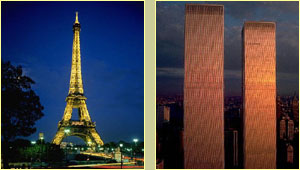 Reaching new heights: When they
were completed, the Eiffel Tower and the World Trade Center each
topped all other structures then standing.
Reaching new heights: When they
were completed, the Eiffel Tower and the World Trade Center each
topped all other structures then standing.
 In this photograph from the early
1960s, Minoru Yamasaki, architect of the World Trade Center,
indicates in a model the site for the new complex in Lower
Manhattan.
In this photograph from the early
1960s, Minoru Yamasaki, architect of the World Trade Center,
indicates in a model the site for the new complex in Lower
Manhattan.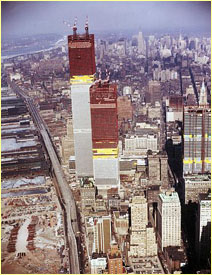 Fill excavated from the site of
the World Trade Center, seen here during construction in 1971, later
provided the foundation for the World Financial Center and Battery
Park City, which rose to the left of the World Trade Center in this
image, on the other side of West St.
Fill excavated from the site of
the World Trade Center, seen here during construction in 1971, later
provided the foundation for the World Financial Center and Battery
Park City, which rose to the left of the World Trade Center in this
image, on the other side of West St.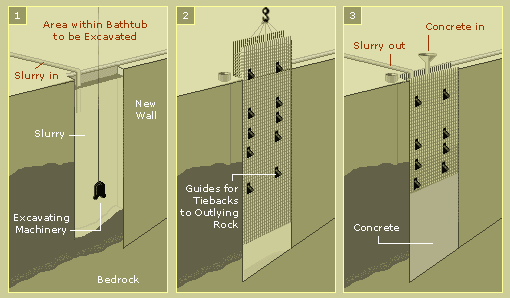 (1) Builders of the "bathtub" wall
first excavated a three-foot-thick trench segment that was 65 feet
deep by 22 feet wide and filled it with a stabilizing slurry. (2)
They then lowered a giant steel cage into the trench, with
attachment points for reinforcing tiebacks that were later anchored
to bedrock outside the wall. (3) Finally, they poured in concrete,
which, as it rose from the bottom up, forced out the temporary
slurry.
(1) Builders of the "bathtub" wall
first excavated a three-foot-thick trench segment that was 65 feet
deep by 22 feet wide and filled it with a stabilizing slurry. (2)
They then lowered a giant steel cage into the trench, with
attachment points for reinforcing tiebacks that were later anchored
to bedrock outside the wall. (3) Finally, they poured in concrete,
which, as it rose from the bottom up, forced out the temporary
slurry.