|
|
 |
|
|
|
|
New York Architecture Images
new york architecture walks- midtown
|
Midtown: The Concrete Jungle
Start: Grand Central Terminal. Subway: Take the 4, 5, 6, 7, or the shuttle to 42nd Street/Grand Central. Finish: The Plaza Hotel. Time: Approximately 4 hours, not counting time for browsing in shops and galleries. Best Time: Weekdays, when Midtown is bustling but the attractions aren't as packed as they tend to be on weekends. Worst Time: Rush hour (weekdays 8:30-9:30am and 4:30-6pm). If there's one area that defines New York in the popular imagination, it's Midtown. Concentrated here are the dozens of the towering skyscrapers that are so closely identified with the city and its skyline. Lining Fifth Avenue and 57th Street are blue-chip art galleries, high-toned boutiques, chic department stores, and, increasingly, theme restaurants such as the Hard Rock Cafe that make New York the consumer capital of the world. Midtown is Manhattan at its most glamorous. From the subway platform, follow the Metro North signs to the main concourse of: |
|
|
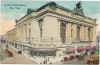
Grand Central Terminal |
|
1. Grand Central Terminal--Commodore
Vanderbilt himself named the station "Grand Central" in the 1860s,
despite the fact that it was then out in the boondocks. The present
terminal was built in 1913. This engineering tour de force combines
subways, surface streets, pedestrian malls, underground shopping
concourses, and 48 pairs of railroad tracks into one smoothly
functioning organism.
Masterfully restored in 1997, the main concourse is breathtaking. It's one of America's most impressive interior spaces, with gleaming marble floors, sweeping staircases, and an aqua vaulted ceiling soaring 125 feet (37m) high. Twenty-five hundred pinpricks of electronic stars litter this "sky" with a view of a Mediterranean winter sky's constellations. Take a Break--Grand Central has numerous spots where you can pick up some provisions to fortify yourself for the tour, including Zaro's Bread Basket, Two Boots Pizzeria, and a branch of Brooklyn-favorite Junior's (try their legendary cheesecake). For something more substantial, head downstairs to the Oyster Bar, where decent seafood is served in a first-rate setting of wide-vaulted ceilings Monday through Friday from 11:30am to 9:30pm.If you'd like to dine under the stars of Grand Central's celestial ceiling, hit Métrazur, perched on a balcony above the rush of the terminal, with an incredible view of the ceiling. Lunch is served 11:30am to 3:00pm, Monday through Friday, and snacks are served every day from 3 to 10pm. The New American menu features such specials as salmon sautéed with grain mustard and served with a frissée salad. Leave the main concourse via the 42nd Street exit and turn right. Walk west for 2 blocks and then make a left onto Fifth Avenue, where you'll find the: |
|
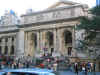 |
New York Public Library |
|
2. New York Public Library--The
library (tel. 212/930-0830; www.nypl.org) sits in splendor,
resembling a Greek temple with rows of Corinthian columns. Completed in
1911, this beaux arts palace, one of the greatest research libraries in
the world, cost $10 million to construct, and President Taft himself
attended the dedication ceremony. Everything inside was designed as a
unit, from the marble walls to the chairs, stepladders, and
wastebaskets.
Climb up the broad stone steps guarded by twin stone lions, named Patience and Fortitude by mayor Fiorello LaGuardia in the 1930s for the qualities he proclaimed New Yorkers would need to survive the Depression. Cafes on either side of the grounds, past fountains marked by classical statuary, offer umbrella tables and food during warm weather. (Bryant Park out back is also littered with cast-iron tables, and it hosts a summer open-air film festival.) The interior of the library contains manuscripts, maps, journals, prints, and more than 38 million volumes occupying 80 miles (129km) of bookshelves. You can sign up for tours (offered Mon-Sat at 11am and 2pm) at the information desk just inside the lobby. The library is open Monday and Thursday through Saturday 10am to 6pm; Tuesday and Wednesday 11am to 7:30pm. Turn left out of the library to head uptown on the west side of Fifth Avenue. Look up and to your right as you cross 42nd Street to get a wonderful perspective view down the block to the: |
|
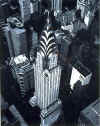 |
Chrysler Building |
|
3. Chrysler Building--At
1,046 feet (314m), you'll see this Art Deco masterpiece, which reigned
briefly in 1930 as the tallest building in the world until the Empire
State Building came along. The stainless steel spire with its hubcap
ribs and thrusting gargoyles creates one of the most beautiful and
distinctive features of the Manhattan skyline.
Continue north on Fifth Avenue for two blocks to 44th Street, where you'll turn left. On the north side of 44th Street, at no. 27, is the Harvard Club, designed by McKim, Mead, and White in 1894 in an architectural style that mimicked Harvard's (at the time). The "Veritas" coat of arms tops the building. A few doors down at no. 37 is the Yacht Club, with a fanciful and flowing concrete facade of captain's cabin windows. Continue along 44th Street. Near Sixth Avenue stands one of New York's most famous literary landmarks: |
|
 |
Algonquin Hotel |
|
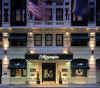
4. The Algonquin Hotel--Baltimorian
H. L. Mencken began staying at the Algonquin on his frequent business
trips to New York after he became the editor of Smart Set in
1914. Under Mencken's stewardship, the magazine published the early
works of Eugene O'Neill, James Joyce, and F. Scott Fitzgerald.
As Smart Set faded from influence in the 1920s, Vanity Fair began to take its place, counting Edna St. Vincent Millay, Elinor Wylie, and Theodore Dreiser among its contributors. In its offices at 19 West 44th St., Dorothy Parker, Robert Benchley, and Robert Sherwood served on the editorial staff. They began hanging out in the Algonquin, and soon their gatherings grew into the famous "Round Table," which also included Alexander Woolcott (drama critic for the New York Times), George S. Kaufman, Franklin Adams (columnist for the New York World), and Edna Ferber. The group became famous for its witty, acerbic commentary on theater, literature, and the social scene. One of the regulars, Harold Ross, took it into his head to start a magazine that would incorporate the group's sophisticated, satirical outlook and rounded up investors to begin publication of the New Yorker, with offices set up nearby at 25 West 45th St. The first few issues were extremely uneven, but within a couple of years E.B. White and James Thurber had been added to the staff and were reshaping the magazine into one of the most prestigious publications in the country. Even after the Round Table stopped gathering at the hotel, the Algonquin continued to count famous writers among its guests, including Gertude Stein and her companion Alice B. Toklas, F. Scott Fitzgerald, and William Faulkner, who wrote the acceptance speech for his 1949 Nobel Prize on Algonquin stationery. To soak up this hotel's genteel ambience, consider having lunch or weekend brunch in the Rose Room. Or ensconce yourself with a cocktail in a comfortable sofa or armchair of the lobby lounge, where New Yorker writers frequently conduct interviews. Across the street from the Algonquin, but light-years away in design, is the Royalton Hotel. Poke your head inside and take a look; the whimsically futuristic Jetsons-style decor, created by Philippe Starck, has to be seen to be believed. Cross Sixth Avenue (also known as Avenue of the Americas) and turn left. Before the corner of 43rd Street is the midtown branch of the: |
|
|
5. International Center of
Photography--The ICP (tel. 212/857-0000;
www.icp.org ) was massively renovated and
expanded in 2000. The center presents around 30 photography shows
annually. Celebrating various trends, artists, and themes, these photo
shows are some of the best in the city.
Double back north along Sixth Avenue to 47th Street, where you'll take a right. This block, between Fifth and Sixth avenues, is the Diamond District, where millions of dollars' worth of gems are traded every day. The business hustle on this block makes an unlikely setting for another literary sight, the: |
|
|
6. Gotham Book Mart--The
store (tel. 212/719-4448), located on the north side at no. 41,
may have moved down the block before you read this; call to check.
Originally founded in 1920 on West 45th Street, the store moved here in
1923. H. L. Mencken and his friend Theodore Dreiser once stopped in and,
delighted to find some of their own works in stock, began to scribble
dedications on many of the books, including the Bible, which they signed
"With the compliments of the authors."
The store sells new and used books and has hosted countless book publication parties, and the list of writers toasted here has included Dylan Thomas, W. H. Auden, Joyce Carol Oates, and Tennessee Williams. Today, you might find Arthur Miller and John Updike, who drop in frequently. In 1947, the store became headquarters of the James Joyce Society, whose first membership was purchased by T. S. Eliot. Owner Frances Steloff (who died in 1989 at the age of 101) was known for lending a hand to perennially cash-strapped artists such as Henry Miller and John Dos Passos (Martha Graham once borrowed $1,000 to stage her first dance performance). This tradition grew into the Writers' Emergency Fund, which still offers loans to struggling scribes. Turn left up Fifth Avenue to 49th Street. On the right side of the avenue stands one of New York's most famous department stores, Saks Fifth Avenue. Immediately opposite Saks, head west into the promenade of: |
|
 |
Rockefeller Center |
|
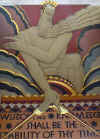
7. Rockefeller Center--Enter
one of the most handsome urban complexes in New York. It encompasses 24
acres and 19 skyscrapers, extending from 47th to 52nd streets between
Fifth and Sixth avenues. People scoffed at John D. Rockefeller in 1929
when he unveiled plans to build this "city within a city," because it
was so far removed from what was then the commercial heart of New York.
But Rockefeller proved all the critics wrong. His complex remade the
map, drawing business uptown and setting the standard for future civic
projects by incorporating public art and open spaces.
Stroll west through the Channel Gardens to Rockefeller Center's famous skating rink. In the summer, this area becomes an outdoor cafe; in cooler months, it's packed with skaters gliding along the ice to music and the twinkle of tiny lights in the trees. Each holiday season, a giant Christmas tree stands here, towering over the promenade. Paul Manship's massive Prometheus lounges above the skating rink, beneath a quote from Aeschylus. Upscale shops surround the plaza. Take a look inside the lobby of 30 Rockefeller Plaza, once the RCA Building and now renamed the GE Building. Above the black marble floors and walls are monumental sepia-toned murals by José Maria Sert. This Art Deco building was featured in the movie Quiz Show. Just to the left of 30 Rockefeller Plaza, head west (right) on 49th Street to Sixth Avenue. You'll pass the wrap-around corner windows with a digital news feed where early risers peer through the glass and wave in the hopes of becoming part of the backdrop during filming of NBC's Today show just inside. When you reach Sixth Avenue, turn right and head uptown. A building boom in the 1960s and 1970s transformed this area into a canyon of 50-story glass skyscrapers. Although the buildings aren't of great note individually, together they form an urban environment of considerable grandeur. On the right side of Sixth Avenue, north of 50th Street, stands the first rock center building to open, in 1932: |
|
 |
Radio City Music Hall |
|
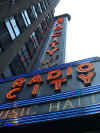
8. Radio City Music Hall--This
wonderful concert hall has been restored to its original Art Deco
elegance. Its original owner, Samuel "Roxy" Rothafel of Roxy Theater
fame, ran it as a vaudeville house, but the enterprise was a flop, and
Rothafel, in poor health, sold out to the Rockefellers. Eventually, it
became basically a glorified movie theater with Rockettes, but economic
considerations and a 1979 overhaul returned it to live show business.
Today, following an extensive 1999 restoration and "pristinization,"
performances run the gamut from B.B. King to Blues Clues Live!, to the
annual Christmas Spectacular starring Radio City's own Rockettes. Pricey
hour-long guided tours take place every half-hour daily from 10am (11am
Sun) to 5pm. Call tel. 212/247-4777 for information; buy tickets
in the gift shop to the left of the entrance.
Continue up Sixth Avenue and take a right on: |
|
|
9. West 52nd Street--This
block was designated "Swing Street" because it holds a special place in
jazz history. It was lined with a number of illicit speakeasies during
Prohibition, and after its repeal, many of the establishments became
jazz clubs, nurturing such great talents as Billie Holliday, Fats
Waller, Dizzy Gillespie, Charlie Parker, and Sarah Vaughan.
The 21 Club, at 21 West 52nd St. (tel. 212/582-7200), is still a popular restaurant and one of the few establishments to survive from this era. Operating as a speakeasy during Prohibition, it relied on several clever devices to guard against police raids, including a trap door on the bar that sent everyone's cocktails tumbling into the sewer when a button was pressed. Today, it serves excellent food in a tavern atmosphere--if you can get a reservation in the popular dining room. The club is closed weekends in summer and Sunday year-round. Continue down 52nd Street. Near the end of the block, take a left through the modern passageway/lobby, numbered 666 Fifth Avenue, through to 53rd Street. Under here, you'll pass by an undulating stainless steel wall waterfall designed by Isamu Noguchi. When you pop out onto 53rd Street, you'll turn right to continue the tour. However, museum shop aficionados can hang a left and jog half a block down to the Museum of Modern Art's (MoMA) bookshop and the design store across the street. Turning right onto 53rd Street, cross Fifth Avenue and walk two-thirds of 53rd's next block to the second pocket-sized, granite-and-waterfall park, where sits a brief, graffiti-covered stretch of the: |
|
|
10. Berlin Wall
Return to Fifth Avenue and take a left to cruise past glitzy outposts of high fashion, including Ferragamo, Cartier, and Versace. Between 51st and 50th streets rises the unmistakable neo-Gothic bulk of: |
|
 |
St. Patrick’s Cathedral |
|
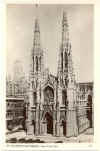
11. St. Patrick's Cathedral--This
is the seat of the Archdiocese of New York and the largest Catholic
cathedral in America. Designed by James Renwick in 1858 and modeled
after Cologne's cathedral, this magnificent structure has twin spires
rising 330 feet (99m) above street level. Construction took 21 years.
Zelda and F. Scott Fitzgerald were married here in 1920. Masses are held
daily.
Across the street as you exit, in front of 630 Fifth Ave., crouches Lee Lawrie's 1937 Atlas, one of New York's most famous statues, in 15 feet (4.5m) of bronze. Walk along the north (left) side of the church on 51st Street. Cross Madison Avenue and take a right down it, admiring the Gothic-style tracery on the backside of St. Paddy's across the street. On your left, the block is filled with the brownstone-gone-amok mass of the: |
|
|
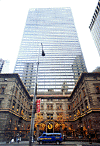
Villard Houses |
|
12. New York Palace Hotel--The
hotel is also known as the Villard Houses after the Bavarian immigrant
Henry Villard, who published the New York Evening Post and
founded the Northern Pacific Railroad. He commissioned the unified
buildings from McKim, Mead, and White in 1881. Today it's home to one of
New York's most oft-reinvented and posh restaurants, Le Cirque 2000
(tel. 212/303-7788;
www.lecirque.com ); and the Urban
Center (tel. 212/935-3592), whose bookshop is a treasure
trove of tomes on architecture; and, through the central doors in the
hotel itself, a compact architectural fantasyland of gilt, marble,
sweeping staircases, crystal chandeliers, and opulent meeting rooms.
Take a left onto 50th Street and
walk toward Park Avenue. As you look right down Park Avenue, you'll see
the
Helmsley B Across Park Avenue, between 50th and 49th streets, stands one of the most famous hotels in the world: |
|
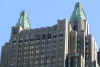 |
Waldorf-Astoria Hotel |
|
13. The Waldorf=Astoria--For
over a century, the Waldorf has been synonymous with wealth and luxury,
though this location only dates back to the early 20th century. In 1897,
in the midst of a devastating economic depression, society matron Mrs.
Bradley Martin decided to hold a costume ball at the Waldorf (in the
original building on Fifth Ave.) for 1,200 guests, who were to attend
dressed in the style of the court of Versailles. When details of the
preparations, rumored to top a quarter of a million dollars, hit the
papers, outrage ran high. A huge squad of police officers, personally
supervised by police commissioner Teddy Roosevelt (whose wife was inside
enjoying the festivities), had to be positioned around the hotel to
prevent the great unwashed from venting their resentment.
Cole Porter and his wife lived for many years in one of the permanent apartments in the Waldorf Towers; one of the hotel's dining spots, Peacock Alley, still boasts his piano. Other famous residents have included General Douglas MacArthur, Herbert Hoover, Henry and Clare Booth Luce, and the Duke and Duchess of Windsor. Gangster Lucky Luciano also lived here under an alias until he was forced to leave the Waldorf for less luxurious digs in the state penitentiary. |
|
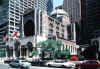 |
St. Bartholomew’s Church |
|
Between 50th and 51st streets on Park Avenue
lies St. Bartholomew's (tel. 212/378-0200;
www.stbarts.org
), a domed Episcopal church from 1918, which was begun in Romanesque style
and switched to Byzantine halfway through construction. The church
sports a three-arched main portal by Stanford White that came from the
original St. Bart's once located down the street.
Take a Break--St. Bart's may be the only church in New York with its own terrace cafe, Café St. Bart's (no phone, though serious advance planners can book on-line at www.opentable.com ). Under large umbrellas, with the Byzantine building shading you, you can dine al fresco on scrumptious fare, like the blue-crab burrito with chili oil, or the St. Bart's Classic--tomato-basil soup and a grilled farmhouse cheese sandwich. Main dishes run from $10 to $14. In summer, the terrace presents live music; in winter, the cafe moves indoors into an uninspired back room of the church's complex. Open for lunch year-round, dinner in summer only. Walk around the left side of St. Bart's down 51st Street to Lexington Avenue and turn left up the east side of it. The subway grating on this block is perhaps the most famous in the world, ever since 1955 when one of its gusts of hot air sent the skirt of Marilyn Monroe's dress billowing right into pin-up legend in The Seven Year Itch. Continue north up Lexington to 53rd Street, where the corner office building (no. 599 Lexington) features Frank Stella's Salto nel Mio Sacco, a colorful 1985 work, in the lobby. Across 53rd Street from this building is the austere, glass-and-buffed-aluminum pinnacle of Citicorp Center. This pillar of international finance incorporates, at the corner of 54th Street, the modern and angular: |
|
|
14. St. Peter's Lutheran Church--This
singularly hip house of worship was built in 1977. Adorned with
sculpture by Louise Nevelson (check out the Erol Baeker Chapel of the
Good Shepard), St. Peter's is famous for its Sunday evening Jazz
Vespers, where many of the greatest names in jazz have performed.
Besides the permanent Nevelson sculptures and a Pomodoro Cross
out front, St. Peter's also regularly displays works by contemporary
artists.
Just north of St. Peter's, at 55th Street and across Lexington, is the: |
|

|
Central Synagogue |
|
15. Central Synagogue--This
is one of New York's finest examples of Moorish Revival-style
architecture. The oldest synagogue in continuous use in the city, it was
dedicated in 1870. It was recently renovated after a fire in 1998, and
the results are breathtaking, reflecting the synagogues original design,
and adding new ornamental towers and crenellation on the outside, and
over 5,000 vividly colored wall stencils inside. Tours are available at
12:45pm on Wednesday.
The longtime home to many of the city's top art galleries and upscale boutiques, 57th Street recently has been filling with theme restaurants and overblown chain retail stores. From Park Avenue, turn left along 57th Street, and you'll come to the beautiful black-and-white: |
|
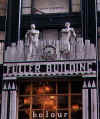 |
THE FULLER BUILDING |
|
16. Fuller Building--This
Art Deco beauty is located at the northeast corner of Madison Avenue and
57th Street. Look at the bronze doors, the marble fixtures, and mosaic
floors and plan to spend some time browsing in the many art galleries
housed here. Though a changeover from old guard galleries has occurred
in recent years, the remaining galleries usually have one or two
interesting shows each year.
Across 57th Street at no. 32 is: |
|
|
17. PaceWildenstein Gallery--PaceWildenstein
(tel. 212/421-3292) is a major art gallery with specialty dealers
spread out on several floors. The main gallery is devoted to
20th-century painting, drawing, and sculpture. It shows blue-chip
artists such as Chuck Close, Jim Dine, Jean Dubuffet, and Pablo Picasso.
On the 10th floor are Pace Primitive Art and Pace Master
Prints and Drawings. On the ninth floor is Pace/MacGill
(20th-century photography) and on the third floor is Pace Prints,
which carries contemporary prints by many of the same artists who show
in the main gallery.
Continue along 57th Street to Fifth Avenue. On your left stretches the bejeweled: |
|
 |
Tiffany’s |
|
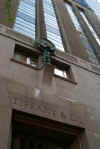
18. Tiffany & Co.,--Here
it is, with its windows full of amazing gems. (Note: Contrary to
popular belief, it's not a good place to try and rustle up some
breakfast, even if you are Audrey Hepburn.)
Cross Fifth Avenue and continue along West 57th Street. Halfway down the next block on your left at no. 40 (an office atrium entrance hallway down the right side of the passage) is the: |
|
|
19. Marlborough Gallery--Located
on the second floor at no. 40 (tel. 212/541-4900;
www.marlboroughgallery.com
), this is one of the most reputable galleries in the world. Big stars
here include the late Francis Bacon (Britain's de Kooning), Fernando
Botero, Red Grooms, Richard Estes, Alex Katz, Antonio Lopez Garcia, and
Larry Rivers.
Across the street, on the seventh floor of no. 41, is: |
|
|
20. George Adams--This
fine gallery (tel. 212/644-5665) has been here for 30 years and
features ceramicist Robert Arneson and other Bay Area artists, realists
Jack Beal and Alfred Leslie, the colorfully eccentric paintings of Peter
Saul, and Latin American painters such as Jose Bedia and Arnaldo Roche
Rabell.
Return to Fifth Avenue, cross it again, and turn left (uptown) onto it, passing some of the city's most glamorous shops. On the east (right) side of the street, on the fourth floor of no. 745, you'll find: |
|
|
21. Mary Boone Gallery--This
is a world-class gallery (tel. 212/752-2929) of contemporary art
by Richard Artschwager, Ross Bleckner, and Eric Fischl, among others.
Also in this building is the McKee Gallery, which shows Philip Guston, a
major abstract expressionist, as well as Jake Berthot, David Humphrey,
Martin Puryear, and Jeanne Silverthrone.
Continue up Fifth Avenue. Just north of 58th Street is the toy store of every child's dreams: |
|
|
22. F.A.O. Schwarz--You
may remember Tom Hanks's famous dance interpretation of "Heart and
Soul," performed here on a giant piano keyboard in the movie Big.
The store is a wonderland of toys, with a menagerie of stuffed animals;
fantastic, mobile Lego creations; squadrons of Barbie dolls; a candy
shop; and command centers of video games where anybody can play.
Across from F.A.O. Schwarz stands the landmark: |
|
 |
The Plaza Hotel |
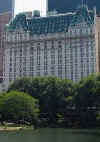
| 23. Plaza Hotel--Back then, suites rented for $25 a night. Zelda Fitzgerald turned heads here by making a splash (literally) in the fountain in front of the hotel. The Fitzgeralds stayed here in September 1922 while looking for a home, and F. Scott used the Plaza as the backdrop for a crucial scene in his masterpiece, The Great Gatsby. Another famous guest, Frank Lloyd Wright, stayed in a suite overlooking the park while he designed the Guggenheim Museum. Young visitors will be familiar with the Plaza as the heroine's home in the children's classic Eloise (you can see her portrait, painted by Eloise illustrator Hilary Knight, across from the Palm Court); movie buffs will recognize it from Crocodile Dundee, The Cotton Club, North by Northwest, Network, Arthur, Home Alone 2, and, of course, Plaza Suite. Little-known trivia: 1920s Plaza chef Hector Boiardi decided to bottle his Italian pasta-and-sauce dishes for the masses; on the labels he phoneticized his name to Boy-ar-dee. | |
|
Winding Down--The
Palm Court in the Plaza is a great place to relax over tea and
cakes after your tour.
For an afternoon cocktail, there's no better place to stop than the bar where the Bloody Mary was invented: the King Cole Bar in the St. Regis Hotel, 2 East 55th St. at Fifth Avenue (tel. 212/753-4500), adorned with a wonderful mural of the merry old monarch himself. An elegant afternoon tea is served in the Astor Court, a plush venue with a vaulted ceiling, trompe l'oeil cloud murals, and 22-karat gold leaf on the delicate stuccowork. The hotel itself is a landmark, built in 1904 by John Jacob Astor and housing some of the most expensive rooms in the city. Ernest Hemingway, Alfred Hitchcock, and Salvador Dalí all stayed at the St. Regis, and John Lennon and Yoko Ono occupied suites here in the early 1970s. |
|