|
|
 |
|
|
|
|
 |
New York Architecture Images- Building
Types New York Firehouses |
|||
|
 |
 |
||
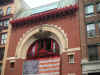
| Engine Company No. 31 | Engine 55 Broome Street | |||
 |
||||
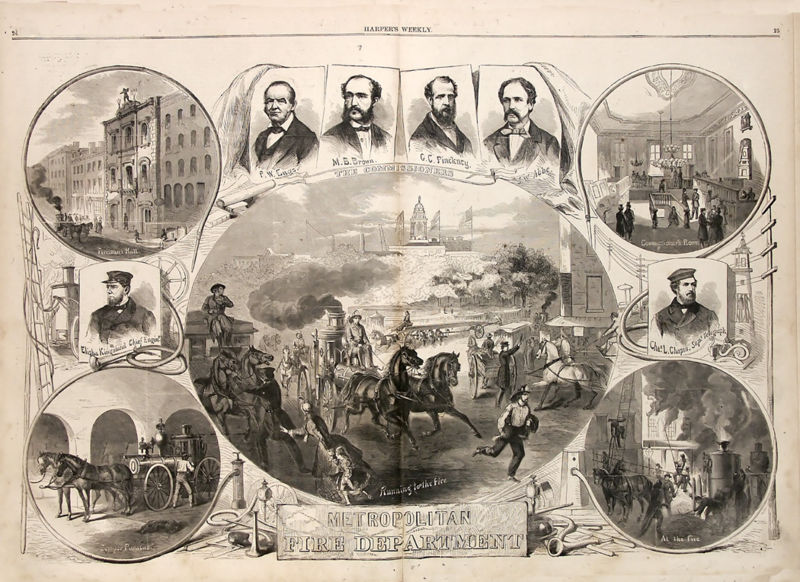
| Original sheet celebrating the official formation of the Metropolitan Fire Department, 1866. | ||||
.jpg) |
||||
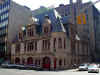
| Former headquarters of the Brooklyn Fire Department, near MetroTech Center, before its consolidation with NYC in 1898. Designed by architect Frank Freeman; built 1892. | ||||
.jpg) |
||||
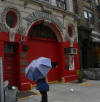
| The quarters of Engine 205 and Ladder 118 depict a mural dedicated to 9/11. | ||||
|
New York City Fire Department "New York's
Bravest" The New York City Fire Department or the Fire Department City of New York (FDNY) has the responsibility for protecting the citizens and property of New York City's five boroughs from fires and fire hazards, providing emergency medical services, technical rescue as well as providing first response to biological, chemical and radioactive hazards. The FDNY is the largest municipal fire department in the world with approximately 11,400 uniformed officers and firefighters. It faces an extraordinarily varied challenge. In addition to responding to building types that range from wood-frame single family homes to high-rise structures, there are the many bridges and tunnels, large parks and wooded areas that can give rise to major brush fires, and the largest subway system on the planet. These challenges add yet another level of firefighting complexity and have led to the creation of the motto for FDNY firefighters of New York’s Bravest. History 1648 - 1865 The origins of the New York City Fire Department trace back to 1648 when the first fire ordinance was adopted in what then was the Dutch settlement of New Amsterdam. Hooks, ladders and buckets were financed through the collection of fines for dirty chimneys and a fire watch was established consisting of eight wardens which were drawn from the male population. An organization known as the prowlers but given the nickname the rattle watch patrolled the streets with buckets, ladders and hooks from nine in the evening until dawn looking for fires. Leather shoe buckets, 250 in all, were manufactured by local Dutch shoemakers in 1658, and these bucket brigades are regarded as the beginning of the New York Fire Department.[2] In 1664 New Amsterdam became a British settlement and was renamed New York.[3] The first New York fire brigade entered service in 1731 equipped with two hand-drawn pumpers which had been transported from London, England. These two pumpers formed Engine Company 1 and Engine Company 2. These were the first fire engines to be used in the American colonies, and all able-bodied citizens were required respond to a fire alarm and to participate in the extinguishing under the supervision of the Aldermen.[4] The city's first firehouse was built in 1736 in front of City Hall on Broad Street. A year later, on December 16, 1737, the colony's General Assembly created the New York Fire Volunteer Fire Department, appointing 30 men who would remain on call in exchange for exemption from jury and militia duty. The city's first official firemen were required to be "able, discreet, and sober men who shall be known as Firemen of the City of New York, to be ready for service by night and by day and be diligent, industrious and vigilant."[4] 1865 - 1898 In 1865 a state act was passed to create the Metropolitan Fire District and the Metropolitan Fire Department (MFD). The MFD lasted until 1870 when the Tweed Charter ended state control in the city. As a result, a new Board of Fire Commissioners was created and the establishment of the Fire Department City of New York (FDNY) came into existence. The change met with a mixed reaction from the citizens, and some of the eliminated volunteers became bitter and resentful which resulted in both political battles and street fights. Subsequently, the volunteers declared that they would accept the decision and, despite their disappointment, continue to function until properly relieved by paid units. Volunteer fire fighters were also given preference when the paid department recruited its members. With the introduction of the steam engine the need for volunteers to pump water disappeared, and the introduction of horses to draw the engines eliminated the problem of hauling fire engines by hand. Initially, the paid fire service only covered New York City (present day Manhattan), until the act of 1865 which united Brooklyn with New York to form the Metropolitan District. The same year the fire department consisted of 13 Chief Officers and 552 Company Officers and firemen. The officers and firemen worked a continuous tour of duty, with 3 hours a day off for meals and one day off a month, and were paid salaries according to their rank or grade. 1865 also saw the first adoption of regulations, although they were fairly strict and straitlaced. Following several large fires in 1866 which resulted in excessive fire losses and a rise in insurance rates, the fire department was reorganized under the command of General Alexander Schaler, and with military discipline the paid department reached its full potential which resulted in a general reduction in fire losses. In 1870 the merit system of promotion in the Fire Department was established. Southwestern Westchester County (which would later become the western Bronx) was annexed by New York in 1874 and the volunteers there were phased out and replaced by the paid department. This pattern was repeated as City services expanded elsewhere. One volunteer unit in the Bronx and five in Queens are still in operation, including Broad Channel VFD which has 102 years in service. 1898 - 2001 On January 1, 1898 the different areas of New York were consolidated, which ushered the Fire Department into a new era. All the fire forces in the various sections were brought under the unified command of the first Commissioner in the history of the Fire Department. This same year Richmond (now Staten Island) became a part of the City of New York, but the volunteers units there remained in place until they were gradually replaced by paid units in 1915, 1928, 1932 and 1937 when only two volunteers units remained. The unification of the Fire Department, which took place in 1898, would pave the way for many changes. In 1909 the Fire Department received its first piece of motorized fire engine. On March 25, 1911 a fire in the Triangle Shirtwaist Company killed 146 workers, most of whom where young female immigrants. Later the same year the fire college was formed to train new fire fighters, and in 1912 the Bureau of Fire Prevention was created. In 1919 the Uniformed Firefighters Association was formed. Tower ladders and the Superpumper System (a fireboat on wheels) were introduced in 1965. Major apparatus of the Superpumper System (the Superpumper and the Supertender) was phased out in 1982, in favor of the Maxi-Water Unit. But the 5 Satellite Units of the system, together with the Maxi-Water Unit (known as Satellite 6 since 1999) are still actively used as of 2007 for multiple alarm fires and certain other incidents. These are now called the Satellite Water System. Other technical advances included the introduction of high pressure water systems, the creation of a Marine fleet, adoption of vastly improved working conditions and the utilization of improved radio communications. In 1982 the first female firefighters joined the ranks of the Fire Department, and on March 17, 1996 Mayor Rudolph W. Giuliani merged the emergency medical services of the NYC Health and Hospitals Corporation into the FDNY. September 11, 2001 attacks On September 11, 2001 terrorists associated with al-Qaeda hijacked four commercial passenger aircraft and used these as weapons in order to attack targets in New York and Washington, DC during the September 11, 2001 attacks. Two aircraft, American Airlines Flight 11 and United Airlines Flight 175 were flown by the terrorists into the twin towers of the World Trade Center, causing massive damage both during impact, when the jet fuel was consumed by fire, and finally when the buildings collapsed.[5] New York City firefighters were deployed to the World Trade Center minutes after the first aircraft struck the north tower. Chief officers set up a command center in the lobby as firefighters climbed up the stairs. A mobile command center was also set-up outside on Vesey Street, but was destroyed when the buildings collapsed. A command post was then set-up at a firehouse in Greenwich Village. The FDNY deployed 200 units to the site, with more than 400 firefighters on the scene when the buildings collapsed.[6] Many firefighters arrived at the World Trade Center without meeting at the command centers. Problems with radio communication caused commanders to lose contact with many of the firefighters who went into the buildings; those firefighters were unable to hear evacuation orders. [7] There was practically no communication with the police, who had helicopters at the scene. When the towers collapsed, hundreds were killed or trapped within. Three hundred forty-three FDNY firefighters and paramedics who responded to the attacks on September 11, 2001 lost their lives, and countless others were injured. The casualties included First Deputy Commissioner William M. Feehan, Chief of Department Peter Ganci[6] and Department Chaplain Mychal Judge.[8] Meanwhile, average response times to fires elsewhere in the city that day only rose by one minute, to 5.5 minutes.[9] Many of the surviving firefighters continued to work alternating 24-hour shifts. Firefighters and EMTs came from hundreds of miles around New York City, including numerous career and volunteer units in Upstate New York, Long Island, Connecticut, New Jersey, and Pennsylvania. 2002 - In the aftermath of the September 11, 2001 attacks the Fire Department has rebuilt itself and continues to serve the people of New York. During the 2003 North American blackout, FDNY was called on to rescue hundreds of people from stranded elevators in approximately 800 Manhattan high-rise office and apartment buildings. The entire fire department was called in to handle the many fires which resulted, reportedly from people using candles for light.[10] At the beginning of the 21st century, there are 11,400 uniformed fire officers and firefighters under the command of the Chief of Department. The New York City Fire Department also includes 2800 Emergency Medical Technicians, Paramedics and Supervisors assigned to Department's EMS Command, and 1200 civilian employees.[2] Ideology and core competencies .jpg) Ladder 21 - "The Pride of Hell's Kitchen". The FDNY derives its name from the Tweed Charter which created the Fire Department of the City of New York. This is in contrast to most other fire departments in the U.S. where the name of the city precedes the word fire department.[11] Ideology The FDNY ideology of aggressive interior fire attack grew naturally out of the building and population density that characterize the city. [12] The contribution of Irish Americans to the FDNY dates back to the formation of the paid fire department. During the Civil War New York's Irish firefighters were the backbone of the 11th New York Volunteer Infantry Regiment (New York Fire Zouaves), a highly decorated unit.[13] In addition to firefighting, rescue and HAZMAT, FDNY stations ambulances throughout the city and supplies paramedics and EMTs. Together with ambulances run by certain participating hospitals (or locally known as voluntaries, not to be confused with Volunteers) and private companies, it is known as the FDNY EMS Command, which is the largest pre-hospital care provider in the world, responding to over 1.3 million calls each year. All of the FDNY EMS Command members are also trained to the HAZMAT Operations level. Some EMS units are trained to the Haz Mat Technician level allowing them to provide emergency medical care and decontamination in a hazardous environment, in addition to their normal 911 duties.[14] Members of the FDNY have the nickname "New York's Bravest".[15] Members of the FDNY EMS have the nickname "New York's Best".[16] Core competencies Saving of life and property Fire suppression Search and rescue Structural evacuation CBRNE/HAZMAT life safety and mass decontamination Arson investigation. FDNY has a rank of fire marshal, between that of firefighter and fire lieutenant. NYC Fire Marshals work out of the Bureau of Fire Investigation, and may also assigned to the NYPD-FBI Joint Terrorism Task Force (JTTF). All NYC Fire Marshals, having graduated from the FDNY Fire Academy as probationary firefighters, must attend the NYPD Police Academy for training in basic law enforcement, criminal investigation and the use of firearms. The marshals of the FDNY have statewide status of full-time police officers, carry firearms both on and off duty (optional), and make arrests for fire department related and occasionally non fire department related crimes. They may also be asked to do internal affairs investigations in the FDNY if criminal activity is suspected. Fire protection inspections Pre-hospital emergency medical care Statistics Fire calls for 2006 For the period 1 January 2006, to 31 December 2006 the FDNY dealt with the following number of calls:[17] Structural fires: 27,817 Non-structural fires: 20,702 Non-fire emergencies: 198,202 Medical emergencies: 209,397 There were 2,971 serious fires in 2006, defined as those declared 'all hands' or above in severity. Response times to incidents were roughly between two and a half, to six minutes from the time of call, depending on total activity and boro, with the quickest responses being in the Bronx, Manhattan and Brooklyn, and the slowest in Queens and Staten Island. How incidents are received and transmitted .jpg) Ladder 21, a Seagrave apparatus. There are five ways in which fires can be reported in New York City: 1. TELEPHONE ALARMS - This is the most common method in which a civilian uses a telephone to dial one of the following: (a) "9-1-1" (...where the call is routed through the N.Y.P.D.); (b) a special, "7-digit telephone number" published in each borough for the specific purpose of reporting fires; (c) "0" [i.e., zero] (...where the call is routed through a telephone company "operator"). 2. ALARM BOXES - The second most common method is by means of F.D.N.Y. alarm boxes in the street and in certain public buildings [e.g., schools, hospitals, etc.] as well as highways, bridges, etc. These consist of the following types: (a) "mechanical" boxes (...also commonly called "pull-boxes" or "telegraph boxes"...) in which a spring-wound mechanism alternately opens and closes an electrical circuit thereby rendering a coded number linked to the specific location of the box; (Until the advent of the STARFIRE "C.A.D.S." [i.e., "Computer-Assisted Dispatch System"], dispatchers had to physically count the "taps" from mechanical boxes when they were received in the central offices. For a time, a "paper punch" system was also used, but it proved ineffective as the number and frequency of alarms from mechanical boxes increased significantly in the 1960s and '70s. Today, a "B.A.R.S." [i.e., "Box Alarm Readout System"] display handles that aspect of the job.) (b) "E.R.S." [i.e., "Emergency Reporting System"] boxes that are equipped with both FDNY (Red Color) and NYPD (Blue Color) buttons allowing either department's dispatcher to have direct voice communication with a reporting party; (E.R.S. boxes began to replace mechanical boxes [...the earliest examples of which date back to the 1800s...] in many areas of the City beginning in the 1970s.) 3. "CLASS 3" ALARMS - Less common than the other two means of reporting fires are so-called "Class 3"s which are routed through commercial alarm companies. These firms monitor sprinkler systems, standpipes, smoke detectors and internal pull-stations in non-public spaces such as factories, warehouses, stores, office buildings and the like. When alarms are received from such accounts, these outfits pass the information along to the F.D.N.Y. central offices usually by dedicated telephone circuits. (F.D.N.Y. "special building boxes" are also called "Class 3"s, but are relegated to public buildings, highways, etc., as noted above.) 4. VERBAL ALARMS - It refers to an instance in which a civilian "verbally" reports a fire directly to a firehouse. The personnel in the station will attempt to investigate, or immediately respond to the incident. The house-watch (firefighter on front desk duty) will call the borough dispatcher to advise that they are going out on a "verbal" and will describe the nature of the incident as reported. The dispatchers will then transmit an appropriate response for the incident based on the description from the firehouse. 5. RADIO ALARMS - This is an alarm given over FDNY radio to dispatchers from any member of the uniform force of the fire department, be it a firefighter or the Fire Commissioner. Most often these come from engines, ladders and battalion chiefs who are in the field, but they have been called in by fire marshals, chaplains and on at least one occasion, by the late Fire Commissioner and Chief of Department, John T. O'Hagan. The most recent major radio alarm was given by Engine 21 for the 2007 Con Edison Steampipe Explosion in Manhattan that went to six (6) alarms. When a member of the public dials "911" they speak with an NYPD 911 operator who assigns the call to where it needs to go based on the information provided. If it is police related, the information is sent to an NYPD radio dispatcher for the precinct or special unit concerned. If it is on an interstate bridge or in a port or other body of water, the Port Authority of NY and NJ is notified. If it is a fire, hazmat, or rescue incident, the NYPD 911 operator transfers the call by dedicated phone line to the appropriate FDNY borough fire alarm office. The FDNY also answers a few direct EMS calls, but most go by telephone directly to the FDNY EMS central office. EMS alarms that require a first responder will be computer switched to the appropriate borough fire alarm office, for an appropriate apparatus response. FDNY Bureau of Fire Communications Offices Presently there are five (5) Bureau of Fire Communications alarm offices, one for each of the five boroughs (counties) that make up New York City. The initial call to an FDNY communications office is taken by the Alarm Receipt Dispatcher (ARD) who speaks with the caller in order to determine the nature of the emergency. The ARD enters the information by keyboard into the Starfire computer system, which gives a recommended response based on the information provided. This information is automatically sent to the Decision Dispatcher (DD)and the "Tour Supervising Dispatcher". When the Decision Dispatcher has made a decision as to what units will actually be assigned to the incident, unless the supervisor intervenes, he or she pushes the "release" button and the alarm is routed to the assigned companies, either in their firehouses or to the mobile data terminals (MDT) if their apparatus is in the field, depending on where the Starfire computer shows them to be situated. If a unit in a fire station does not acknowledge the run within 30 seconds, the computer will notify the voice alarm dispatcher who will call that unit in the station by the dedicated intercom system. One minute after the alarm is released, it will appear on the computer screen of the radio dispatcher, who will announce the alarm and the response two times and ask for acknowledgment from any units assigned who have not done so by radio, voice alarm or MDT. The radio dispatcher has a special keyboard called the Status Entry Panel "SEP" which he uses to update the status of units based on information he receives by radio. The entire process from initial notification until a unit is dispatched can take up to two (2) minutes, depending on the complexity of the call, the information provided by the caller(s) and the degree of other alarm activity in the office. If a borough alarm office is so busy that its incoming telephone alarm lines are all busy or not answered within 30 seconds, the call is automatic transferred to another borough fire alarm office. If an ERS box is not answered with 60 seconds, usually because all of the Alarm receipt Consoles are in use, the computer automatically dispatches an engine company to the box location. Any fire alarm office in NYC can take a fire or emergency call by telephone for any borough and upon completion of information taking, the incident will automatically be routed by the Starfire computer to the Decision Dispatcher (DD) for the borough in which the incident is reported. Box Numbers Each address in the city is assigned a box number, based on the closest street, special building or highway box. This gives the companies en route cross streets for the alarm. Box numbers can duplicate in different boroughs, which is why they are always identified by borough name or numerical prefix on the computer (66 for Bronx and Manhattan, 77 for Brooklyn, 88 for Staten Island and 99 for Queens). If there is also a street address given to the dispatchers, the responding apparatus will get this information in the firehouse, over the air, and via their mobile data terminals in the rigs. At present there are about 16,000 physical street boxes in New York City, with many additional special building boxes and highway boxes, as well as "dummy boxes" used for special response assignments. In addition there are two airport crash boxes, one in the LaGuardia Tower (Queens Box 37) and one in the JFK Tower (Queens Box 269), which can only be activated by the personnel in these towers. When either box is sounded it brings an automatic second alarm (2-2) response of equipment, along with various special units. Critical Information Dispatch System CIDS stands for Critical Information Dispatch System, and is pronounced by the dispatcher as "Sids". CIDS information which is transmitted to units in the firehouse and en route is information that is collected on a building during inspections and by public input, which would have an impact on fire-fighting operations. Such things as: warehoused apartments, type and length of line stretch (or hose), number of apartments per floor, unsafe conditions, standpipe conditions, and anything else the Bureau of Fire Communications or the FDNY Staff Chiefs deem important This information is printed on the fire ticket and can be read by the dispatcher if requested. This information is also read automatically when a signal 10-75 (working fire)or higher signal is given or when the supervising dispatcher deems it is important for the units to have it before arrival at an incident. Alarm Levels A Signal 10-75 is transmitted by the first arriving fire company for a working fire or other incident where it appears that the assigned companies will likely all be put to work at a fire or other emergency. Contrary to belief a 10-75 can be transmitted where the emergency is non-fire related but appears to require a full first alarm assignment. When a 10-75 is given a Rescue Company and a Squad Company are automatically assigned, unless they went on the box. In addition a third and fourth engine company and a F.A.S.T. truck (ladder company) are assigned, along with an additional battalion chief. Notification is made to the deputy (division) chief for the district, and he almost always asks for a fire ticket and starts his response. When All Companies are put to work, the Signal 7-5 is transmitted over the Starfire computer system, but on the radio the listener will simply hear the terms "All Hands" or "All Companies at Work (or Working)". If the All Hands is in a subway or railroad facility, or any other location where communications might be difficult, a Field Communications Units is sent. A Deputy Chief is mandatorily assigned on transmission of the Signal 7-5, but he almost always has responded on the 10-75 signal. Special calls for additional units above a Signal 7-5 are by number and type of unit. A Dispatcher's greater alarm, formerly used to fill out special call requests during busy periods of fire activity, has been eliminated from dispatch procedures. Higher alarms bring additional ladders, engines and special equipment, depending on location and type of incident. Greater alarms are a Second (Signal 2-2), a Third (3-3) and Fourth (4-4) and a Fifth (5-5). Technically there are no alarms greater than a Fifth Alarm and no computer signals exists for them. If a chief asks for a sixth or higher alarm, it has to be written out as such in the computer and companies are assigned by the Supervising Dispatcher of the Tour. Borough calls and simultaneous calls, previously used for incidents that required more than a five alarm assignment, have been eliminated from dispatch procedures. There are also certain special signals given for unique incidents. A 10-76 is a signal for a working fire in a high-rise (more than 7 stories) commercial building or hotel. A 10-77 signal is used if the high-rise is a residential building. Both of these signals brings large numbers of special units to the scene. A 10-60 is a signal for a major incident (such as the Manhattan Steampipe Explosion) that brings a major response of equipment to the scene. A 10-66, the newest signal, is used for missing firefighters at an incident. It was first used at the August 2007 fatal fire in the Deutsche Bank Building, where a number of firefighters got lost in an illegal maze of demolition and asbestos removal structures, and where two veteran firemen were killed. A 10-80 signal, which has a number of different levels, is used for Hazmat incidents and brings a variety of special units, depending on the level. Any or all of these signals (10-76, 10-77, 10-60, 10-66 and 10-80) can be used in conjunction with a 10-75, and All Hands or a greater alarm, depending on circumstances. For example, at the aforementioned Deutsche Bank Building Fatal Fire in 2007, Seven Alarms were struck in addition to the use of the 10-76, 10-66 and 10-80 signals. The 2007 Manhattan Steampipe explosion utilized Six alarms, plus the 10-60 and 10-80 signals. Air Support Although FDNY is is the largest fire department in the world, it lacks its own helicopter fleet and must rely on using one of the seven helicopters operated by the New York Police Department. When a major fire or incident occurs, the Fire Department dispatches one of four specially trained battalion chiefs in Brooklyn to Floyd Bennett Field where they have to wait for a police helicopter to take them and their aide over the scene. This Air Reconnaissance program has been in effect since 2002, but still displays a very poor response time, averaging more than a half-hour. This is in contrast to a city like Chicago, where its Fire Department's own helicopter can be over any part of the city in eight minutes or less.[18] Organization .jpg) An FDNY deputy chief attempts to clear his eyes of soot during rescue efforts at the World Trade Center following the September 11, 2001 attacks. Like most fire department in the United States, the New York City Fire Department is organized in a paramilitary fashion.[19] The departments executive staff is divided into two areas including a civilian fire commissioner who is in charge of the department and a Fire Chief who is the operational lead. The current fire commissioner is Nicholas Scoppetta and the current fire chief is Salvatore Cassano. The 32-member executive staff includes the civilian fire commissioners who are responsible for bureaus within the Department, along with the Chief of Department, Chief of Fire Operations, Chief of EMS, the Chief Fire Marshal and the nine staff chiefs. Staff chiefs include the seven citywide tour commanders, the Chief of Safety, and the Chief of Fire Prevention.[20] Operationally and geographically, the department are nominally organized into five borough commands for the five traditional boroughs of New York. Within those Borough Commands exist nine divisions, each headed by a Deputy Chief. Within each division operate four to seven battalions, led a Battalion Chief and typically consisting of 180-200 firefighters and officers. Each battalion consists of four to eight companies, with a company being led by a Captain. He or she commands three lieutenants and 25 firefighters. Lastly, the unit consisting of the members of the company on call during a given shift. Union representation The Department's fire officers are represented by the Uniformed Fire Officers Association while firefighters and Fire Marshals are represented by the Uniformed Firefighters Association.[21] Fire Alarm Dispatchers are represented by the Fire Alarm Dispatchers Benevolent Association. EMTs and Paramedics are represented by the Uniformed EMTs & Paramedics and EMS officers are represented by the Uniform EMS Officers Union.[22] FDNY EMS Calls to 911 for emergency medical services (EMS) in New York City are dispatched by the New York City Fire Department's Emergency Medical Dispatch under it's Communications Bureau. Ambulances are staffed by uniformed service EMT's and paramedics of the New York City Fire Department or civilian EMTs and paramedics working for non-profit hospitals. It is the largest public, non-profit ambulance partnership in the world.[23] Prior to March 17, 1996, municipal ambulances were operated by NYC EMS under the New York City Health and Hospitals Corporation a public benefit corporation, which dispatched both it's own ambulances and the hospital ambulances. After that date, NYC EMS was merged with the FDNY and became the Bureau of EMS. Presently it is referred to as the FDNY-EMS Command and is an operational unit of the FDNY which operates under the Chief of EMS, who in turn reports to the Chief of Department. FDNY EMS respond to more than 1.2 million medical emergencies per year, or 3,300 per day.[23] Although EMS in New York City is controlled and dispatched by the Fire Department, approximately one third of the ambulances in the system are operated by the non-profit hospitals in New York City, the majority of these being in Manhattan and Queens. These hospitals have historically provided emergency ambulances for over 125 years, with some now subcontracting actual ambulance operations to private ambulance providers.[24] The New York City prehospital care system consists of three distinct levels: First responder engine companies, staffed by firefighters trained as Certified First Responders (CFRs) providing first aid, CPR, and defibrillation; basic life support (BLS) ambulances, whose two EMTs provide first aid, defibrillation, and limited medication administration; and advanced life support (ALS) ambulances, whose two paramedics provide prehospital critical care, including patient assessment, 12-lead electrocardiography, pulse oximetry, defibrillation, cardioversion, cardiac pacing, endotracheal intubation and other advanced airway procedures; intravenous (IV), interosseous (IO), intramuscular (IM), oral (PO) and respiratory therapy, with over 40 medications both under standing medical orders and in consultation with a medical control physician. Each area of response is divided into overlapping grids, with the closest FDNY first responder engine company dispatched to life-threatening emergencies, along with both a BLS and ALS level ambulance as necessary.[25] Some EMTs and paramedics have been trained as Hazardous Materials Technicians and function to provide patient care while wearing Chemical Protective Clothing in the 'Hot Zone' at HazMat incidents. Recently, all of FDNY-EMS's EMTs and paramedics have been trained to the Hazardous Materials Operations level in order to operate in the 'Warm Zone' of HazMat incidents. Some of the HazMat trained paramedics have been trained at the FDNY Fire Academy as 'Rescue Medics' in order to be able to provide patient care in both high-rise rescue and confined space situations. While EMT's and paramedics work well professionally with the firefighters of New York City, there have been occasional "culture clashes" between EMS and Fire, for instance, a plan in 2006 to move ambulances into a firehouse in Queens drew an outcry from both the unions of the firefighters and EMS workers and was ultimately scrapped by the city.[26] This is due to several factors, the relative little attention paid to the sacrifices and achievements of EMS workers by the public in relation to that paid to firefighters, as well as the separate mindset that each respective job entails; firefighters must operate as a team and strictly and swiftly execute the orders they are given by their officers to achieve their goals, while EMT and paramedic crews are expected to act independently and usually without direct supervision by their EMT and paramedic officers or medical control physicians, in most cases, due to the nature of the job.[citation needed] Apparatus .jpg) FDNY Engine 6, an older Seagrave pumper which replaced the newer apparatus which was destroyed on 9/11/2001. The names of the four Engine 6 firefighters lost that day are written on the front door. In recent years, FDNY has used several fire apparatus manufacturers nearly exclusively. Beginning in the late 1970s, Mack and American LaFrance made most of the pumpers and ladder trucks in the FDNY fleet. In the late 1980s, Mack made only chassis and not apparatus bodies, so Ward was used for truck bodies. Often Mack would work with Baker Aerialscope to create its tower ladders. Mack left the fire apparatus business in the early 1990s and FDNY turned to Seagrave to develop its next generation of fire truck. FDNY's very specific specifications meant that few apparatus manufacturers could compete with Seagrave for the contract. Most of the engines in FDNY's fleet are Seagrave Commander II's and include 500 gallon water tanks and either 1000 or 2000 gallon per minute pumps. The 2000gpm pumps are primarily located in the high-rise districts and are considered high pressure pumpers. With the loss of apparatuses which occurred as a result of the September 11 attacks, FDNY began to use engines made by other companies including Ferrara and E-One. The FDNY is making the move from a fixed cab to a "Split-Tilt" cab, so the Seagrave Marauder II Pumper will fill the FDNY's new order for 69 new pumpers. Truck companies are generally equipped with Seagrave aerials. Ladder length varies and often depends on the geographic area to which the unit is assigned. Those in the older sections of the city often use tiller trucks to allow for greater maneuverability. Before Seagrave was the predominant builder, Mack CF's built with Baker tower ladders were popular. Most FDNY aerials are built with 75’, 95' or 100' ladders. Tiller ladders, rear mount ladders and tower ladders are the types of trucks used. For specialty units, FDNY uses a variety of manufacturers. Its current heavy rescues, often called a 'toolbox on wheels' are made by Pierce (Rescue 1) and E-One/Saulsbury (Rescues 2-5). Other specialty units, including hazardous material units, collapse trucks, and reserve rescues are made by American LaFrance, Pierce, E-One and Freightliner. Various body types include standard heavy rescue bodies, step vans, busses and smaller units built on GMC and Ford pick up truck bodies. FDNY chiefs generally operate with Chevrolet Suburbans and Ford Excursions at the Battalion level and Ford Crown Victorias at the Division level. As they come up for replacement, the Crown Victorias are being changed to Excursions at the Division level as well. This provides greater command options for the Deputy Chiefs who command the Divisions. In addition to its engine, truck, and rescue companies, FDNY operates three fireboats as Marine Companies: Marine 1 – John McKean Marine 6 – Kevin C. Kane Marine 9 – Firefighter Reserve – Governor Alfred E. Smith A former FDNY Marine Unit, the John J. Harvey, is notable as having returned to active service as Marine 2 on September 11, 2001 and providing firefighting services for 80 hours following the attack.[27] FDNY in film and television The New York City Fire Department has appeared in numerous films and television shows in recent years. One of the earliest was the 1972 documentary Man Alive: The Bronx is Burning, for BBC Television. It was screened in the United Kingdom on September 27, 1972 and followed firefighters from a fire house in the South Bronx: Battalion 27, Ladder 31 and Engine 82. It chronicled the appalling conditions the firefighters worked in with roughly one emergency call per hour, and the high rates of arson and malicious calls.[28] The documentary focused heavily on firefighter Dennis Smith who served in the South Bronx area amd went on to write Report from Engine Co. 82 and a number of other books. He has become a prominent speaker on firefighting policy.[29] In 1991, brothers Brian Hickey, a New York City firefighter and his brother Raymond produced a documentary entitled Firefighters: Brothers in Battle.[30] The film features footage of fires and rescues throughout the five boroughs of New York City, including the infamous Happy Land Social Club fire which killed 87 persons, dramatic rescues from a crashed airplane off of La Guardia Airport, and footage and interviews at Medal Day 1991. Unfortunately, Raymond died of cancer in 1993 and Brian was killed on September 11, 2001 while operating at the World Trade Center.[31] Brian last served as Captain of Rescue Company 4 in Queens. The 2002 documentary film 9/11 features the September 11, 2001 attacks from the perspective of the FDNY.[32] Two other documentaries include the 2005 film Brotherhood: Life in the FDNY, which focuses on Squad 252 in Brooklyn, Rescue 1 in Manhattan and Rescue 4 in Queens. A 2007 Scottish short film titled 343 was made by director Stephen Philip Donnelly in remembrance of the 343 firefighters killed on the 9/11 attacks. Television series about FDNY have included Rescue Me, which began airing in 2004 and depicts the fictional life of firefighters in a FDNY firehouse.[33] The NBC drama Third Watch ran from 1999 to 2005 and provided a fictionalized and highly dramatized depiction of the firefighters and paramedics of the FDNY and police officers of the New York City Police Department. While presented as a procedural drama, it had many glaring inaccuracies. Errors in geography, operational procedure, member duties, radio protocol, human pathology and appropriate treatment, unit designations, physics, tactics, and city and state laws and ordinances were common owing to dramatic license.[34] However, due to the popularity of the TV show, it had great influence on the general public's perception of how the FDNY operates.[34] |
||||
|
F.D.N.Y. , HOW IT GOT IT'S NAME Excerpt from "WHEELS OF THE BRAVEST" John A. Calderone , Jack Lerch (special thanks to http://nyfd.com/ ) 1864 -1865 During the final days of the Civil War, a movement to replace New York City's volunteer firefighters with a paid department was started by the insurance companies because they felt New York's ordinary fire loss was too heavy. This movement soon gained two powerful allies: the Metropolitan Police Department, because too many fire alarms resulted in inter company riots, and the State Republican Party who saw a chance to deprive the City Democrats of a valuable political weapon-the volunteer firefighters. On March 17th, 1864 the Board of Fire Underwriters appointed a committee of officials from insurance companies underwriting fire insurance in New York City to "promote the greater efficiency of the Fire Department." The Metropolitan Police Department supplied quite a bit of evidence to this committee against the volunteers. There were many affidavits from police captains describing the "rioting, pilfering, public annoyance and sabbath desecration" caused by the volunteers. Republicans agreed to sponsor a bill in the State Legislature to create a paid department. A survey of paid departments operating in other cities was undertaken. This committee study and conclusions resulted in charges that the volunteer system was more expensive and less efficient than a paid department would be; that the Chief Engineer was deprived of control of the volunteer department's finances (by a Democratically controlled City Hall) and that there was too much political involvement in the volunteer department. There was a quick attempt by City Hall and the Volunteer Department to reorganize the department and correct some of the abuses, but it came much too late. On January 16th, 1865 a bill was introduced in the State Legislature entitled "An Act to Create a Metropolitan Fire District" which included the establishment of the so�called Metropolitan Fire District, a Board of Fire Commissioners (appointed by the governor), and a paid department. In effect, City Democrats would lose all control over the Fire Department and, more importantly, its finances, thereby also suffering a heavy political loss. The bill passed on March 30th, 1865. The vote was 21�6 in the Senate and 81 �3 9 in the Assembly. It was quickly signed by the Governor. The Act provided for the City of New York (at that time consisting only of Manhattan) and the Eastern and Western Districts of Brooklyn to be united to form the Metropolitan Fire District of the State of New York and the creation of a Board of Fire Commissioners (four citizens of this new district) to be appointed by the governor who would create the new paid Metropolitan Fire Department and have exclusive authority to extinguish fires within the new district. Also included in the act was a requirement that the volunteers turn over all their property, apparatus and firehouses to the new department. Selection of members of the new department was to be from the volunteers as much as possible. Brooklyn was included so that the constitutionality of the Act would not be objected to. The first Board of Fire Commissioners' meeting was held on May 4th and on the following day they were served with two court orders which had been obtained by the volunteers forbidding the commissioners from taking charge of any Volunteer Fire Department property and ordering them to show by what authority they held their office. A relatively short court battle followed. While awaiting the court's decision, the new Commissioners began recruiting (with preference to the volunteers), drew up a budget and started organizing the new department. On June 22nd, the Court of Appeals in Albany declared the "Act to Create a Metropolitan Fire District" constitutional. The new Commissioners immediately took posession of all Volunteer Fire Department property. The volunteer companies in the meantime were to continue in operation until the paid companies were established. On June 24th, the new department established its Headquarters at 155 Mereer Street Metropolitan Engine 1, the first paid unit in New York City entered service with this new Amoskeagsteamerwhich had been delivered to the volunteer department shortly before the paid department took over. "Metropolitan Steam Fire Engine Company 1" the first paid company, was established on July 31st at 4 Centre Street equipped with a new Amoskeag 1st size double vertical pump round tank steamer. Between September 1st and December 1st, 33 additional engine companies and twelve ladder companies were added to the new Metropolitan Fire Department. In addition, 5 "Suburban Engines" and 3 "Suburban Ladders" were organized. All of these units were established in former volunteer firehouses. The "suburban" companies operated differently than the regular "full time" paid units. Hoseman and ladderman in the suburban units were paid less than their counterparts in the regular units but they were permitted to work at their former occupations. They had to conform to all other rules and regulations of the new department, were required to sleep in the firehouse, attend all alarms, and be present in quarters two afternoons per month for drills and committee work. The suburban engine companies were equipped with hand drawn pumpers and the suburban ladder companies were equipped with ladder trucks similar to the regular ladder companies except that they were hand drawn. The volunteers had turned over to the new Metropolitan Fire Department 32 steamers, 36 fuel tenders, 25 hand pumpers, 49 hose carriages, and 18 ladder trucks all of which were hand drawn. The volunteer department consisted of 52 engine companies, 54 hose companies, and 17 ladder companies. The transition period from volunteer to paid was not a smooth one, overshadowed by both personal and political opposition. There were many instances of the new department being blocked from responding, having hose slashed, apparatus damaged, and members insulted and physically abused. Often, volunteer hose companies refused to lay lines from the steamers of the paid department. The Metropolitan Fire Department replaced these 123 volunteer units by the end of 1865 with 34 engine companies and 12 ladder companies establishing full paid fire protection up to 87th Street. North of that point, then the "suburbs", the 5 Suburban Engines and 3 Suburban Ladders provided fire protection. On organizing, the MFD policy was to equip each Engine Company with a horse drawn steamer and a one horse hose tender. In order to accomplish this, the MFD Repair Yard, which was established at 21 Elizabeth Street with 34 mechanics, immediately set about converting 29 of the 32 steamers that the volunteers had turned over, to horse drawn (the remaining 3 steamers were converted a few years later). The other five engines were equipped with hand drawn hand pumpers in lieu of steamers as were the suburban engines. The former volunteer steamers that were converted by the shops included an 1859 2nd size James Smith, two 1859 2nd size Lee and Lamed, an 1860 2nd size Amoskeag, an 1860 2nd size Silsby, an 1861 2nd size Silsby, an 1861 2nd size Portland, an 1861 3rd size Portland, an 1861 2nd size Amoskeag, an 1861 3rd size Amoskeag, an 1862 2nd size James Smith, two 1862 3rd size James Smith, an 1862 3rd size A.B. Taylor, an 1863 2nd size Joseph Banks, two 1863 3rd size Joseph Banks, an 1863 2nd size Jeffers, three 1863 3rd size James Smith, an 1864 3rd size James Smith, an 1864 3rd size Joseph Banks and two 1864 Van Ness. The size of the steamer was determined by its gallon per minute pumping capacity as follows: Extra First Size 1100 1300 gpm, First Size 900-1000 gpm, Second Size 700-800 8pm, Third Size 500-600 8pm, Fourth Size 300-500 8pm, Fifth Size 250-300 gpm. Thirty-four new hose tenders were delivered by Amoskeag in 1865 with one being assigned to each engine thus eliminating the separate hose companies of the volunteers. These hose tenders were of the 1 horse 2 wheel hose reel type, each carrying 16 lengths of rubber 21/2" hose. There was a box on the rear of the tenders which carried a supply of fuel for the steamer thereby eliminating the separate fuel wagons used by the volunteers. This type of hose tender provided for a quick stretch and rapid reloading. A hand brake controlled the speed of rotation ofthe reel when stretching hose while a side handle was used to rewind. The only riding position for men on these tenders was for the driver. Engine Company manpower consisted of two officers, an engineer, driver, stoker and seven firefighters. A typical ladder truck of the early department, it carried only ground ladders and equipment and did not have room for the firefighters to nde. The 12 ladder companies of the MFD were equipped with "standard" type "hook and ladder" trucks which were also turned over by volunteers and converted to be horse drawn in the repair yard. They carried ground ladders up to 73' in length which reached the roofs of most buildings of the time (aerial ladders were not yet invented). Two officers, a driver, tillerman and eight firefighters were assigned to each ladder company. The company commander was required to maintain not less than 9 men in quarters at all times and a minimum of 11 after evening meal leaves were finished. These manpower requirements reflected the amount of men needed to raise the long heavy ladders of that period. Former Volunteer ladder trucks that were placed in service with the paid department were a W.H. Van Ness of unknown year, an 1856 Pine and Hartshorn, an 1856 John H. Sickles which had been rebuilt in 1862 by James P. Conk, an 1859 C.E. Hartshorn, two 1859 William Williams, an 1860 C.E. Hartshorn, an 1861 William Williams, three 1862 C.E. Hartshorns, an 1863 C.E. Hartshorn and two 1865 C.E. Hartshorns. In addition to the 34 new hose tenders, 7 new steamers were purchased in 1865 from the Amoskeag Locomotive Works in Manchester, New Hampshire. These included three 1 st Size double vertical pump round tanks and four 2nd Size single vertical pump tanks. These steamers replaced some of the volunteer steamers and hand pumpers which were then either reassigned to other engines or used as spares. 1866 As the city expanded and the need for waterfront fire protection became apparent, the Board of Fire Commissioners contracted with the owners of the steam salvage tug "John Fuller" to operate as a fireboat on a "call basis" for a yearly fee. The "Fuller" was equipped with two Amoskeag steam pumps of 2000 GPM capacity and was capable of throwing thirteen streams of water. The boat was stationed at a West Street dock in the Hudson River and when required, the dispatcher would transmit a special call signal over the department telegraph system to the quarters of Engine 27 who would then send one man to the boat with the necessary information. New apparatus for the year consisted of five 1st size barrel tank frame Amoskeag steamers, eight 2nd size "U" tank frame Amoskeag steamers and one 2nd size double straight frame Amoskeag steamer. Two new ladder trucks were also received. The first one was built by Charles E. Hartshorn while the second one was manufactured by Francis Young. These were basically the same as the former volunteer ladder trucks still being used by the MFD. In addition, each of the ladder company firehouses were assigned a "jumper". These were two wheel hand drawn carts with hose reels and eight lengths of hose. This allowed the ladder companies to start putting water on the fire when they arrived on the scene before the engine companies. They were known as "jumpers" because they were easily maneuvered and able to be "jumped" over curbs and other street obstructions. Two 2 wheel hose tenders were placed in service during 1866. The first was built in the Repair Yard while the second was purchased from Amoskeag. These were of the one horse hose reel type. 1867 The "part-time" system utilized in the suburban companies was found to be ineffective. As the city expanded north, it was recognized that fully paid units would be needed, so, on December 28th, all of the suburban engines and ladders were disbanded and four new engines and three new ladders were established. While the Board of Fire Commissioners concerned themselves with organizing, equipping and expanding the MFD in New York, the City of Brooklyn, which was also covered by the "Act to Create a Metropolitan Fire District", was ignored. The residents and city leaders of Brooklyn were unsatisfied with this situation and attempted to have the state legislature amend the Metropolitan Fire District Act to allow Brooklyn to organize its own paid fire department. They were unsuccessful at this time. As the MFD expanded, its need for steamers outgrew their availability. Four new engines had been organized and there were still three engines running with hand pumpers. Three steamers that were in service with engines were rebuilt at the Repair Yard. Those were an 1860 Amoskeag, an 1863 Smith and an 1859 Lee & Lamed. A fourth steamer, that had not yet been placed in service by the MFD, was rebuilt by Amoskeag. This one was an 1865 R.M. Clapp 3rd size horizontal frame steamer which was turned over by the volunteers in 1865. Amoskeag rebuilt it, installing a new boiler and generally up-grading the steamer. Five new 2nd size Amoskeag straight frame steamers were also placed in service. Four new Amoskeag two wheel hose tenders were also purchased to equip the new engines. A new ladder truck was purchased from C.E. Hartshorn in addition to rebuilding two 1862 C.E. Hartshorn, one 1859 William Williams and the Van Ness ladder trucks. Two gooseneck ladder trucks, both built prior to 1865, were upgraded and placed in service with Engine 38 and Ladder 15. The assignment of a ladder to Engine 38 made it the first "Combination Engine Company" which meant that in addition to its steamer and hose tender, it also ran with a ladder truck with extra manpower to perform truck work. These combination companies were generally in areas remote from ladder companies and where the type of construction and life hazard in the area did not call for a full time truck company. The repair yard also built three hose tenders. All of the available spares were kept in the Repair Yard at this time. There were eight steamers, three hose tenders and two ladder trucks which were designated alphabetically to indicate that they were spares. The Rules and Regulations of the MFD at the time stated that a maximum of three men were permitted to ride on the steamers, only two on the hose tenders and only the driver and tillerman on the ladder trucks. Everyone else, including the chiefs, ran alongside the apparatus when responding to alarms. This situation seems to have been a holdover from the traditions of the volunteer department. None of the volunteer rigs were horse drawn and everyone was needed to pull the apparatus hence there were no riding positions on the rigs turned over to the MFD. When these apparatus were converted to horse drawn at the Repair Yard, there was no prior reason to have riding positions added for the men because the men never rode on the apparatus before. Realizing that their men, now responding to more alarms than the volunteers ever did, were arriving at the scene physically exhausted, the Commissioners directed the chief in charge of the Shops to devise a method for the men to ride to fres rather than run. 1868 After some trial and error, the Repair Yard began installing "running boards" on the side of the ladder trucks so that the men could ride the apparatus to alarms. It is interesting to note that the term "running boards" was used instead of "side step" or some other term as the boards were used in place of running. This was a major innovation in fire apparatus design at the time and lasted unchanged for almost a century until bucket seats were added on cab forward aerial ladder tractors and eventually the completely enclosed four door crew cabs provided seating for all members removing everyone from the "running boards". However, the running boards themselves survive on newly designed tillered apparatus to this day. Solving the riding problem on the ladders, the Shops turned its attention to the engine companies. This was a much more difficult problem. While the ladder trucks were upgraded with little difficulty, there was no practical way to have any more men ride on the steamers. The answer to this problem was to totally redesign the hose tender. An "improved" hose tender was constructed by modifying an existing hose tender, placing four seats topside and a step for two or three men across the rear. Five of these rigs were built at the Repair Yard by upgrading 1865 Amoskeag hose tenders and 6 new ones were constructed while Amoskeag provided 11 new hose tenders of the "improved" design. The rear step which had been placed on these tenders eliminated the fuel box which necessitated establishing separate fuel wagons as the volunteers had used. There were eventually 36 fuel tenders throughout the city before the steamers were phased out. Four of these were regularly assigned to respond on multiple alarms while the others were fully loaded in various firehouses. The assignment cards designated engines that had responded to the fire who were responsible to provide fuel supply. After arrival at the fire, the hose tender driver of these engines would unhitch his team and proceed to the firehouse where the fuel tender was kept and return to the fire with it. On June 18th, while Engine 1 was operating at a fire on the Bowery, and explosion occurred in the boiler of the 1865 Amoskeag steamer which killed seven persons and injured many others. There were charges of incompetency in maintaining safe operating pressures and as a result, Engine 1 was disbanded. Six new steamers were placed in service, four 2nd size straight frame Amoskeags, one 3rd size crane neck frame Gould and one 2nd size Allerton. The Repair Yard also rebuilt an 1861 Amoskeag 2nd size, an 1863 James Smith 3rd size, and an 1859 Lee and Lamed 2nd size steamer as wellasan 1862andan 1865 C.E.Hartshornladdertrucks,an 1856 Pine and Hartshorn ladder truck and the 1866 Young ladder truck. Three new ladder trucks were built in the Repair Yard and placed in service during the year.. Due to the poor condition of the unpaved roads north of 86th Street, it was necessary to provide heavier apparatus in ~this area. Six, two horse, four wheel hose tenders were purchased for this purpose. All other hose tenders in service up to this point were of the one horse, two wheel style. Two new fuel wagons were also purchased. A decision was made to gradually eliminate all first size steamers. It was determined that they were too heavy and cumbersome to be drawn by one team of horses, especially during the winter months. Within four years, this decision would be reversed. 1869 At the beginning of 1869, three Brigades and eight Battalions were formed. The first organized training program was established and a Manual of Instructions for Officers was issued. The shops rebuilt another former Volunteer steamer that had not yet been placed in service, an 1865 Amoskeag. Having decided that first size steamers were not suited for service in New York City, four second size Allerton steamers were purchased commencing the replacement of the first size steamers. It was recommended to put the first size steamers into reserve and locate them at strategic locations such as the repair yard, selected firehouses and fuel depots in the event that their services would be required. Thirty-one hose tenders were rebuilt and one Allerton 2 wheel hose tender was purchased. The Repair Yard also built two new ladder trucks. During the early years of the paid department, it was common practice for the Shops to build new apparatus. Three new fuel wagons were placed in service during 1869 bringing the total of fuel wagons in operation to ten. By the end of the year, all but four of the original volunteer steamers had been replaced by new steamers. While the Metropolitan Fire Department developed at a steady pace, events were occurring on the other side of the East River that would greatly reshape the new department in the future. On May 5th, a law was passed known as an "Act to Reorganize the Fire Department of the City of Brooklyn" which allowed Brooklyn to establish its own paid fire department.. The Brooklyn Board of Fire Commissioners started planningthe replacement of the volunteers. Representatives were sent to New York to observe the operations of the Metropolitan Fire Department. As a result, most of the rules, regulations, procedures, specifications for uniforms and for apparatus ofthe Metropolitan Fire Departmentwere adopted by the Brooklyn Fire Department. One major exception was apparatus color. Brooklyn apparatus was painted a two-tone green to distinguish them from the red apparatus of the Metropolitan Fire Department.. Brooklyn's changeover from volunteer to paid units occurred on September 15th and was not piecemeal as in New York. On that date, fifty-three volunteer units were replaced by nineteen paid units; thirteen engines and six ladders. Six District Chiefs were also organized. Brooklyn, at this time, consisted of only a small portion of what it is today, (the Downtown Area, South Brooklyn, Brooklyn Heights, a portion of Williamsburg, and the area around the Navy Yard.). In preparation for this changeover, Brooklyn's Shops, which had been established at Saint Edwards and Boliver Street, began converting former volunteer apparatus for use by the new paid units. Sets of single and two-horse harnesses were borrowed from the Metropolitan Fire Department and duplicated by Brooklyn harness makers. The Brooklyn Volunteers turned over eighteen steamers, four hand pumpers, twenty-three hose tenders and nine ladder trucks. Thirteen of these steamers were altered by Amoskeag. Included among these were two 1861 second size Amoskeags, an 1867 third size Amoskeag, an 1868 second size Amoskeag, an 1868 first size Amoskeag, an 1869 second size Amoskeag, an 1869 first size Amoskeag, four 1864 Smiths, an 1859 Silsby, and a steamer of unknown year built by Novelty Works. Thirteen new two wheel Amoskeag hose tenders were purchased and six of the ladder trucks were rebuilt.. Unlike New York, Brooklyn was more prepared to institute a paid professional fire service. The transition period was much smoother because all of the volunteers were replaced on the same date, not allowing for any conflicts developing between volunteer and paid forces at the same fire as had happened in New York. 1870 The Metropolitan Fire Department continued to be the object of politics. On April 5th, the "Tweed Charter" was passed in Albany. The Tweed Charter abolished all state control over New York City. Among other provisions, it wiped out the Metropolitan Fire District, established a new Boardof Fire Commissioners and the Metropolitan Fire Department became the "Fire Department ofthe City of New York". This act, indirectly, was responsible for the "F.D.N.Y." logo on apparatus instead of "N.Y.F.D.". Most departments place the city or town initials prior to "F.D." but as a direct carry over of the provision to create the "Fire Department of the City of New York", "F.D." was placed before "N.Y." on the apparatus, a tradition which lasts today. On May 21st, the new Board of Fire Commissioners ordered the removal of "MFD" from all apparatus to be replaced by "F.D.N.Y.".. -------------------------------------------------------------------------------- |
||||
|
links |
|
|||