| Top Ten NYC Architecture |
top ten Brooklyn buildings |
|
| |
|
|
| |
For a more complete list, see
Brooklyn |
|
| 1 |
Prospect Park |
|
 |
|
architect
|
Olmsted and Vaux |
|
location
|
Prospect Park, Grand Army Plaza, Prospect Park W, Prospect Park SW.,
Parkside Ave., Ocean Ave., and Flatbush Ave. |
|
date
|
Designed 1865. Constructed 1866-1873. Frederick Law Olmsted & Calvert Vaux.
Various alterations. Scenic landmark. |
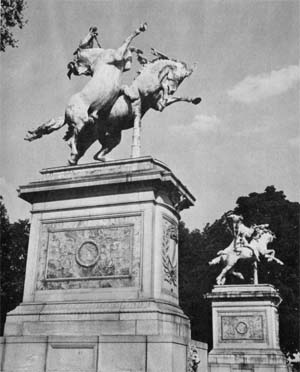
Prospect Park is a 585 acre (2.4 km²) public park in the New York City
borough of Brooklyn located between Park Slope, Prospect-Lefferts Gardens,
Kensington, Windsor Terrace and Flatbush Avenue, Grand Army Plaza and the
Brooklyn Botanic Garden and seven blocks northeast of Green-Wood Cemetery. It is
run and operated by the New York City Department of Parks and Recreation, and is
part of the Brooklyn-Queens Greenway.
The park was designed by Frederick Law Olmsted and Calvert Vaux after
they completed Manhattan's Central Park. Attractions include the Long Meadow, a
90 acre (36 ha) meadow thought to be the largest meadow in any U.S. park; the
Picnic House which houses offices and a hall that can accommodate parties with
up to 175 guests; Litchfield Villa, the historic home of the previous owners of
the southern part of Park; Prospect Park Zoo; a large nature conservancy; the
only urban Audubon Center & a Visitor Center (at the Boathouse); Brooklyn's only
lake, covering 60 acres (24 ha); the Prospect Park Bandshell that hosts free
outdoor concerts in the summertime; and various sports and fitness activities
including seven baseball fields. There is also a private Quaker cemetery on the
grounds of the Park in an area known as Quaker Hill. (Actor Montgomery Clift is
interred there.) |
|
| |
|
|
| 2 |
Grand Army Plaza
|
|
 |
|
architect
|
Olmsted and Vaux |
|
location
|
All Grand Army Plaza, within Plaza St. at the intersection of Flatbush Ave.,
Prospect Park W., Eastern Pkwy., and Vanderbilt Ave. |
|
date
|
1870. |
|
style
|
Beaux-Arts |
|
type
|
Monument |
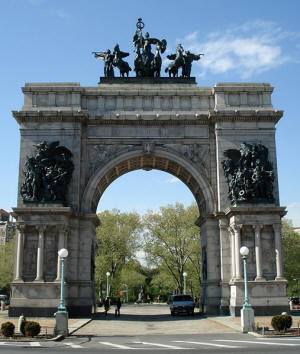
Olmsted & Vaux designed this monumental oval traffic circle in the spirit of
Paris Etoile (now the Place Charles de Gaulle), that circular 12-spoked traffic
rond point that bears in its central island the Arc de Triomphe, although they
opposed an arch here. A masterstroke of city planning, this nexus joins their
great Eastern Parkway, and their Prospect Park, with the avenues that preceded
it on other geometries. This triumphal arch did not arrive for 22 years: the
Soldiers’ and Sailors’ Memorial Arch
W by John H. Duncan, architect of Grant’s Tomb, was built between
1889 and 1892, commemorating Union forces that perished in the Civil War. The
arch provided, as in its Parisian inspiration, an excellent armature for
sculpture, planned by Stanford White (McKim, Mead & White. 1894-1901), the most
spectacular of which is Frederick MacMonnies’ huge quadriga on top (1898).
Inside the arch itself is more subtle work, bas-reliefs of Lincoln (Thomas
Eakins) and Grant (William O’Donovan), both installed in 1895. On the south
pedestals are two bristling groups representing The Army and The Navy by
MacMonnies (1901). A museum within the arch is open to the public.
|
|
| |
|
|
| 3 |
Williamsburgh Savings
Bank |
|
_small.jpg) |
|
architect
|
Halsey, McCormack & Helmer, |
|
location
|
located at 1 Hanson Place, at the corner
of Ashland Place, near the intersection of Atlantic and Flatbush Avenues,
across from Atlantic Terminal Mall (despite the name it stands in the Fort
Greene section of Brooklyn rather than Williamsburg). |
|
date
|
1929 |
|
style
|
Art Deco
|
|
construction
|
512-foot, 34-story |
|
type
|
Bank,
Office Building |
The 'Willie'
was built by the architectural firm Halsey, McCormack and Helmer from 1927-1929.
It is 512 feet tall, and can be seen from Brooklyn housetops as far away as Bay
Ridge and Dyker Heights. It is the tallest building in Brooklyn and one of the
two tallest buildings on Long Island. Its four-faced clock was the largest in
the world in 1929, and held the title until 1962, when it was surpassed by the
clocks on the Allen Bradley Building in Milwaukee. The ground-floor banking room
boasts a 63-foot ceiling, and windows overlooking Hanson Place are 40 feet high.
|
|
| |
|
|
| 4 |
The Montauk Club |
|
 |
|
architect
|
Francis H. Kimball |
|
location
|
25 Eighth Avenue. NE cor. Lincoln Place. 1889-1891. |
|
date
|
1891 |
|
style
|
Venetian Gothic |
|
type
|
Club |
|
construction
|
Brownstone, brick, terra-cotta,
and verdigris copper. |
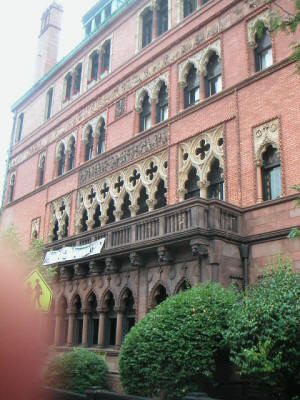
A
Venetian Gothic palazzo, whose canal is the narrow lawn separating it from its
cast-iron fence. Remember the Ca d’Oro. But here in brownstone, brick,
terra-cotta, and verdigris copper. It bears the name of a local tribe, which
explains the 8th Avenue friezes at the 3rd and 4th stories, honoring these
former local natives.
|
|
| |
|
|
| 5 |
Boys High School
|
|
 |
|
architect
|
James W. Naughton. Additions 1905-1910 C.B.J.Snyder |
|
location
|
832 Marcy
Ave., bet. Putnam Ave and Madison St. |
|
date
|
1891-92 |
|
style
|
Romanesque Revival
|
|
construction
|
red brick and terracotta |
|
type
|
School |
|
notes
|
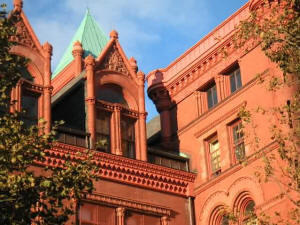
A major Brooklyn landmark, in splendid
Romanesque Revival: arched, quoined, towered and lushly decorated in
terracotta in the manner of Louis Sullivan. |
|
|
| |
|
|
| 6 |
232 Hancock St |
|
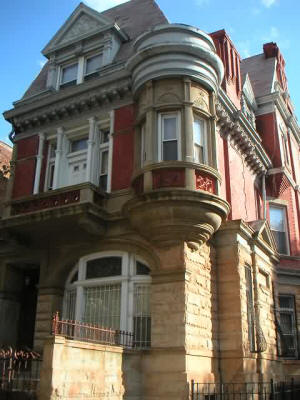 |
Bedford-Stuvvesant is the amalgam of two middle-class communities of the
old City of Brooklyn: Bedford, the western portion, and Stuyvesant Heights, to
the east. Today's BedfordStuyvesant is one of the city's two major black
enclaves; the other is its peer, Harlem. Bed-Stuy differs from its Manhattan
counterpart in its much larger percentage of home owners, although Harlem is
rapidly following its lead in gentriying its own blocks. The southern and
western portions comprise masonry row housing of distinguished architectural
quality and vigorous churches whose spires contribute to the area's frequently
lacy skyline. The northeastern reaches have considerable numbers of wooden
tenements, containing some of the nation's worst slums. But on the whole,
Bed-Stuy has a reputation that doesn't fit with reality: a stable community with
hundreds of blocks of well-kept town houses.Where Bedford-Stuyvesant has
distinguished architecture, it is very good. Its facades of brownstones and
brickfronts create a magnificent townscape as good as-and sometimes better
than-many fashionable areas of Brooklyn and Manhattan. Parts of Chauncey,
Decatur, MacDonough, and Macon Streets, and the southern end of Stuyvesant
Avenue, are superb. Hancock Street, between Nostrand and Tompkins Avenues, was
considered a showplace in its time (why not now too?). Alice and Agate Courts,
short cul-de-sacs isolated from the macrocosm of the street system, are
particularly special places in the seemingly endless, anonymous grid.
Bed-Stuy comprises roughly 2,000 acres and houses 400,000 people, making
it among the 30 largest American cities. |
|
| |
|
|
| 7 |
Excellence Charter School |
|
 |
|
architect
|
James W. Naughton
restored with addition, Robert A. M.
Stern 2005. |
|
location
|
225 Patchen Ave. |
|
date
|
late 1880s |
|
style
|
Second Empire Baroque
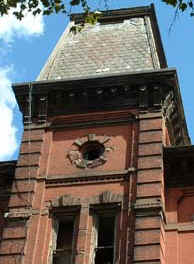
From Napoleon III's Second Empire: a mansarded central block over brick and
brownstone: an admiring follower of Lefuel and Visconti's Louvre. |
|
construction
|
red brick with brownstone trim |
|
type
|
Education |
James W. Naughton’s 1880 gauged red brick and brownstone school building
was abandoned in the late 1970s after a major fire. Uncommon Schools, a
non-for-profit organization known for developing urban college preparatory
charter schools in the northeast chose the site for its academy in Brooklyn –
Excellence Charter School – after an exhaustive search.
“The lowest-risk strategy would have been to demolish the charred
shell of the building,” said David Saltzman, Executive Director of the Robin
Hood Foundation and a trustee of the Excellence Charter School. “It required the
extraordinary vision of Robert A.M. Stern Architects to reincarnate this lost
treasure as a new charter school.” |
|
| |
|
|
| 8 |
Williamsburg Art and Historical Society |
|
 |
|
architect
|
King &
Wilcox. William H. Wilcox.
|
|
location
|
135 Broadway, NE cor. Bedford Ave, Williamsburg. |
|
date
|
1868 |
|
style
|
Second Empire Baroque
|
|
type
|
Bank |
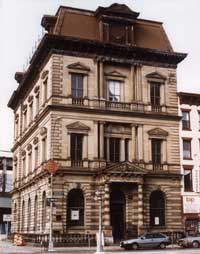
Bands of smooth and vermiculated Dorchester stone and slender Ionic and
Corinthian columns alternate to enliven the exterior of the banking floor of
this splendid Second Empire masterpiece. Victorian at its best, even the
interior is carefully preserved, the gaslit chandeliers all present (but wired
for electricity). Look at the plaited Indian hut in the entry pediment.
|
|
| |
|
|
| 9 |
Williamsburgh Savings Bank |
|
 |
The eclectic Victorian crossbreeding of Renaissance and Roman parts. It is a
sharp, hard, gray place reminiscent of the work of Brooklyn's own great
architect, Frank Freeman, at the old, long since demolished, Brooklyn Trust
Company (below the dome).
|
|
| |
|
|
| 10 |
178 Meserole Street |
|
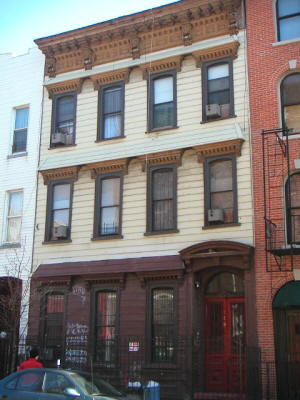 |
Exuberant, painted wood tenements -two of the city's best. "Tenement" is
perjorative today; in fact it describes a walk-up apartment house that covers
most of its building site. Here the light in the back rooms is minimal, but the
visible architecture is magnificent. A quite incredibly rare surviving example
of the type of decorative cladding that once adorned all such timber frame
buildings in Brooklyn. |
|
| |
|
|