|
|

 |
|
|
|
|
 |
New York
Architecture Images- Newport Mansions, Brooklyn Hunter House |
|
|
architect |
||
|
location |
Washington Street (Point Section) | |
|
date |
1748 | |
|
style |
Georgian | |
|
type |
House | |
|
construction |
wood | |
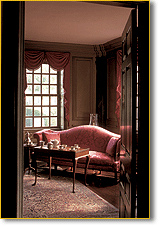
Hunter House is one of the finest examples of
Georgian Colonial architecture from Newport's "golden age" in the
mid-18th century. The house was built and decorated 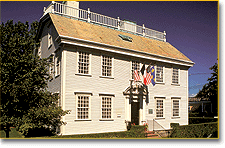 when
Newport was a cosmopolitan city with a principle of religious tolerance
that attracted Quakers, Baptists, Congregationalists and Sephardic Jews.
The great mercantile families lived patrician lives, building
harbor-front mansions overlooking their trading ships, and entertained
in grand style. They bought furniture and silver from local craftsmen
and were the patrons of such important early painters as Robert Feke and
Gilbert Stuart. when
Newport was a cosmopolitan city with a principle of religious tolerance
that attracted Quakers, Baptists, Congregationalists and Sephardic Jews.
The great mercantile families lived patrician lives, building
harbor-front mansions overlooking their trading ships, and entertained
in grand style. They bought furniture and silver from local craftsmen
and were the patrons of such important early painters as Robert Feke and
Gilbert Stuart. 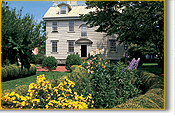 The
north half of Hunter House was constructed between 1748 and 1754 by
Jonathon Nichols, Jr., a prosperous merchant and colonial deputy. After
his death in 1756, the property was sold to Colonel Joseph Wanton, Jr.,
who was also a deputy governor of the colony and a merchant. He enlarged
the house by adding a south wing and a second chimney, transforming the
building into a formal Georgian mansion with a large central hall.
Colonel Wanton also ordered the graining, or "spreckling," of the pine
paneling in several rooms to resemble walnut and rosewood. During the
American Revolution, Colonel Wanton fled from Newport due to his
Loyalist sympathies. His house was used as the headquarters of Admiral
de Ternay, commander of the French fleet, when French forces occupied
Newport in 1780. After the war, Colonel Wanton's house was acquired by
William Hunter, a U. S. Senator and President Andrew Jackson's charge
d'affaires to Brazil. The Hunters sold the house in the mid-1860s, and
it passed through a series of owners until the mid-1940s The
north half of Hunter House was constructed between 1748 and 1754 by
Jonathon Nichols, Jr., a prosperous merchant and colonial deputy. After
his death in 1756, the property was sold to Colonel Joseph Wanton, Jr.,
who was also a deputy governor of the colony and a merchant. He enlarged
the house by adding a south wing and a second chimney, transforming the
building into a formal Georgian mansion with a large central hall.
Colonel Wanton also ordered the graining, or "spreckling," of the pine
paneling in several rooms to resemble walnut and rosewood. During the
American Revolution, Colonel Wanton fled from Newport due to his
Loyalist sympathies. His house was used as the headquarters of Admiral
de Ternay, commander of the French fleet, when French forces occupied
Newport in 1780. After the war, Colonel Wanton's house was acquired by
William Hunter, a U. S. Senator and President Andrew Jackson's charge
d'affaires to Brazil. The Hunters sold the house in the mid-1860s, and
it passed through a series of owners until the mid-1940s
Concerned that the fine interiors of the house would be purchased and removed from the building, a small group of concerned citizens led by Mrs. George Henry Warren initiated a preservation effort, purchasing the house in 1945 and forming The Preservation Society of Newport County. The Preservation Society restored Hunter House to the era of Colonel Wanton (1757 to 1779). Today, the house exhibits examples of the finest achievements in the arts and crafts of 18th century Newport. The collections include furniture by the Townsend-Goddard family, premier cabinetmakers of the colonial era who worked in the neighborhood of Hunter House. Newport pewter and paintings by Cosmo Alexander, Gilbert Stuart and Samuel King are also on display. Hunter House is a National Historic Landmark. |
||
| Special thanks to http://www.newportmansions.org/ | ||
|
|
||
|
links |
http://www.newportmansions.org/ | |