|
|

 |
|
|
|
|
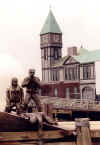 |
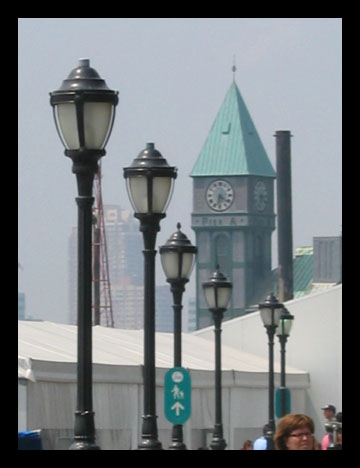
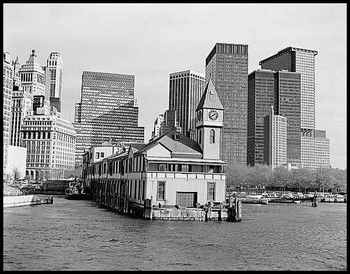
New York Architecture Images- Lower Manhattan Pier A Landmark |
|
architect |
|
|
location |
west of the Battery. |
|
date |
1886 |
|
style |
|
|
construction |
brick, metal cladding |
|
type |
pier |
|
|
 |
|
images |
  |
  |
|
 |
|
  |
|
|
notes |
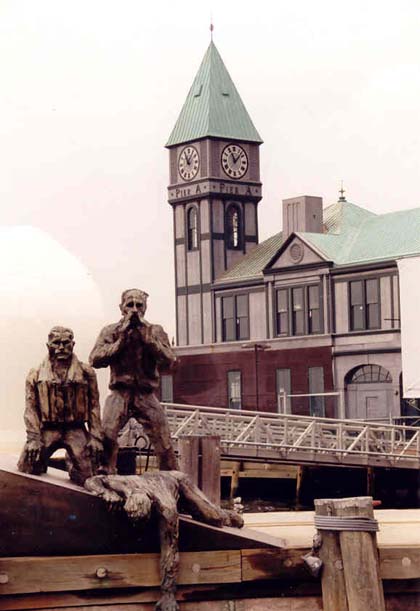
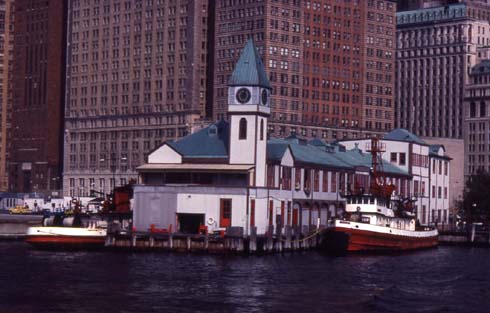
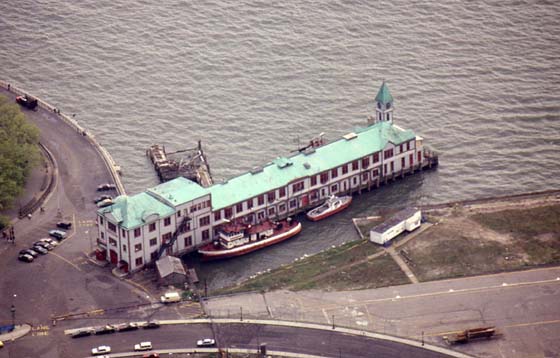
The last remaining pier from the lower west side. The rest were removed to allow the land-fill for Battery Park city. |
|
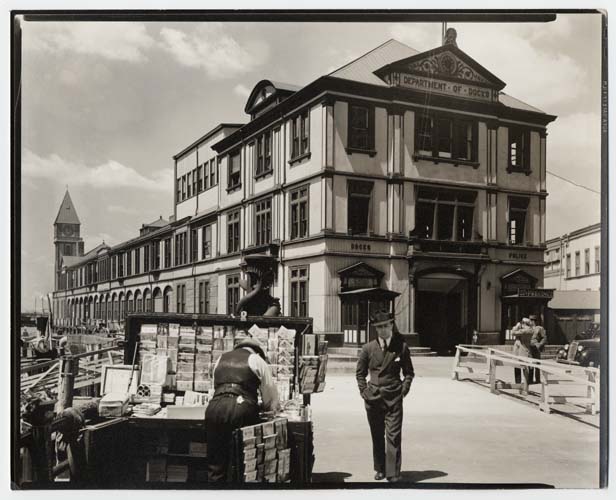
The Department of Docks stood on Pier A,
Manhattan's southmost Hudson River pier. This utilitarian brick
structure was built in 1886; in 1900, a three-story front section and
metal siding were added, and in 1919, a clocktower was appended as the
nation's first World War I memorial. In Abbott's day, celebrities
arriving in New York City were ceremoniously greeted here, and the
department's guestbook, which included the signature of Charles
Lindbergh, attracted tourists visiting the nearby aquarium.
Although slated for demolition during the construction of Battery Park City, the building was designated a landmark in 1975. Now vacant, it is likely to be renovated for commercial use |
|
|
Pier A Progress Perennially delayed project
back on track
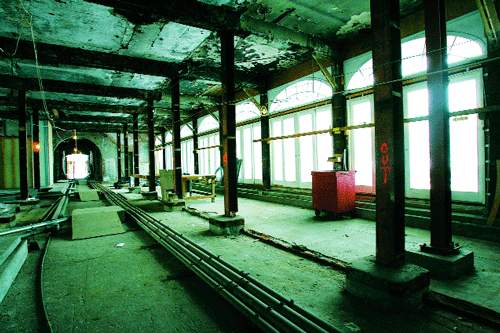
By Ronda Kaysen Pier A in Battery Park may finally get a long awaited multi-million dollar restoration now that the city and the pier’s leaseholders are close to hammering out an agreement, bringing nearly two decades of wrangling to a close. The three-story pier was once a Victorian wonder in Battery Park that welcomed the likes of Amelia Earhart, the Queen of England and various heads of state. Today it is a dilapidated shell of a berth, hidden behind a chain link fence and shrouded in a thick layer of scaffolding. Soon, all that may change. “How do I feel about this? I’ve been working on this for 16 years! I’m thrilled,” said Thomas Ickovic, one of the managing partners of Wings Point Associates, the leaseholder for the property. In recent months, Wings Point settled lawsuits with the city and New York Waterway, which recently sold its Downtown commuter ferry routes to attorney William Wachtel, a Wings Point managing partner. With the legal issues resolved, Wings Point and the Economic Development Corporation, the landlord for the property, have reached an agreement in principle, according to a source at Wings Point who requested anonymity. The National Park Service will, if the agreement is signed, have a permanent home for its Statue of Liberty security checkpoint, bringing an end to the temporary—and unsightly—gray tents that have marred the Battery Park promenade since Liberty Island reopened with tighter security in December 2001. “We’re just so excited to have anything happening there; it means we have our promenade open to the public again,” said Warrie Price, president of the Battery Conservancy. “We want [the promenade] back — that great experience of coming to Castle Clinton and having that doorway framing the harbor for you is your first major impression of looking out at those 11,000 acres of water. That plaza has got to be open space for the people Downtown.” Opened to the public for the first time in its history, a portion of Pier A’s sweeping ground floor will be used for Park Service security, and Wings Point has strongly suggested that Statue of Liberty-bound visitors enter through a north pier entrance, with the north and west docks used for Circle Line ferries. Today, the ground floor is little more than a construction site with hanging wires and plank and plywood floors. But its arched windows and open floor plan tell a different story. Built in 1886 for the now defunct Department of Docks and Ferries, the ground floor has an impressive bank of floor to ceiling arched windows, filling the dusty structure with light and breathtaking views of the New York Harbor. “They needed to read blue prints,” Ickovic said of the city workers. “They needed a building with extraordinary light.” The pier was also used as an observation tower for the city’s harbor police and most recently the marine division of the city’s fire department. Federal legislation signed by President George W. Bush last December gave the Park Service the authority to secure a permanent location for its security facilities. Wings Point, which signed a lease for the property in 1989, plans to donate the space to the Park Service, according to James Pepper, superintendent of national parks in Manhattan. Without a signed and sealed agreement, however, Pepper, is wary of premature celebrations. “We think it’s an exciting opportunity, and we’re looking at it very closely,” Pepper said. “But we haven’t actually signed any agreements at this stage.” The Economic Development Corporation, which controls the property, shares the Park Service’s sentiment. “We have been working closely with Wings Point and the National Park Service and are very happy to have the project moving again,” Janel Patterson, an E.D.C. spokesperson said. However, “There are still some issues to be resolved but we hope they’ll be worked out in the near future.” Wings Point plans to transform the top floor of the 32,000 sq. ft. structure into a “tavern-on-the-water” type events-catering hall and use the south pier for its own harbor tours, water taxi service to South Street Seaport and morning and evening New York Waterway commuter ferries, Ickovic said. The second floor and portions of the ground floor will be used for a harbor museum experience and other facilities. The agreement should be finalized by the middle of March with work beginning immediately thereafter, said a source at Wings Point, who requested anonymity because the final deal has not yet been signed. The pier is expected to be open to the public this year. “Certainly by the early fall, if not sooner, the pier will be a vibrant hall for millions of Americans to see the Statue of Liberty,” the source said. “The key is for all parties to get their arms around [the agreement.]” Wings Point filed permits with the city’s Dept. of Buildings recently so it can begin work. “This building has so much history, I am so stoked to be a part of this project,” said Seth Goldstein, project coordinator for the renovation. “I can’t wait to get started on this.” The massive loading barge that the Port Authority placed at the edge of the dock after September 11, 2001 for displaced PATH commuters will not return. Ickovic said the restored pier will not include a barge anywhere near that size and will have what he called a small floater with room for a few boats. Pier A was built immediately after work was finished on the Brooklyn Bridge and with the same equipment. Restoring it requires replacing the original detailed metal façade and fixtures that are no longer produced in this country. The machinery that casted the pressed metal detailing no longer exists. “For us to replicate it is much more work than it was to originally build it,” Ickovic said. The original clock keeps perfect ship time in a tower at the western end of the pier, but was badly damaged with time and needed its gears completely recast. “That was a very expensive restoration job,” Ickovic said. A historic renovation has its perks, however. Wings Point qualifies for the Historic Preservation Tax Credit program, which means the company will receive a 20 percent tax credit for the $40 million project, Ickovic said. In 1997, the company also received an $8 million loan from the U.S. Dept. of Housing and Urban Development, which will also be applied towards the restoration costs. Ickovic is thrilled to see the pier, which juts 300 feet out into the water and is the closest site on Manhattan to the Statue of Liberty, restored. “It’s really one of the most significant maritime buildings in New York City. Period.” Downtown Express Volume 17, Number 41 | March 4 - 11, 2005 |
|