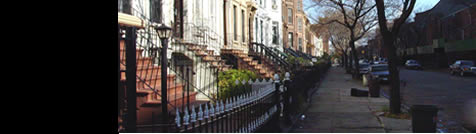
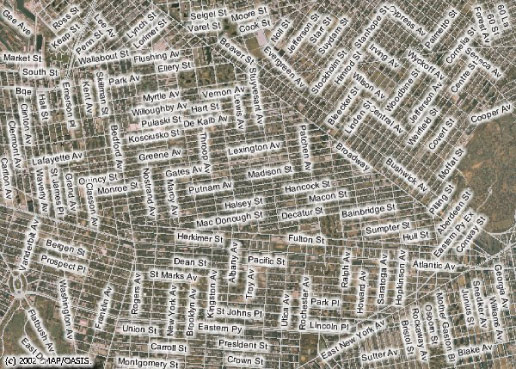
Map 3 (left) : Brooklyn Community District 3.
Map 4 (middle) : Bed-Stuy according to the Bedford-Stuyvesant
Redevelopment Corporation.
Map 5 (right) : Bed-Stuy according to the Department of Housing
Preservation & Development
History
As Douglass North simply put it: “History matters. It matters not just
because we can learn from the past, but because the present and the
future are connected to the past by the continuity of a society’s
institutions.”(6) Bed-Stuy has a relatively short history as a
community, since its Afro-American and Caribbean population really
started coming to the neighborhood in the1920s.(7) The brief historical
description of the neighborhood which follows aims at demonstrating that
institutions and social capital had little opportunity to develop until
the end of the century. Examining another history, the history of
American slavery, would be needed to understand why immigrants from the
South of the US did not have levels of trust and cooperation among their
community comparable those of other immigrant communities, such as the
Caribbean and African communities. But I will limit myself here to the
history of Bed-Stuy.
The Dutch West India Company established Bedford in 1663. It was a rural
community until the Nineteenth Century(8) when Dutch farmers started
selling land to newcomers. Free African-Americans were among the first
to buy land and settle in the area. Weeksville was named after James
Weeks, an African-American entrepreneur who bought land in 1838 and sold
it to other black settlers.
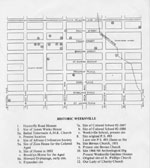
Weeksville and Carsville are two small closely related black settlements
begun in the 1830s and 1840s. They were located less than a mile from
each other on the former farmland in the Southern portion of Bedford, in
an area bounded approximately by present-day Atlantic Avenue, Ralph
Avenue, Eastern Parkway, and Albany Avenue. By the mid century, these
communities were well formed and had begun to establish schools,
churches, and other institutions of community life.(9)
 |
|
Map 6 : Pratt Center for Community & Environmental Development
and Joan Maynard |
These settlements became
a refuge for blacks from New York City during the great Draft Riots in
1863 and kept expanding thereafter.(10)
In the 1860s and 70s an increasing number of wealthy New Yorkers, mainly
from Dutch and German descent, established residence in Bedford. The
urbanization of the neighborhood followed the street plan ratified in
1839, which extended the grid throughout Brooklyn11. Bedford was an
exclusive and highly demanded suburb. Market pressure led to rapid
urbanization of the area: “the suburban district of freestanding frame
and brick homes was gradually transformed into a more urban neighborhood
of brick and brownstone row houses.”12 Instrumental in popularizing the
neighborhood was the construction of the elevated railway lines giving
fast access to Downtown Brooklyn and Manhattan. The housing market
boomed from 1880 to 1920 as Neo Greek, Romanesque, and Queen Ann style
buildings mushroomed all around Bedford.
In the course of a few years, the demographics of the neighborhood
changed dramatically. “[W]hile the brownstone houses of Bedford were
solidly built and long lasting the community itself was to be temporary,
transformed in a few short years by the ceaseless forces of urban
change.”13 Between the wars, and particularly after the Great
Depression, middle and upper class people moved out of the neighborhood.
Real estate value dropped and working class people moved in. Bedford
became less exclusive and more integrated: “Jews, Italians, West
Indians, Irish and other ethnic groups settled in this aging yet still
comparatively attractive neighborhood.”14 Many property owners had
become too poor to keep their homes. Sold because their owners were no
longer able to afford their property taxes, or voluntarily selling their
property before it devaluated further, the brownstones of Bedford
quickly switched hands. Black in-comers filled up the houses abandoned
by previous immigrants. The devaluation of Bedford corresponded to the
massive migratory flux of black Southerners and West Indians to New York
that began in the 1910s and 20s. “From the poverty and social
constraints of the rural South came thousands of black men and women,
seeking the greater opportunities for economic advancement and personal
freedom supposed to exist in northern cities. Bedford became first
choice destination for black immigrants. The existence of communities in
Weeksville, Carrsville, and Fort Green made it easier for other black
immigrants to settle in the area. The construction of the A train in the
1930s made the commute between Harlem and Bedford much easier. Many
people came from uptown to central Brooklyn, which offered more jobs and
better housing.
Property value was dropping fast. A number of white homeowners reacted
by attempting “to persuade residents not to sell to blacks and
encouraged the use of racially exclusive covenants.”15 However, the
white flight was a self-fulfilling prophecy, and totally destabilized
the real estate market. The real winners were not the black immigrants
who purchased the properties, but real-estate traders:
How do slums begin in the cities? Ask the question to some older or
former Bed-Stuy residents and they will be quick to give you a one-word
answer a³blockbusting. Real estate brokers, speculators, professional
blockbusters, not excluding certain banks and mortgage companies are all
considered to follow this practice and hence to be slum builders. Many
stories are told and retold about such incidents of exploitation as
black family forced to pay $20,000 for a house that the realtor had
purchased for $2,000 or $3,000 just the week before. Additionally it was
hard for a black man (or woman) to get a mortgage, many blacks had to
turn to a middleman, who did his “share” in fleecing poor buyers. Thus
the new black owners found themselves faced with an ironic situation:
they had entered into this financial serfdom in order to provide a
better standard of living for their families and themselves. Yet in
order to maintain the homes that were to help to do this, many were
compelled to cut up the older Bedford-Stuyvesant house they had
purchased into “rabbit warrens” renting out the cubicles for whatever
amount they could bring.16
The “slumification” of
the neighborhood really began in the 1930s after the Great Depression as
bankruptcy and poverty spread all over New York. Blacks were the first
fired and last hired. From then on, the neighborhood was pretty much
left to itself by the public authorities until the 1960s when Senator
Robert F. Kennedy toured the dilapidated streets of New York’s
Bedford-Stuyvesant neighborhood and planted the seeds for what would
become the Bedford-Stuyvesant Restoration Corporation.
Job opportunities at the Navy Yard during the Second World War brought
more black immigrants to what is now known as Bedford-Stuyvesant. The
two neighborhoods, following the same evolution, came to be known as
Bedford-Stuyvesant.
Since the postwar period to our days, racial diversity declined
steadily. The population of Bedford-Stuyvesant went from being 25% black
in 1940 to 50% in 1950, 74% in 196017, 82% in 197018, and to about 85%
since the 1980s. Behind this apparent racial homogeneity lies a variety
of national origins and socio-cultural backgrounds, including, by the
1970s, Puerto Rican, middle class black-Americans, and West Indians.19
The concentration of blacks in Bed-Stuy can be attributed to racial
segregation in housing more than the will of black people to live in
homogeneous community.
Blacks of the 1950s and 1960s were simply unable to buy or rent homes in
large parts of Brooklyn and in many white residential districts
throughout the metropolitan area. Residents and real-estate brokers, in
these areas combined to exclude black families unhampered by the
ineffectively enforced civil rights laws. Bedford-Stuyvesant was one of
the few areas open to blacks.20
In a 1967 survey of the Bed-Stuy community, when asked to choose between
“moving into a block with people of the same race or one with people of
every race”, nearly 4/5 of respondents chose “every race.”21 Despite
rampant segregation and institutional racism thus, the black population
was open to live in a multi-ethnic environment. The schools were not
receiving adequate support, city services, and public works were almost
non-existent, and the police were feared rather than reassuring.
Injustice and poverty led a minority of black-American to endorse a
separatist ideology. Political tension reached its climax in Bed-Stuy
during the Civil Rights Movement, in the late 1960s. It resulted in a
one-day riot on July 29, 1967:
[T]here were serious disturbances at the busy intersection of Fulton and
Nostrand Avenue. Over one thousand young blacks (age fifteen to
seventeen years) had broken windows, set buildings aflame, ripped
storefront gates, stolen and looted on Nostrand Avenue between Atlantic
and Fulton. ? fourteen people had been arrested; a full alert had been
put on in Bedford-Stuyvesant. The 20th Tactical Patrol Force had been
sent into Bedford-Stuyvesant because there had been four consecutive
nights of sporadic violence in Spanish Harlem.22
Most rioters were disillusioned second-generation teenagers. In 1967,
the “need for jobs and fuller employment” was cited by 41% of surveyed
residents as a main problem23. Perhaps the high percentage of recent
immigrants in Bed-Stuy prevented the riots from reaching the scale of
the riots in Harlem, Newark, Los Angeles, or Detroit. Immigrants are
often too busy trying to make it to engage in political action.
These events happened shortly after Senator Robert F. Kennedy had toured
Bed-Stuy and initiated the first Community Development Corporation (CDC)
in the country, the Bedford-Stuyvesant Restoration Corporation. Senator
Kennedy convinced eminent personalities of the political and business
world to join the board of the Restoration Corporation, thus insuring
maximum credibility and enabling it to become the first CDC to receive
federal funds.
However, the Restoration Corporation did not succeed in lifting Bed-Stuy
out of poverty. Not all programs succeeded, as the failure of the
following IBM project illustrates. One of the chairmen of IBM, Thomas B.
Watson, was also a board member at the Restoration Corporation. Mr.
Watson was instrumental in opening an assembly plant employing four
hundred people. Unfortunately, the plant failed to show adequate returns
on investment and was finally converted to public housing (after an
unsuccessful attempt to transfer the ownership to the employees). The
“additional cost, above and beyond that which a similar plant elsewhere
would have required, has militated against the likelihood that other
corporations would locate there.”24
It seems that the Restoration Corporation was no exception to the
general failure of CDCs to develop distressed neighborhoods. David Rusk
notes that “in cities across the country, the 34 target areas served by
the most successful CDCs as a group still became poorer, fell farther
behind regional income levels and lost real buying power.”25 The same
observation was also made by Margaret E. Dewar: “Most evaluations
conclude that state and local business financing to stimulate economic
development outside big cities does not achieve the explicit goals ?
Programs aimed at specific distressed geographic areas show almost no
effects on the growth of these areas.”26 In other words, if citywide
programs can have an impact on neighborhoods growth, no evidence proves
that programs limited to specific locations bring results. It is hard,
however, to evaluate the impact of CDCs on depressed neighborhoods
because firstly their programs might have long-term a reach rather than
short-term effects and secondly it is impossible to evaluate how much
worse the neighborhood could be had the CDCs not being present.
However, even if the Restoration Corporation did not save Bed-Stuy, the
money and expertise it channeled to the neighborhood have had a long
lasting effect on the neighborhood. Its renovation and mortgages
programs had a tremendous impact on the longer-term appreciation of the
housing stock and stimulated private re-investment. The Restoration
Corporation could even take a good part of the credit (or the blame?)
for the current boom in real-estate value, since its revitalization of
the neighborhood stimulated private investment.
The Restoration Corporation brought a great deal of linking capital to
the community27: it re-established formal connections with some
mainstream public and private institutions. It was a welcomed
manifestation of good will from the authorities, even though much more
was needed to restore the community’s trust in public institutions.
Years of economic poverty, financial redlining, political segregation,
and legal injustice have definitively done much to “ghettoize” the
community. As World Bank social scientist Michael Woolcock noted,
“hostile or indifferent government have a profoundly different effect on
community life (and development projects), for example, than government
that respect civil liberties, uphold the rule of law and resist
corruption.”28 Henry L. Gates of the African-American Studies department
of Harvard, suggests indeed that much of the “gangster culture” and
“show me the money” attitude that came to epitomize black ghettos such
as Bed-Stuy has deep roots in the political and institutional history of
American society, starting at the White House.29
On top of existing economic and social problems came the devastating
crack and heroin epidemics, which began during the 1970s and late 1980s.
Drugs were and still are a way out of boredom and bitterness for many
unemployed and disillusioned youth, and also the most direct (sometimes
the only) way to make money. “The quest for manhood is not a simple
thing in any community, but in such areas as Bed-Stuy, in Brooklyn it is
as difficult as an escape from prison.”30 Indeed, many youth of Bed-Stuy
grew up with weakened or non-existent social and familial structures:
As a result action is what happens on the street, and when a youth
graduates from them, he has his diploma into adulthood but he is not
necessarily a man. His entire experience is likely to be circumscribed
by a series of predictable dehumanizing incidents: gang rumbles, quickie
sex in tenement hallways, petty thievery, menial jobs at meager pay, and
a number of abusive confrontations with the law. Indeed, his
relationship with the police is the most predictable of all. It is also
likely to be the most brutal.31
Poor neighborhoods become poverty machines that generate poverty
itself.32 Bed-Stuy seemed to be locked up in a vicious cycle of poverty
until the early 1990s. Redlining by banks made it difficulty to start
new businesses or even to save money. The unavailability of capital in
the neighborhood prevented investment and thus the creation of more
capital. It constituted an absolute constraint on growth. Poverty itself
has an anti-growth effect. Poor are often unable to develop skills for
the market and are less responsive to opportunities.33 Given this
seemingly hopeless situation, many of the most upwardly mobile residents
moved out of the neighborhood as soon as they could, leaving behind more
empty houses, broken windows, poverty, and despair.
Poverty, hopelessness and drugs congregated to create “high rate of
crime and violence that [in turn] generate[d] low levels of trust and
cooperation among residents.”34 However, it seems that as a response to
a hostile environment and in the absence of mainstream institutions
linking Bed-Stuy to the rest of society, solidarity and informal
institutions got stronger. But the social capital needed to support
economic institutions in the neighborhood was definitively lacking. The
legal system was not trusted, and connections to the rest of society
weak. Reliance and cooperation with the immediate entourage was
therefore a matter of survival, to the youth it could mean sticking to
the gang, and to the elderly, reliance on familial and religious circle.
In other words bridging capital was low but bonding capital high35.
 |
 |
|
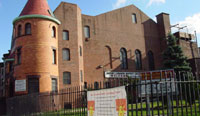
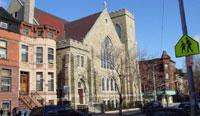
The numerous religious communities of today’s Bed-Stuy inherited
some beautiful churches from the upper-middle class population
of the early twentieth century. |
Community organizations
such as charities and churches have a very important role in Bed-Stuy.
They have been instrumental in preserving some sense of pride and
solidarity in the community and to a large extent filled up “structural
holes36 left by the lack of formal political and economic institutions.
In an interview I had with Assemblywoman Robinson, who represents the
57th precinct (which includes Bed-Stuy), she recalls the great benefits
brought by churches to the community. They bound religious communities
together, and many have direct social programs such as food and clothing
distribution, affordable housing development, and financial support for
small business.
Today the ghetto is still in Bed-Stuy, but Bed-Stuy is out of the
ghetto: Nearly a quarter of households have an income over $50,000
(compared to only one eighth in 1990)37. Real-estate value has doubled
or tripled in the last five years. The infant mortality rate decreased
from 21 per thousand in 1990 to 9.1in 199938. Crime rate in the 79th and
81st Precinct covering Bed-Stuy has decreased by 60% and 58%
respectively since 199339. The war on crime launched by the Giuliani
administration since 1993 definitively deserves a large part of the
credit for this dramatic decreases. While reduction of criminal offenses
in the Bed-Stuy area corresponds to the citywide numbers, other
neighborhoods with similar reduction in crime rates did not experience
the same income growth and quality of life improvement. Other macro
factors for the recent development of Bed-Stuy include the American
economic growth of the 1990s. A little share of the wealth created by
Wall Street and Midtown trickled down to Bed-Stuy.
The history of Bed-Stuy is the history of the trial and tribulations of
its people. By an irony of history one of the most beautiful
neighborhoods of New York City became the home of some of those who have
suffered most from segregation and injustice. Residents of Bed-Stuy are
increasingly recognizing the value of their neighborhood, as newcomers
keep flowing in. Today, the neighborhood is developing from the bottom,
with poor immigrants striving to make it and running small businesses,
and from the top with newcomers bringing investment and hope. The next
section will focus on immigrants coming from poor countries. The history
of Solomon and Malik will illustrate the energy and entrepreneurial
spirit of immigrants from the Caribbean and Africa.
Immigration
Poor immigrants kept coming from the Caribbean, but also from the French
Antilles, Latin America, and Africa throughout the twentieth century. At
the same time, second and third generation black Southerners and
Caribbean with higher educational and income levels came (or came back)
during the 1990s, bringing more purchasing power to the neighborhood. I
will first describe the contribution of the Caribbean and African
immigrants to the recent development of the neighborhood, discussing
along the way the costs and benefits of the informal economy for which
these groups are often held responsible. Then I will analyze the impact
of higher-income newcomers, from New York and the rest of the world.
The West Indian population started moving into the neighborhood as early
as the 1920s. It seems that they have been among the most successful
segment of the community. As a Caribbean resident stated: “ the Bed-Stuy
West Indian would be among the most ambitious and hard-working people
one would find anywhere. This seems to be true wherever the West Indian
finds himself, and however incongruous his ambitious behavior may be
when contrasted to others in the community.”40 Mr. Senckler,
vice-president of the Restoration Corporation, himself a
second-generation Caribbean born and raised in New York, calls
immigrants the “backbone of the community”. He believes that they bring
a positive energy to the neighborhood. “They are hard working people,
with a strong desire to succeed.” Mr. Senckler also emphasizes the
cultural contribution of immigrants to the community.
 |
|
The picture shows a gas truck owned by a Caribbean driver in
Bed-Stuy. The Drawing represents the Lion of Judah, a biblical
symbol of the Rastafarian religion and culture. The flag with
the colors of Ethiopia reading “positive” is representative of
the attitude of many Caribbean descendent. |
Many businesses in
Bed-Stuy are owned by people of Caribbean descent, typically health food
stores, take-away restaurants and house repair. The Caribbean population
is often perceived as having strong moral values and entrepreneurial
skills. Many Caribbean families choose to invest in their children’s
education and send them to religious or private schools. This has paid
off already as an increasing number of second generation Caribbeans who
came from poor immigrant families, climbed up the social ladder to
middle and upper-middle class professions and incomes. Mr. Senckler
himself exemplifies this pattern of success. As a resident quoted by
Mary Monomi bluntly put it: “It is one thing to say that there are
blacks in high positions in the police and fire departments and in the
school system, and those who own some sort of business. It is quite
another thing to check it out and see that most of those so-called
success stories are about immigrants whose formative years were spent on
some small foreign islands in the Caribbean a³or the children of those
immigrants.”41 However this statement is dated (1973) and probably says
more about the pride of the respondent than anything else. The Caribbean
and African-American cultures have merged to a large extent in Bed-Stuy.
Assemblywoman Robinson, who praises immigrants for the cultures and
value they bring, doesn’t like to separate black-American and Caribbean
people: “both share a common history and are the original people of
Bed-Stuy.’
Solomon’s story exemplifies both the entrepreneurial spirit of Caribbean
immigrants and their integration. Bricklayer and brownstone owner,
Solomon came to New York in the 1970s from Trinidad. He first settled in
Queens, in a neighborhood where he could find good schools for his two
children. After working and saving money for years, he decided to invest
in a house. His family and friends thought he had lost his mind when he
bought a brownstone in Bed-Stuy about six years ago in the mid 1990s,
before the market got hot. But Solomon, who built houses for many years,
knows how to recognize quality. Once, after I referred to the new Trump
tower as a “high-class residential building”, Solomon (otherwise very
well behaved) replied impulsively: “High-class? B? S?! I have been
working on these buildings. The walls are paper-thin. If you throw a
kick, you end up in the neighbors’ dinning room! Now look at these walls
(pointing to the brick walls of his brownstone that he had stripped of
all wallpaper and painting), this is quality. They don’t make houses
like that no more.” He has a point: Bed-Stuy brownstones are high-class.
Unfortunately, most of them are in a bad shape. Solomon entirely
renovated his brownstone himself, working every day after work. At one
point, he had pierced holes in the ceilings, the floor, and the walls to
fix the water pipes and electricity and take away the layers of
wallpaper, paint, carpet added throughout the years. Solomon is now
renting the two top floors of his brownstone and talking about retiring
to Trinidad.
If Solomon’s dreadlocks hint at his Caribbean origins, no exterior signs
would attest of his son’s ancestry. Dressed in the straight up hip-hop
fashion of Bed-Stuy, he looks like a³and actually is a³ an American kid.
As Greg Donaldson, explained in an interview42: “Most Caribbean youth
adopt the African-American culture as soon as they go to school and
socialize.” Youth might keep their Caribbean roots inside, but they very
quick to adapt to the local American culture. A few years older,
Solomon’s daughter might be closer to her origins in style, but she also
definitively integrated the local culture. Solomon mentioned that most
of her friends are from their former neighborhood, including her white
boyfriend. “If it is love, it cannot be wrong”.
A new wave of immigrants from sub-Saharan Africa has recently joined the
community. The Pratt Area Community Council ancestry figures show a
large increase in African residents from 1990 to 2000. According to one
African vendor I talked to, between one and two thirds of the African
residents in Bed-Stuy are undocumented. One thing is sure: the African
presence is very visible in the streets of Bed-Stuy, particularly along
the Fulton street commercial strip, where many shops and restaurants are
owned or managed by Africans. Bed-Stuy has a high concentration of
African Muslims. A mosque situated right at the corner of Bedford and
Fulton is always busy with street activity. The segment of Fulton
between Bedford and Franklin Avenues has about a dozen halal restaurants
and bakeries, serving some of the best quality food in the neighborhood.
The African Muslim community seems to be well integrated to other
Muslims communities, such as the Indonesians and Pakistanis.
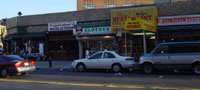 |
|
“Muslim Street”, on Fulton Avenue between Bedford and Franklin.
The image shows the mosque at the corner next to a clothing
shop, a Halal restaurant and a bakery. |
The African community
itself is divided into sub-communities. Members of each sub-community
might have strong tights with each other, for instance most French
speaking Africans know each other, however they seem relatively weakly
connected to the black-American community. Some long-term residents
resent the apparent lack of involvement in the community of the African
Diaspora. Crystal, a black-American storeowner, notes that African
immigrants do not seem to do much effort to integrate the rest of the
community. Many of them are single men or women with families back in
Africa. They are mainly in New York to make money to send back home. As
they do not plan to stay in the community forever, they have little
incentive to get involved in communal life. Moreover, many have several
jobs, or work every day of the week. If they do not manage to engage in
social activities, they certainly try hard to supply goods and services
demanded by the community. Malik, an African CD vendor on Bedford
Avenue, argues that immigrants like him cannot afford to let
opportunities go by, “we are more willing to take risks and work hard
than others because we have more pressure to make it.” He still has a
family to look after in Africa. With the little cash he makes, he sends
eight children to school in Burkina Faso.
Economics of immigration
Immigration made New York City. Since incoming immigrants are generally
poor, their economic impact on neighborhoods such as Bed-Stuy do not
directly boost income statistics. However, they indirectly contribute to
the economy. In the short term, immigration from poor countries might
appear to limit economic development since it increases the poverty
level and puts pressure on the infrastructure and social services. In
this section, I will first analyze the benefits of immigration, which
include economic dynamism, increased spending, cheap labor, small
business creation, and innovation. Then I will evaluate its cost,
including, loss of jobs for the local population, criminal activity,
infrastructure congestion, social burden, and the informalization of the
economy.
Immigrants, legal and illegal, are increasingly numerous in Bed-Stuy.
Using the definition of the neighborhood boundaries of the Department of
Housing Preservation and Development (narrower than Community District
3), and the census data from 1990 and 2000, the population of the
neighborhood increased by 6%. The foreign-born population increased by
58%, faster than the local population. Foreign-borns are now
representing 18% of the total population in 2000 as compared to 12% in
199043. The data is uncertain, since a good proportion of the
foreign-born population, particularly illegal immigrants, are not
accounted for by official statistics.44
Because they are under extreme pressure to “make it”, immigrants often
seize opportunities and take jobs that locals, even poor, do not want.
This entrepreneurial “do-it-yourself” spirit directly benefits the local
economy in different ways. First it creates a pool of cheap labor that
reduces production costs and increases the productivity of capital,
making local business more competitive.45 For instance, shop owners can
hire staff that will help them serve more than one client at the time,
or allow them to take care of other businesses. Entrepreneurs employing
cheap immigrant labor can reinvest a larger part of their capital in
their business. As development economist Slobodan Djajic puts it:
availability of cheap clandestine labor represents a significant
advantage for entrepreneurs initiating new businesses and reduces the
risk of embarking on new ventures. To the extent that it promotes
start-ups of small businesses, the availability of illegal aliens in the
economy may be an important factor in stimulating economic growth,
investment, and a competitive business environment. In turn, a healthy
and dynamic small business sector is at the heart of jobs creation for
the native workers in most economies.46
Immigrants are consumers, renters, and taxpayers. As the population
increases, consumption rises, thus local businesses directly benefit
from immigrants. As they create businesses themselves, they invest their
revenues to purchase stock or hire workers. Immigrants also spend money
on residential and commercial rents. Rental of retail space to immigrant
entrepreneurs directly increases the income of local owners. Finally,
they pay taxes, whether they are legal or clandestine. Even businesseses
owned by illegal immigrants generate tax revenue through the automatic
tax withholding system. Although Malik is himself in an irregular
working situation, his business is official registered and taxed.
Immigrants are good at filling up gaps in demand. As Malik puts it, “we
see opportunities natives don’t see, and we are willing to do the job.”
The hat or incense stalls on Fulton or Nostrand Avenues
characteristically fill up little spaces unusable by the bigger shops.
Moreover, immigrant vendors, using their community networks, are often
good at satisfying specific demands, such as finding the CD of a
particular musician or the hat of a particular baseball team.
The entrepreneurial and “self-help” spirit of immigrants stimulates
experimentation and innovation. For instance, a general utility store on
Nostrand Avenue just moved its facade inward in order to put an outdoor
stall selling inexpensive winter goods. This allowed the store to take
full advantage of the pedestrian traffic. Consumers do not have to step
in; they can just purchase a pair of gloves on their way to the subway.
Interestingly this innovation was inspired by street vendors who rely on
“opportunity” rather than “destination” shopping. Another example of
creative innovation is the delicious “bean pie” invented by a Muslim
baker on Fulton. Unique in taste, it can be found only in Bed-Stuy (at
least that is what the baker says!).
In Bed-Stuy, as elsewhere, immigrants are “vital to progress in carrying
ideas from place to place.”47 Some examples are: specialty shops selling
authentic African fabric and crafts, Caribbean bookstores and health
stores, Halal restaurants, and Southern Soul food restaurants. They all
bring new cultures and lifestyles to the neighborhood and stimulate the
local economy.
If immigration brings a positive spirit to the neighborhood and
stimulates local economic activity, it also has its costs. Firstly,
Assemblywoman Robinson observes that African and Indian communities
would rather trade among each other. She argues that the money does not
circulate, going straight from the hands of residents to the pockets of
foreign merchants. It is probable that many business transactions are
made within the community. The immigrants’ own communities are obviously
a first choice business network with higher levels of cooperation and
trust. Many recent immigrants do not even speak English. When he first
arrived to New York four years ago, Malik did not even know how to order
food. Four years later he is fluent and trades everyday with locals. The
pirate CDs he sells are produced locally by indigenous residents.
However, he spends little of his money in local shops and business. This
is because he hardly ever spends any money for non-essential goods and
services. Most of the money he earns is sent abroad to his family. It is
probably generally true that immigrant workers send a good share of
their revenues abroad. This is good for Africa and South America, but on
the first sight seems to channel money away from Bed-Stuy.
[M]any trade economists argue that humanity as a whole benefits
enormously from migration. Alan Winters of Britain’s Sussex University,
in a study for the Commonwealth Secretariat, has tried to quantify these
gains. He concludes that, if the rich countries raised the number of
foreign workers that they allowed in temporarily by the equivalent of 3%
of their existing workforce, world welfare would improve by more than
$150 billion a year. That is bigger, he points out, than the gains from
any imaginable liberalization of trade in goods.48
Therefore, in a global, long-term perspective, the money sent abroad
also contributes to local wealth. A richer world is good for the US
because it expands the market for its export goods. Moreover, better
distribution of wealth in the world reduces the need of residents of
poor countries to immigrate. Although the connection is quite direct, it
seems far remote from the everyday economic life of Bed-Stuy. Also, if
immigrant merchants send abroad a portion of their revenue they still
spend a good share of it locally in business investment and living
expenses.
Another commonly perceived cost of immigration is that it takes jobs
away from the locals. As immigrants are willing to work more and for
less, it is believed that they “take jobs held by [or destined to]
natives and thereby increase native unemployment.”49 Most economists
reject this argument for being too simplistic: “Immigrants not only take
jobs but they also make jobs, in two ways: First, their spending
increases the demand for labor, leading to new hires. And second, they
frequently open small businesses that are a main source of jobs.”50
Moreover, the assumption that illegal immigrants are more likely to
indulge in criminal activity than natives seems to be false. Illegal
residency produces a paradoxical effect. As it increases precariousness
and subjects immigrants to the arbitrariness of institutions, the
police, or employers, it forces them to lead a honest life.51
Mr. Senckler of the Bed-Stuy Restoration Corporation points out that
newcomers represent a supplementary cost for the community in the
following areas: education, sanitation, housing, and transportation.
“The standard presumption is that additional people a³children or
immigrants- have a negative effect upon the incomes of the rest of the
people. The usual reasoning is diminishing fixed stocks of agricultural
and industrial and social capital, together with the dependency burden
of additional children and the consequent need for additional
demographic investment.”52 The main burden associated to the demographic
increase caused by immigration is on the school system:
Immigrant children and their use of educational services have been at
the center of the public debate on the public-sector impact of illegal
immigrants. According to Weintraub and Caderas (1984), 85 to 93 percent
of the cost of the public services used by illegal immigrants goes for
education.53
However, it appears that the contribution made by immigrants to the
public coffers is higher on average than their cost. A “magisterial
study in 1997 of the economic impacts of immigration, by America’s
National Research Council, found that first-generation immigrants
imposed an average net fiscal cost of $3,000 at present discounted
value; but the second generation yielded a $80,000 fiscal gain.”54
Nevertheless, if immigrants directly benefit the government through
increased tax revenue, they might represent a burden to the community as
they create an additional pressure on existing infrastructure,
especially if they do not spend their earnings in the neighborhood.
Therefore, to truly benefit from immigration, Bed-Stuy should have
enough public subsidies to expand its infrastructure in line with its
demographic increase.
Another cost of illegal immigration is the one paid by the illegal
immigrants themselves. Informal workers have the hardest working
conditions and lowest wages. Malik works from 9 AM to 9 PM, seven days a
week, and has not had a break in four years. Living close to subsistence
level, he cannot afford to take holidays. Moreover, the very precarious
condition of his status and activity, and his total reliance on it,
makes him very vulnerable to exploitation from potential lenders, his
landlord, and even clients. He lives under the permanent threat of
losing everything. He has no health insurance, social security, or
pension, and cannot go in and out of the country. The precariousness of
his situation prevents him from investing much. The risk of losing
everything usually outweighs potential future gains. Therefore
precariousness itself prevents development.
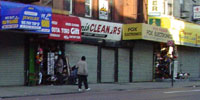 |
|
The last two commerce open at 7 PM on Nostrand Avenue, between
Fulton and Macon, are the hat shops owned by Africa immigrants. |
Finally, immigrants,
particularly undeclared ones, are often blamed for sustaining a
secondary, informal economy. Assemblywoman Robinson estimates that the
portion of the local economy which is “unregulated by the institutions
of society”, to use Castells and Portes’ definition, is “rather
important” in Bed-Stuy.
“Immigrant communities are a key location for informal activities
meeting both internal and external demand for goods and services.”55
However no systematic relationship between immigration and the informal
economy can be made. Many illegal immigrants in Bed-Stuy and New York
City run declared, tax-generating businesses. The informal economy is
not, as I will try to demonstrate, a direct consequence of immigration.
As Saskia Sassen puts its:
Immigrants, in so far as they tend to form communities, may be in a
favorable position to seize the opportunities represented by
informalization. But the opportunities are not necessarily created by
immigrants. They may well be structured outcome of current trends in the
advanced industrialized economies.56
Informal Economy
Indeed, a current trend in advanced industrial economies is the
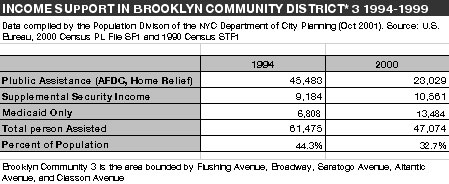
dismantling of the welfare state. Since 1990, the number of people
qualifying for Public Assistance in Community District 3 has declined
from 45,483 to 23,029.57 It would thus appear, at first sight, that
poverty decreased in Bed-Stuy. According to the Brooklyn Chamber of
Commerce report58, the percentage of households earning less than
$10,000 annually went from 35% in 1990 to 24% in 200059. Converting to
2000 dollars, we can restate this statistic above this way: In 1990
18,986 households earned less than $13,175 (in 2000 dollars) and in
2000, 12,729 households earned less than $10,000. It would seem
therefore that poverty in absolute numbers has not significantly
decreased. What has decreased, however, is the number of people
qualifying for welfare benefits. Indeed, from 54% in 1997, the rejection
rate for welfare in New York City rose to 75% in 1998.60
As social safety nets disappear, those who cannot, or do not want to
join the pool of minimum-wage workers feed the informal sector:
In their quest for survival, [agents] have connected with a more
flexible, ad hoc form of economic activity that, while reviving old
methods of primitive exploitation, also provides more room for personal
interaction. The small-scale and face-to-face features of these
activities make living through the crisis a more manageable experience
than waiting in line for relief from impersonal bureaucracies.61
 |
The informal street
vendors, who were all over Fulton Avenue until 2001, are the best
example of the vitality and negative externalities of the informal
economy in Bed-Stuy. The anarchic street market has now been “cleaned
up” by the authorities. Now, a couple of street vendors occasionally
sell sweaters or CDs, but it is nothing like it used to be. The street
vendors who had “been a permanent fixture on Fulton Street for decades,
have been relocated from the sidewalks near the intersection of Nostrand
Avenue and Fulton Street to a central location known as the Bed-Stuy
Coop Market, on the corner of Albany and Fulton Streets.”62 Some liked
the informal market and others hated it, but no one was indifferent.
I asked Jahdan, a local musician who has know the area for as long as he
can remember, how the neighborhood had changed in the recent years:
“Before, it was open to merchants, but they chased them out of Fulton.
Now they need an authorization. Street vendors are outlawed. Fulton
market sold products for the community. It was a strong economic,
social, and cultural space.” Delie, another young resident, makes the
same analysis: “Stopping the market was negative for the community
because it prevented people to make money legally.” He remembers
merchants selling clothes, watches, house utilities, everything
inexpensive. The market was bringing black people of different origins
together, interacting freely and openly. It was a lively cultural and
social scene.
Crystal and Charles, homeowners, disagree. They argue that street
vendors were often selling illegal products, and evading taxes. Charles
says that they were downgrading the street and preventing upper scale
businesses from coming to Bed-Stuy. It congested the street and made it
hard for people and cars to circulate. Crystal didn’t like its aspect.
It was messy and gave a bad image of the neighborhood. Its existence was
a disincentive to rent unoccupied storefronts. Finally, they argue,
street vendors constituted a disloyal competition against established
regular businesses.
Fulton First is an initiative of the Brooklyn Chamber of Commerce,
financed by the Fleet Bank, the Giuliani Administration, and the New
York City Department of Business Services, aiming at revitalizing Fulton
Avenue. This nearly $4 million plan will redesign the look and feel of
the Avenue “adding lighting fixtures, street furniture, structural
design elements, and traffic flow through the commercial corridor.”63
 |
|
About half of the tents provided by the Fulton First Initiative
to street merchants remain empty during the week. |
The first visible action
of Fulton First was the evacuation of street merchants by the police. A
new place was given to street vendors at the corner of Albany and
Nostrand. I have been there a few times during the week and it is pretty
quiet, to say the least. There were about 15 vendors and about half of
the stands were closed. I bought a dubplate mix-CD, a poster and three
pairs of socks for less than fifteen dollars. The market is organized
and orderly but the dynamism seems to be gone. Jahdan believes it was
better for the community when the merchants were not taxed and
controlled. “Let the people do it. People organize the market better
than the City.” Classical economics since Adam Smith agrees:
Smith believed that individual welfare rather than national power was
the correct goal; he thus advocated that trade should be free of
government restrictions. When individuals were free to pursue
self-interest, the “invisible hand” of rivalry or competition would
become more effective than the state as a regulator of economic life.64
The informal market of Bed-Stuy was a perfect example of what happens
when economic agents trade without regulations: creative chaos. Creative
because the free interaction of a multiplicity of vendors and buyers
created a self-sustaining economy out of nothing. Chaos because in an
uncontrolled market, no one is individually responsible for the mess
collectively generated. Street congestion is an example of negative
externality produced by unregulated street markets.
The informal economy is the purest expression of the free market. It
exists spontaneously wherever the formal regulated economy is not:
[i]t is only because there is a formal economy (i.e., an institutional
framework of economic activity) that we can speak of an “informal” one.
In an ideal market economy, with no regulation of any kind, the
distinction between formal and informal would lose meaning since all
activities would be performed in the manner now called informal. At the
opposite pole, the more a society institutionalizes its economic
activities following relatively defined power relationship and the more
individual actors try to escape this institutionalized logic, the
sharper the divide between the two sectors.65
The informal sector emerged in Bed-Stuy as a result of the breakdown of
mainstream economic and social institutions and poverty. In the same way
churches and other non-profit organizations filled up structural holes
in the social fabric, informal businesses emerged opportunistically (one
could even say organically) to fill the economic void. The informal
sector is thus firstly a response to the lack of a formal sector. If
there were a Blockbuster in Bed-Stuy, there would probably be fewer
video vendors in the streets. The informal sector is a product of
low-income consumers’ demand and low-income suppliers who cannot find
adequate sources of income in the formal sector.
On the supply side, the struggle for survival pushes “street
entrepreneurs” to reproduce and sell any kind of goods and services they
can sell. Informal street vendors would certainly prefer to have a
steady income, job security, a pension, and health insurance rather than
living in precariousness. However, the absence of economic opportunities
in the formal sector draws many to the informal sector. Sometimes, as
the quote above stated, regulations can keep people from setting up
legal businesses. For instance, some foreigners might not be able to go
through the procedures required to set up a legal business. Illegal
immigrants might equally be barred from regulating their business for
fear of being expelled. As Steve Mariotti, founder of the National
Foundation for Teaching Entrepreneurship, states:
The minority entrepreneur usually ends up being his own lawyer and
accountant ? The paperwork, cost, and confusion ? drive would-be
entrepreneurs away from certainty and down a slippery slope. They
develop contempt for the government, because they no longer see it as
their ally. That drives people into the underground economy, where there
are no contracts ? Once an entrepreneur moves into the balkanized a³and
chaotica³ underground economy, growing the business is not a viable
option. 66
On the demand side, the need for cheap goods and services feeds the
informal sector. Should a Blockbuster open in Bed-Stuy, it would need to
compete with street vendors selling pirated movies for five dollars.
Since the purchasing power of the local population is lower than in the
rest of the city, market forces naturally drive down the price of goods
and services closer to their marginal cost of production, and closer to
the subsistence level of the producer and distributor. Informal
entrepreneurs are good at fulfilling local demand at competitive prices.
The redundancy of many street businesses, such as CD and hat vendors
insures a quasi-perfect competitive market, which keeps the price near
the margin. Also, the highly open, unstable, and opportunistic informal
small-business environment of Bed-Stuy prevents the formation of price
cartels, and therefore prevents artificial price inflation. The informal
sector is thus closer to the textbook model of perfect competition than
the formal sector because in the formal sector, laws and regulations
artificially maintain the price of goods and services well above the
marginal cost of production.
Such a local economic base may well represent a mechanism for maximizing
the returns on whatever resources are available in the communities
involved. In this regard, they may contribute to stabilize low-income
areas by providing jobs, entrepreneurship opportunities and enough
diversity to maximize the recirculation of money spent on wages, goods
or services inside the community where the jobs are located and the
goods and services produced.67
Low-income consumers are not the only ones benefiting from the lower
prices of the informal economy. The middle-class itself benefits and
promotes the informal sector. Saskia Sassen notes that gentrifying
neighborhoods tend to have high levels of informal economic activity. A
source of informal activity is the rapid increase in the volume of
renovations, alterations, and small scale new construction associated
with the transformation of many areas of the city from low-income, often
dilapidated neighborhoods into higher income commercial and residential
areas ? The volume of work, its small scale, its labor intensity and
high skill content, and the short-term nature of each project all were
conducive to a heavy incidence of informal work.68
Craftsmanship is definitely highly demanded in Bed-Stuy, fueled by the
mix of a deteriorated housing stock and booming real-estate market.
According to the Department of Housing’s statistics, only 49% of
residential buildings are in good or excellent condition. This is the
second lowest score in Brooklyn after Bushwick. 37% of residential
buildings are judged to be in fair condition, and 13.5% in poor
condition, the second highest percentage after Brownsville Ocean Hill.69
There is plenty of maintenance work to do and, according to Charles,
brownstone owner; skilled labor is lacking or expensive. Informal
contractors are found from word of mouth, and are usually freelance and
self-employed. Revenues from house repair typically go undeclared.
Other sectors with high concentration of informal activity include “the
Gypsy cabs [which are] serving areas not served by the regular cabs,
informal neighborhood child-care centers, low-cost furniture
manufacturing shops, and a whole range of other activities providing
personal services and goods.”70
The informal sector is therefore not a problem in itself, but rather the
market solution to poverty and exclusion. The lower purchasing power of
many Bed-Stuy residents stimulated the growth of a market of
substitution. Informality reduces the cost of production and
distribution through tax evasion and proximity to the consumer. The
structural breakdown of economic and social institutions such as the
welfare state has also contributed to the expansion of the informal
sector.
Libertarian economists believe that the unregulated market is the best
way to maximize economic efficiency. The economy, they argue, is like an
ecosystem. Exterior intervention can only harm the perfect
self-organization of the free market. The problem is that, as Adam Smith
noted when he developed his invisible hand theory, the free market has
negative externalities such as labor exploitation and environmental
degradation. Moreover, the unregulated market can sometimes get stuck at
sub-optimal levels. Intervention is needed to help the market grow in
the desired direction. As Paul Krugman ironically puts it:
The economy is an ecosystem, like a tropical rainforest! And what could
be worse than trying to control a tropical rainforest from the top down?
You wouldn’t try to control an ecosystem, wiping out species you didn’t
like and promoting ones you did, would you? Well, actually, you probably
would. I think it’s called “agriculture.”71
This comment helps us to look at the informal economy of Bed-Stuy from
another angle. It should neither be curbed nor be seen as a ready-made
solution requiring no intervention. Its positive outcomes and negative
externalities need to be recognized and dealt with. Its most positive
aspect is that it generates income for many residents and provides goods
and services that would not otherwise be available or affordable to the
community. Informal workers and entrepreneurs should be assisted in
their effort to formalize their businesses. Negative externalities need
to be reduced as much as possible without taking away the positive
outcomes. For instance, the displacement of street vendors to the Albany
square destroyed the previous dynamism of the market. I will suggest
possible ways to preserve the benefits of the informal economy while
reducing its negative aspects in the last section of this paper.
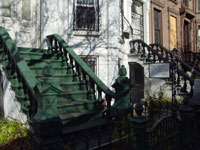 |
|
A renovated brownstone in Bed-Stuy, right next to a board-up
property. The sign reads: “Please keep your block clean, Filth
is lack of pride”. |
To conclude this section
on immigration and informal economy, I would say that, while illegal
immigrants are sometimes drawn to the informal sector by lack of choice,
the informal economy itself did not develop as a “consequence of the
large influx of Third World immigrants and their propensities to
replicate survival strategies typical of home countries.”72 But rather
as a result of the high poverty level existing in Bed-Stuy prior to
their arrival. Far from being a nuisance to the neighborhood,
immigrants, legal and illegal, are a source of growth and change.
Adequate policies are needed to maximize the positive input of
immigrants to the community. The striving small business environment and
the availability of cheap goods and services contribute to the
incremental development of the neighborhood. How many brownstones would
have been privately renovated if the only available craftspeople were
working at Manhattan wages? The self-help attitude of many poor
immigrants and natives has allowed the emergence of a solid economic
base in the neighborhood. The consolidation of this economic base has,
in turn, a stabilizing effect on the social environment, strengthening
social institutions and indirectly setting the context for in-migration
of higher income people.
Newcomers
In the next section, I will consider the factors that turned Bed-Stuy
into an attractive residential location, then portray some
representative newcomers. I already described how the incremental
economic development of the neighborhood, significant reduction of crime
and citywide economic growth improved Bed-Stuy’s physical and economic
condition. These factors, combined with a very tight citywide housing
market during the late 1990s, led an increasing number of people to
chose Bed-Stuy. The work of the Restoration Corporation as well as other
agencies, including the Department of Housing, also has to be accounted
for. The growing black middle-class willing to invest in a home has also
been instrumental in regenerating Bed-Stuy. All these factors contribute
to attract more newcomers. The atmosphere of the neighborhood is
changing. In the words of a local reporter:
On every block, around every corner, there’s a demolition or renovation
project going on; a dumpster filled with the innards of some long
abandoned, burnt out or recently purchased dwelling. (How many scaffolds
did you walk under today?) Those little quality of life issues, like the
refurbishing of those glass and crack vial gardens into viable
playgrounds, are finally being addressed.73
The Restoration Corporation has largely contributed to the appreciation
of the housing stock through its renovation and mortgages programs. In a
little more than thirty years of activity, “it has renovated 4,200 homes
covering 150 blocks and provided more than $250 million in home
mortgages and rehabilitation loans to neighborhood homeowners.”74 In
2000 there were 48,661 housing units in total according to the
Department of Housing Preservation and Development. The Department of
Housing has also contributed to stabilize the neighborhood’s low-income
households by building new affordable housing units, many of which are
located on Gates Avenue. All together, the Department of Housing has
rehabilitated or built more than 8000 housing units since 1986. Still
there is room for much more work. According to a 1999 New York survey of
the Department of Housing. Almost 38% of the housing units are on the
same street as buildings with broken or boarded-up windows, the highest
percentage in Brooklyn75. There is still much room for revitalization
and price rise. As most interviewees noted, the architecture of the
neighborhood is its main asset.
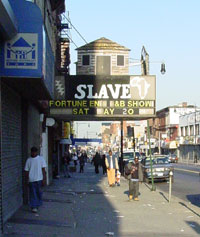 |
|
The Slave 1 Theater has been closed to the public for some time.
It only reopens occasionally for weddings and other private
events. Next to it is a fully equipped musical lounge that also
opens sporadically. |
Another asset of the
neighborhood, which might increasingly become an attraction to
newcomers, is the culture of its people. Bed-Stuy might lack economic
capital, but certainly not cultural capital. The many cultures and
lifestyles of Bed-Stuy are, as most interviewees noted, assets to the
community. They connect the neighborhood to the rest of the world and
bring in new ideas. Together with Fort Green, Bed-Stuy is a stronghold
of the Black American culture of New York. From history to
consciousness, the African-American culture developed a critical edge
that is often lacking in the rest of society. Through struggle and
survival, inner-investigation and self-affirmation, reaction and
creation, grew a strong sense of identity. This culture is transnational
by nature. Thanks to its dynamism and fertility it has grown branches
throughout the world. Artists and musicians from the US and the rest of
the world are increasingly looking at Bed-Stuy as a good location to
live. Diego’s story illustrates the crossing realities of the
neighborhood’s past and future.
Originally from Europe, Diego studied jazz at Berklee College in Boston.
After one year in New York he formed a band with players from Boston,
Manhattan, and Brooklyn. The two lead singers, Jahdan and Delie, are
from Bed-Stuy. In need of space for his studio and his family, Diego
decided to move to Bed-Stuy. For the price of a three-bedroom apartment
in Fort Green he was able to rent a duplex in a fully renovated
brownstone with garden on Green Avenue, right by the G train. It took a
few months for Diego and his wife to get used to the neighborhood. The
bohemian utopia has quickly given way to the reality of the ghetto. The
summer they moved in, three people were shot in their block. One of
them, a neighbor known by everyone on the block, was killed by seven
bullets shot by the police because he was supposedly waving a toy gun at
them. A version denied by some witnesses but validated by local
tabloids, which called the victim homeless although he lived with a
woman in a brownstone on the block.76 Despite this, and other incidents,
Diego and his family have integrated the neighborhood well. They know
most of their neighbors and feel at home.
 |
|
Noble Society. From left to right: Diego, Jahdan, special guest
Afu-Ra, Rory Jackson, Delie. |
Moving to Bed-Stuy was
strategic for Diego: not only is he getting more space to rehearse and
record with his band, but he is also getting closer to one of his main
sources of inspiration. Many famous black musicians and producers come
from Bed-Stuy, such as Notorious B.I.G. and Spike Lee. Music brought
Diego to Bed-Stuy. He knows that if he makes it in Bed-Stuy, he makes it
in Brooklyn; and if makes it in Brooklyn, he makes it in New York; and
if he makes it in New York? The waves generated by the black culture of
Brooklyn have crossed the oceans to Europe and Asia, and back.
Having grown up in the neighborhood, Jahdan, lead singer in Diego’s
band, doesn’t see Bed-Stuy as any different than any other neighborhood
in Brooklyn. His experience of Bed-Stuy has not changed much in the past
years. With his wife and son, he is part of the 49% of households
earning less than $25,000 a year.77 Recently, Jahdan found a job as a
janitor at a school in Queens. Starting work at 6:30 AM, he wakes up at
4:30 AM every day and earns minimum wage. His wife is unemployed, as one
tenth of the population of the Community District 3.
The Bed-Stuy of today makes it possible for Diego and Jahdan to meet and
create music together. The fusion of the rich local culture and the
motivation of newcomers is explosive. The cultural energy of the
neighborhood lies today in the mix of inspired local and international
artists, creativity, survival, space, informality, instability, change,
potentiality, and openness.
Asked if the neighborhood could be described as “international,” all
interviewees responded affirmatively except Crystal who said that
international was not the first word that would come to her mind to
describe the neighborhood. She sees the neighborhood as rather
homogeneous since the great majority of residents are black. She agreed
however, that the homogeneity of the neighborhood was more “facial” that
cultural, since the black community is very diverse. Jahdan also
observes that African descendents, dispersed around the world, come
together in Bed-Stuy forming an international cultural melting-pot.
According to Delie, Bed-Stuy, with its mix of Afro cultures, is a
breeding ground for contemporary black identity. He says that the street
market of Fulton was a scene where the international black culture of
Bed-Stuy could progress and develop.
None of the interviewees believed that other ethnicities coming in the
neighborhood were a threat to the identity of Bed-Stuy. Delie notes that
five years ago, when he moved in the neighborhood, there were no white
people on his Macon block. Now they are maybe six or seven. Crystal also
observes that there are more white people than in recent memories, but
she believes that the neighborhood will remain predominantly black. The
vast majority of homeowners and buyers are black. Jahdan welcomes the
arrival of other colors. “It had to happen. The interaction of different
people is good for communication and the economy. More white people
moving in means cultural exchange and big money movement.”
Jasper is a twenty-six years-old white American who moved into the
neighborhood about a year ago with three other friends from Switzerland
and Panama. Jasper feels “as comfortable in the neighborhood as a white
guy living in a black neighborhood can feel.” When he first moved in, he
was expecting some reactions from the people. But nobody ever gave him a
negative look. People were neutral. It might be due to the fact that he
is “pretty low-key.” “Some yuppie might be treated differently. It is
probably a matter of attitude.” He notes that the fact that he has been
involved in black-American culture for many years and traveling to
different countries certainly helped him to feel at ease in Bed-Stuy.
Jasper runs a music business specializing in hip-hop, funk, and reggae
records and DJ equipment. He says that if he had only been listening to
mainstream white rock his whole life, it would be different.
CÄline, one of Jasper’s Swiss roommates concurs, “I guess that when you
are real, people feel it.” Because she works in a Non-Governmental
Organization in the United Nation building, she has to be formally
dressed every morning. At first, she was worried about the perception of
other residents. She didn’t want to be seen as a rich white girl taking
advantage of the community. Asked if she considered herself to be
middle-class, she said, “it depends. In terms of income, I am probably
lower class! In terms of education probably middle-class, and in terms
of privileges probably upper-class because I have an excellent insurance
and I can travel.” At first people were wondering what she was doing in
the neighborhood. But any hostility would disappear as soon as they
would hear her French accent. Now she feels she has been completely
accepted. She knows all the shopkeepers, has conversation with everyone
on the block, and guys at the corner call her “Mamy.”
Jasper believes that there is definitively a plateau for white people in
Bed-Stuy. Each time he sees white people he “checks them out,” curious
about what they are doing here. Other white people in the neighborhood
interestingly “threaten your specialty in some ways.” But after giving
it much thought, he came to the conclusion that “diversity is a good
thing; whether it is blacks moving into white neighborhoods or whites
moving into black neighborhood.” However he doesn’t want to see in
Bed-Stuy what happened to many other neighborhoods of New York. “It is a
good thing that there is no more heroin in the East Village, but it is
boring now! White wash completely took over the neighborhood.” ”It is
important to have a good mix.” “Good things can happen because there are
more different types of people.” So what would the right mix be?
“Somewhere between here and Fort Green would be nice.” “The social
atmosphere of Fort Green is nice, but you get a croissant and coffee and
it is five dollars or something! ? They are trying too hard to be like
Manhattan, or some kind of bohemian expensive place.”
Eric is another new resident representative of the ongoing change in
Bed-Stuy. By lack of a better term, Eric could fall into what Richard
Florida calls “the creative class.”78 Eric recently moved with his
boyfriend into a three-story brownstone on Hancock Street. Their
building is occupied by a black writer on the third floor, a white
teacher from Chicago on the second floor, and them, two trendy black
gays on the ground floor. Eric was attracted by the physical character,
space, low rent and excellent transportation that the neighborhood
offers. The A train, five minutes away from his apartment brings him to
his Manhattan office in less than twenty minutes. Because of the
shortage of affordable housing and his lifestyle he had to think
strategically about his living location. Although at first he was much
less enthusiastic about living in Bed-Stuy than his boyfriend, he now
sees the potential of the neighborhood and likes it. Eric believes that,
in five years time, Bed-Stuy will be a new Clinton Hill. That is, a
trendy place to live. It seems that he was always at the right place at
the right time: Chelsea in the early 1990s, Fort Green and Clinton Hill,
in the mid-1990s, and now Bed-Stuy. Recalling when he and his artist
friends moved to Clinton Hill in the mid-1990s, he describes how no
social space existed for them there; they had to make it happen
themselves. Some of his friends opened cafes and shops in Clinton Hill,
which contributed to the transformation of the neighborhood. He would
like to see the same evolution in Bed-Stuy and hopes that new businesses
will open soon, particularly more quality food stores, bars, and
restaurants, offering the goods and services that he needs and replacing
some of the numerous 99 cents stores. He welcomes the arrival of
“educated blacks and brave white people.”
Eric likes the anonymity of cities, but quickly found out that he would
not be a stranger to the people living in his block. Now he begins to
appreciate the strong sense of community of the neighborhood. People
were welcoming, and he did not feel that being a gay couple was more
problematic in Bed-Stuy than anywhere else. He never had problems with
the crackheads at his corner either. Living in Brooklyn he learned to be
“street smart.”
Eric does not see displacement as a big issue in Bed-Stuy now, since
many people own their houses. Anyway, there is nothing he can do about
it, “owners decide the fate of the neighborhood.” “The new replaces the
old, that’s life.” There is still a lot of empty space that can still be
bought out by newcomers.
He doesn’t necessarily see the cultures of newcomers and these of the
locals blending together anytime soon. He says that the people who grew
up in Bed-Stuy are much more complaisant. He doesn’t quite understand
why the people on his block like hanging out on their stoop and doing
barbecue on the street side of their house so much, but he doesn’t
believe that living side by side will be a problem. New shops and stores
will not necessarily be aimed at the present population, he believes,
but integration is not indispensable. “There is enough room for
everybody.”
But is there? In the next section I will analyze the current trends in
housing and describe the kind of pressure exercised by the influx of
middle-class buyers and renters on the long-time residents of the
neighborhood.
Displacement
 |
|
Speculation in Bed-Stuy today is reminiscent of the 1920s when
brookers made fortunes turning out properties from white owners
to black owners. In contrast however most home buyers still are
middle-class black people. |
According to Gabriel, of
the Pratt Area Community Council (PACC), displacement is an issue in
Bed-Stuy. His job is to help residents keep their homes. There is not
much he can do for renters, but there are also plenty of brownstone
owners threatened by predatory lenders. Long-time brownstone owners are
under severe pressure to sell because they are often poor but sit on
equities that have hugely appreciated in the past ten years. Bed-Stuy
has the highest number of foreclosures in Brooklyn. Predatory lenders
get foreclosure lists and target owners, offering loans, which they know
the creditor will not be able to reimburse. Erica McHale, homeowner
counselor at PACC and currently dealing with about forty cases, exposes
a typical scenario: A cash poor widow owns a brownstone that her husband
bought thirty years ago for $20,000. She doesn’t have enough liquidity
to renovate the deteriorated roof of her brownstone. A lender knocks at
her door and offers to help. Not only can he provide the funds to
renovate the house, but he can also find people to do the job. He will
give her a $100,000 credit for complete renovation at 12% interest rate
(in some cases it was as much as 19%), and the works can start as soon
as next week. Unaware that her credit history would allow her to get a
much cheaper deal with a conventional lender, and that the loan she
contracted is unaffordable, she trusts the lender, and signs with her
house as a collateral. Very soon, unable to repay her debt, she goes
over foreclosure. The lender gets the house and resells it between
$200,000 and $400,000 (“those in exceptional condition [were] recently
selling for almost $600,000. At of the date of the report, real estate
listings for Bedford-Stuyvesant brownstones were as high as
$750,000”)79, making between 100% and 400% profit.
Subprime loans, that is,
loans made by non-conventional lenders are a good indicator of predatory
lending. A study by the Neighborhood Economic Development Advocacy
Project (NEDAP) has shown that the neighborhoods which were historically
redlined by bank (i.e.: non-white ones) are also the one with the
highest concentration of subprime loans:
There is a strong
correlation between concentrations of refinancing loans made by subprime
lenders and neighborhood racial composition. Likewise, there is a clear
relationship between the predominance of subprime loans and high
concentration of foreclosure action filed, by neighborhood.80
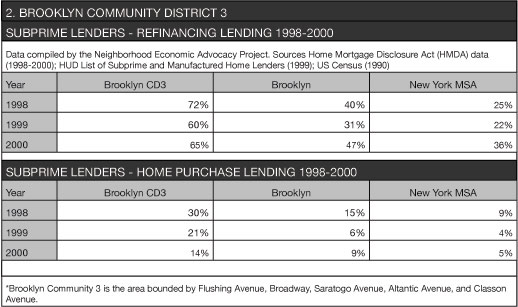
Subprime lenders made 30% of home purchase loans in Bed-Stuy in the year
1998, compared to only 9% in New York State. In 2000, Bed-Stuy also had
the highest share of refinancing loans made by subprime lenders in the
city, 65%81. Gabriel points out that the few non-profit organizations
counseling homeowners are overpowered by the dozens of speculators
operating in the neighborhood. Predatory lenders go door to door,
establish personal relationships with homeowners, and obtain deals with
people who could get cheaper loans elsewhere. Not all subprime loans are
predatory, however. They have in the past allowed people living in
redlined neighborhoods to borrow. Today they also serve people with bad
credit history for instance.
Another real-estate scam affecting first-time homebuyers
(disproportionately in communities of color) is preoccupying the PACC:
First time homebuyers are sold dilapidated houses with a home mortgage
loan designed to fail.
Most New York City
property flipping scams involve the same basic elements: real estate
companies buy distressed properties on the cheap and perform cosmetic or
no repairs. These “one-stop shops” then offer a package of services to
borrowers who believe their interests are protected because the loans
are insured by federal FHA insurance a³but instead, appraisals are
inflated to provide huge profits to sellers, loan applications are
doctored, home inspections are faked, and attorneys purportedly retained
to protect borrowers watch while they sign their rights away. In one New
York City case, a real estate flipper purchased a devastated property
for $20,000 and sold it 14 months later to an unwitting Jamaican
immigrant grandmother and first-time homebuyer for just under
$200,000.82
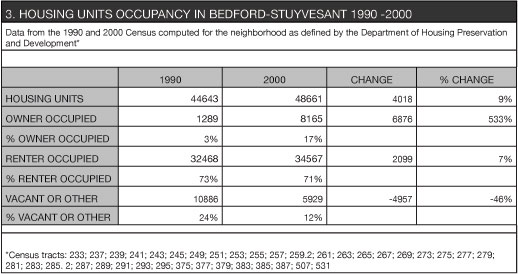 |
As during the 1930s, the
current gap between newcomers and current owners put pressure on
Bed-Stuy’s real-estate market. People have been buying and moving in
massively in the area in the last ten years, driving up the price. A
report prepared for the Brooklyn Chamber of Commerce explains the rising
real-estate market of the past ten years as follows:
Factors driving this trend include pricing for brownstones in other
neighborhoods throughout New York City (including Clinton Hill, Fort
Greene, Park Slope, etc.), general residential real estate and economic
trends throughout the metropolitan New York City area, activity in the
stock market, and favorable interest rates.
Buyers consider brownstones within the Bedford-Stuyvesant area due to
the high quality of the brownstone residences, superior building widths
(sometimes 30 to 40 feet, compared with more narrow buildings in other
parts of the City), excellent subway access to Manhattan, the character
of the neighborhood and its brownstone blocks, and significant recent
decreases in crime.83
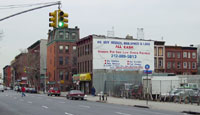 |
|
Sign on Bedford and Green Avecnues: It could not be clearer.
Your brownstone is wanted. |
According to the census
the number of owner occupied buildings has increased by 633% from 1289
in 1990, to 8165 in 2000. Meanwhile, the number of renter-occupied units
increased from 32467 to 34567. In addition, new housing units have been
built during that period, notably by the Department of Housing. The
total number of housing units went up from 44643 to 48830.84 The demand
largely outstrips the supply, which inflates prices. PACC staff observed
a change in the people attending the first time homebuyers’ workshops
they organize. “Since last summer a lot more Manhattan people come to
the workshops. Backgrounds are very diverse, from working class to PhDs,
blacks, white, Asians.” The brownstones and excellent access to public
transportation attract them. It is a mixed blessing: business do better,
more upscale businesses and restaurants start opening, which lifts up
the neighborhood, but it is not necessarily a good thing for low income
residents, particularly renters, who might get priced out. Assemblywoman
Robinson, however, estimates that, while displacement is one of the big
issues the neighborhood faces right now, rents need to go up a bit.
According to the Department of Housing the median contract rent and
median gross rent are the lowest in Brooklyn at $495 and $515
respectively. She is quick to add control mechanisms such as rent
control, moratorium on conversions, and public housing are needed
a³especially for senior residents. She also points out that many housing
units are rent controlled in Bed-Stuy. The Department of Housing survey
confirms: 37.5% of renter occupied units is unregulated, 25% is public,
21,4% is stabilized, 13.1% is under some other kind of regulations, and
rent-controlled units are “too few to report.” It appears thus that a
little more than a third of the housing units are unregulated, and
almost two third are under some sort of regulation since public housing
are rent controlled by definition and stabilization is a form of
rent-control.
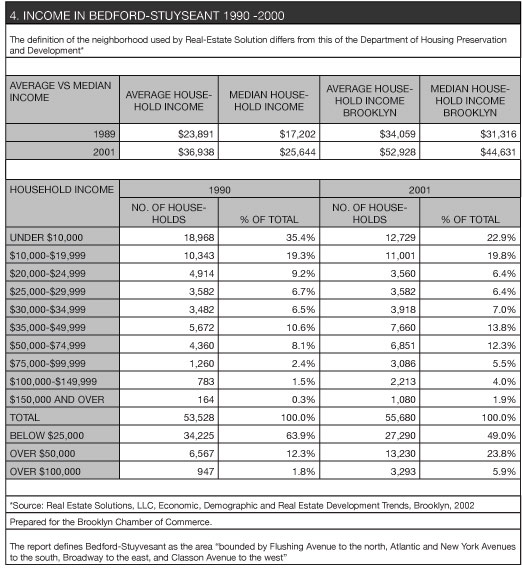 The demand
for rental apartments within the Bedford-Stuyvesant area has momentarily
decreased since the fourth quarter of 2001, but that most probably
reflects a citywide 9-11 effect rather than a change in trend. As the
neighborhood keeps attracting new people, uncontrolled rent will go up
and many current residents will be displaced, in the words of resident
Baye McNeil:
The demand
for rental apartments within the Bedford-Stuyvesant area has momentarily
decreased since the fourth quarter of 2001, but that most probably
reflects a citywide 9-11 effect rather than a change in trend. As the
neighborhood keeps attracting new people, uncontrolled rent will go up
and many current residents will be displaced, in the words of resident
Baye McNeil:
With gentrification, many people will be dislocated, priced out, razed
by this economic bulldozer. Eventually, and that right soon, the
underclass, the impoverished, which means many of our everyday people,
will simply have to vacate the Stuy (Can’t picture it? Remember Alphabet
City? Take a look at the Lower East Side now).85
Gentrification is a politically loaded word. Originally describing the
immigration of middle class into working class neighborhood, the term
took a racial connotation. As Baye McNeil puts it “in Bed-Stuy, as is
the case in Fort Green, Harlem, and inner cities all over the country,
in fact, it’s also a race issue because in America the vast majority of
the middle class is still white.” So who is gentrifying Bed-Stuy and who
is being displaced?
I asked Assemblywoman Robinson if she would believe me if I said that
income doubled in the neighborhood in the past five years. She responded
affirmatively without hesitation. In fact, I learned later, the income
did not exactly double in five years, but it still significantly
increased. The average household income went up from $23,819 in 1989 to
$36,983 in 1999, and the median income went up from $17,202 to $25644.
During the same period, the real purchasing power for households
increase by $1,473, which is more than twice as much than Brooklyn as a
whole ($629 increase). “ It should be noted that average household
incomes are higher than the median incomes ? during 1989 and 2001. This
generally occurs when the average is distorted by a few households that
have relatively high incomes.” Indeed, what doubled is the percentage of
households earning over $50,000 a year; it went from 12.3% in 1990 to
28.3% in 2000. And the number of households earning over $100,000 went
from 947 to 3,293 (a 350% increase). Therefore, the increase in average
income is probably due more to a rise of the higher earners than to a
harmonious rise in income along the whole spectrum.
The same report notes also that in Bed-Stuy, between “1990 and 2001, the
racial composition ? varied insignificantly.”86 The racial homogeneity
of the Stuy is thus still intact. But anyway, homogeneous is not an
adjective that can really be used to talk about Bed-Stuy with its
diverse population from every American states, Jamaica, Trinidad,
Barbados, Guyana, Puerto Rico, Haiti, Burkina Faso, Ivory Coast, Mali,
Morocco, Tunisia, Indonesia, Malaysia, Bangladesh, France, and Italy,
not to mention the 115 Russians and 69 Polish who live in the Bed-Stuy
segment of Lee Street. Apologies to the numerous nationalities I missed.
Assemblywoman Robinson confirms. “The community always had new people,
There is no problem with newcomers of different race and ethnicity.
Bed-Stuy is a loving community.”
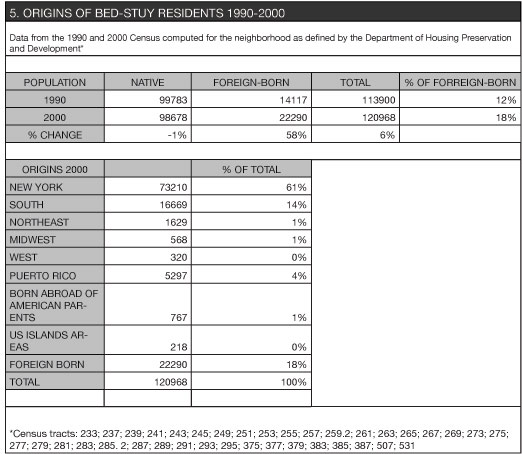 Therefore,
if white people have increasingly started moving in recently, they are
not (yet) the reason for the important rise in income and purchasing
power of the neighborhood. The rise in income is mainly due to the
return of the black middle-class. Crystal, owner of a bookstore on Lewis
Street and member of the Brownstoners of Bed-Suy association, observes
that “most recent homebuyers are black and most white people living in
the neighborhood are renting.” She doesn’t see gentrification and
displacement as an issue. Although she personally knows a couple of
people that have been displaced, she doesn’t think that it is
representative of the current trends. She concedes that displacement is
perceived as a threat in the neighborhood, but does not believe that the
threat is real. “Actually, she says, the neighborhood in undervalued.”
Crystal was born in the neighborhood, then lived away for some time, and
came back to the neighborhood in 1995 and bought the brownstone right
next to her father’s. The neighborhood changed during the 1990s when new
people bought homes and moved in alongside investors, who were buying,
renovating, and selling. She recalls how every block had construction.
Therefore,
if white people have increasingly started moving in recently, they are
not (yet) the reason for the important rise in income and purchasing
power of the neighborhood. The rise in income is mainly due to the
return of the black middle-class. Crystal, owner of a bookstore on Lewis
Street and member of the Brownstoners of Bed-Suy association, observes
that “most recent homebuyers are black and most white people living in
the neighborhood are renting.” She doesn’t see gentrification and
displacement as an issue. Although she personally knows a couple of
people that have been displaced, she doesn’t think that it is
representative of the current trends. She concedes that displacement is
perceived as a threat in the neighborhood, but does not believe that the
threat is real. “Actually, she says, the neighborhood in undervalued.”
Crystal was born in the neighborhood, then lived away for some time, and
came back to the neighborhood in 1995 and bought the brownstone right
next to her father’s. The neighborhood changed during the 1990s when new
people bought homes and moved in alongside investors, who were buying,
renovating, and selling. She recalls how every block had construction.
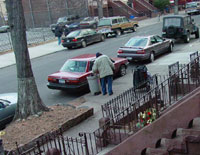 |
|
Someone, who probably comes from the homeless shelter of
Atlantic and Nostrand, is looking for food in the carbage of
Macon Street, one of the better-off streets in Bed-Stuy, where
SUVs, BMW and other nice cars are regularly stationed. |
Pratt professor Frank
DeGiovanni uses the number of conversions of rental properties to
owner-occupancy as an indicator of the level of displacement. According
to my evaluations, in 1990, 2.8% of housing units were owner-occupied,
72.7% were renter-occupied, and the remaining 25% were vacant or
squatted. In 2000, 16.8% were owner-occupied, 71% were renter-occupied,
and 12.5% vacant. The total number of renter-occupied units increased by
2099. The total number of housing units increased by 4018 and the number
of vacant units decreased by 4957, which represent a nearly 50% decrease
(see chart 3). Although I do not have the data for the exact number of
conversion of rental property to owner-occupancy, we could infer that
that new owner-occupied units come not only from conversion from rental
property, but also to a significant extent from the rehabilitation of
vacant units and the construction of new ones. That might mean that
despite a dramatic rise in home-occupancy in the past decade, the
incidence of displacement has remained relatively low. Revitalization of
vacant units and new constructions have increased the offer for rentals,
which has kept rents low despite rising demand (as I indicated earlier).
The construction of new affordable housing units by the City as well as
non-profit organizations is another explanation for the increase in
housing units and stability of rents. New developments are still coming,
such as the Saratoga Square housing developments adding more than a
thousand units to the neighborhood. With its very high concentration of
affordable housing, it is likely that Bed-Stuy will retain its
low-income population even if the rents of uncontrolled housing units
start increasing significantly. Moreover, with two of the largest
homeless shelters in New York on Marcus Garvey Boulevard and Atlantic
Avenue (which has a total of 350 beds87), as well as three methadone
centers, Bed-Stuy will stay the residence of some of the poorest New
Yorkers for some time.
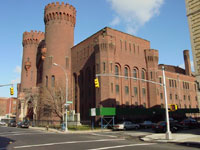 |
 |
|
Military fort converted in housing shelter on Marcuse Garvey
Boulevard. The Altantic Avenue shelter is the biggest in
Brooklyn with a total of 350 beds. |
Given that Bed-Stuy rents
are still the lowest in Brooklyn it is probable that most displaced
people stay in the neighborhood. Not only does Bed-Stuy seem to have
easily absorbed newcomers, but it still has room for more. If these
deductions are correct, the case of Bed-Stuy a³so fara³ would confirm
Whyte’s argument that gentrification is not a threat to poor
neighborhood:
Those who hailed the possibility of a middle-class revival of
neighborhoods are unhappy now it has become a reality : They say that it
is elitist; that it has been at the expense of the poor; that the
displacement of them by the middle-class people has broken up once
stable neighborhoods and ethnic groups ? Check the year-by-year changes
in the neighborhood households and you will find very few cases of
direct displacement; that is, a renter going out of the door as a
homeowner comes in ? Of all moves the Department of Housing and Urban
development has estimated, only 4 percent are caused by displacement ?
The implicit assumption of the gentrification concept is that the chief
threat to housing for the poor is the improvement of the neighborhoods.
The problem is the opposite. The chief threat is the deterioration of
neighborhoods. The poor are not being hurt by middle-class investment.
They are being hurt by disinvestment a³by landlords and owners who let
buildings go to rot, who walk away from them, who torch them.88
If neighborhood feels more “middle-class” now than five or ten years
ago, it might be because more middle-class residents have moved in, not
necessarily because more poor people have moved out. Nonetheless,
revenues have significantly risen as we saw before This can mean two
things: either people have really been displaced, or more people got
jobs. The evidences are contradictory and I cannot confirm any of the
hypotheses. Probably that both are partly true.
The sharp decline in the percentage of people receiving income support
in Community District 3, probably only reflects the disinvestment of the
Welfare state. The unemployment rate, which has fluctuated between 9%,
14% and 10% from 1990 to 200189 suggests that the level of poverty
stayed stable, but the unemployed are only a part of the poor: an
increasing number of the poor are working. In the whole country, “more
than a third of those requesting food assistance were employed” in
1999.90 Indeed, poverty rose in New York City during the 1990s. So did
income polarization as the widening gap between average income and
median income attests.
Moreover, the revitalization of the housing stock by newcomers and
better-off homeowners might indirectly push out poorer homeowners,
through its effect on taxes. The property tax system is doubly unfair to
poorer homeowners. They are firstly determined by real-estate value of
the whole neighborhood. Therefore, as owners improve their property the
value of the neighborhood increases, and the cost of keeping one’s
property increases for everyone. Property taxes also take into
consideration the number of rented units in each property. Many
non-renovated brownstones are still divided into single room occupancies
and rented by the week very cheaply. Therefore a senior house owner
renting six rooms for $100 a week pays more taxes than a recent owner
who has renovated his brownstone and divided it into four apartments,
each of which he rents for $1000 a month. Particularly affected are
older homeowners:
All are faced with rising property taxes. Perry, Faulkner and others are
particularly concerned that senior homeowners on fixed incomes will be
overwhelmed by higher taxes and forced to sell their homes.91
 |
|
Where are the owners of these buildings? Maybe they are too poor
to renovate or maybe that they are waiting for better times to
sell them. |
Displacement doesn’t need
to be an issue in Bed-Stuy right now. With 12% of the housing units
remaining vacant, there should be room for more people. However, given
that in 2000 there were 5929 vacant units and only 670 were sold, it
seems that many investors are keeping their housing stocks for later,
when the market price will be higher.
Real-estate speculation inflates the market because the fewer the houses
on the market, the higher the price. As the price of houses increases,
lower-income buyers get priced out. Real-estate speculation is therefore
a direct cause of gentrification and displacement. The facts confirm: in
Bed-Stuy, “market participants indicated, ? the majority of purchasers
currently originate from outside.”92 Another negative externality of
speculation is an under optimal use of space. Inactive land and
unoccupied buildings, at best, do not benefit the community, and at
worst, constitute a cost. One building with boarded-up and broken
windows depreciates the whole street. Another example is unoccupied
storefronts. The revenue that a business could generate by using it
represents the opportunity cost of inoccupation for the community. Many
real-estate operators are currently surfing housing market appreciation.
In an appreciating market, some traders choose to keep their housing
stock vacant so they can be traded fast. Having renters makes it longer
and more costly for owners to sell their properties, particularly if
they are long-term renters who might refuse to leave the premise. It
actually completely changes the nature of the investment. Being a
landlord means committing to the renters, and relatively low, steady
income. Real-estate traders, on the other hand, use housing property as
financial assets, which can yield high returns on short-term operation.
Empty stocks are more fluid and tradable. Moreover, in an appreciating
market, time is money. In comparison to other neighborhoods, as Crystal
noted, Bed-Stuy is still undervalued. It thus makes sense for operators
to keep their property out of the market until they judge the price is
high enough to sell. Keeping the housing stock not rented might be
individually rational for operators, but represents a cost for the
collectivity, both economically and socially.
For the community, the short and middle term opportunity cost of keeping
housing units unoccupied is the rent not generated, the money not spent,
and taxes not paid by the potential tenant. In addition, the artificial
shrinking of housing supply (rent and sale) caused by speculation,
together with the present high demand for housing puts an upward
pressure on the cost of available housing stock. Higher rents for
current residents mean less money to spend in local businesses.
Economic polarity has increased in New York during the past ten years.
This means that there are more people at the two extremes of the
economic spectrum. Both the number of low-income renters and the number
of high-income buyers have increased. Bed-Stuy still has a majority of
low-income residents, and since there are many higher income buyers, it
makes more economic sense for investors to keep their properties empty
than to rent them.
Planning Proposals :
Public Space and Social Integration
In the coming years, Bed-Stuy will have an increasingly varied
population, both in terms of income and origins. At the same time, the
neighborhood has a strong identity, both architecturally and culturally.
Ideally, all residents should have a feeling of belonging to the whole
community as well as to their particular sub-communities. The ideal
situation would be a strongly integrated heterogeneous community, where
the differences of each would be respected and valued, while a sense of
belonging to the community cuts across cultural particularities. To some
extent this is already the case in Bed-Stuy. However spaces where people
can meet and bond are lacking. Right now, the only place where everybody
meets is the street. Public places should be developed. There few green
spaces and playgrounds in Bed-Stuy, and space is lacking for park.
However, there are many vacant lots, which are fenced or serve as
junkyard. These “leftover” spaces could be converted into little
squares, reminiscent of those of European medieval towns. Each one would
have its own design and identity. These public squares can serve
multiple purposes. They can be playground for children; meeting points
for teenagers and adults; extended sidewalk cafes; hangout spots for the
elderly. They could also be used for block parties, public
announcements, or neighborhood flea markets or cooperative farmers’
market on the weekends. Rather than leaving car bodies rot and weed grow
behind fences, they could simply be cleaned up, and left to the
imagination of residents. For instance local artists could paint murals
around them, or if some funds are available from the city built a
sculpture or even a fountain. The idea would be to reinforce the sense
of the place and the interaction with the neighbors. Some spaces are
rather large and could be used for bigger events. For instance there is
a large empty space behind the Adult Learning Center of Nostrand,
between Macon and Hashley. It is currently being used as a daytime
parking lot. This space would certainly be better used as Public Square
or playground for kids.
 |
|
All too common streetscape in Bed-Stuy: visual disgrace and vast
of space. |
Some of the streets are
also underused and could be made pedestrian. People could then extend
their activity further on the street. Bed-Stuy has many residents under
driving age; they should be able to ride their bikes and rollers without
risking getting hurt by a car on the road, or hurting an elderly
resident on the pavement. The grid pattern makes all streets redundant,
therefore, even if a third of the smaller streets were barred, traffic
would still flow. Bed-Stuy doesn’t need to be a suburban car paradise,
thanks to its excellent access to public transportation. Making bike
lanes on the main arteries should also encourage the use of bicycles.
The security would be increased by a public takeover of the street and
increased interaction. If the community was tight and spending more time
in the street, drug dealers would not dare standing at block corners.
Culture & Creative Sectors
All interviewees believed that new shops, cafes, and restaurants should
open in Fulton. The Real Estate Solution's report estimates that the top
five most needed businesses on Fulton are: Family style restaurants,
coffee/bakery/cafes, video store, CD/record store, and cards/gifts
stores. Overrepresented businesses are: Nail and braiding shops, beauty
salons, variety stores, small grocery stores, discount stores of any
kind.93 I generally agree with the report, but I would add quality food
stores in the top-five list. There are presently only two health food
stores on the Fulton strip, forcing consumers to go down to Fort Green
and Downtown Brooklyn for more choice. Cafes are needed not only as
commercial space, but also, and more importantly as social spaces. I
would also add bars and dancehalls to this category.
Eric, Celine, Jasper, Jahdan, Delie, and Charles all mentioned the need
for cultural and social spaces in the neighborhood. Music for instance
is a very important part of the local culture, but there are few venues
where residents and people from other neighborhoods can listen to music
and dance. Nighttime activity would stimulate the creative sector and
make the area more attractive to artists and musicians. It is very
importantly that the population under 21 years old not be forgotten from
the social and cultural scene94. The 15-21 years old usually have more
time that any other segment of the population for social activity. It
would be preferable to see the youth in legitimate social spaces than
bored in the street. Between childhood and adulthood, much of the
identity gets constructed. Culture plays a very important role in this
process. I would suggest the creation of publicly financed cultural
centers for teenagers that would provide activities such as parties,
music, sport, art and holiday camps to other countries. These cultural
centers would be excellent places to recognize young talents and
encourage them to develop their skills. Similarly, some activities such
as computing, cooking, photography, drawing or writing could be designed
to prepare teenagers to choose an educational or professional path. New
York City has one of the highest percentages of creative industries in
the country and attracts talents from all over the world. I am sure that
the creative capital of Bed-Stuy is currently under-exploited.
Alongside the revitalization of the neighborhood’s cultural life through
bars and cafes, cultural industries should be particularly encouraged to
open. I am thinking for instance about music labels, recording studios,
fashion and graphic design studios, painting and sculpture ateliers, and
Internet start-ups. These small-scale businesses could fill up many of
the empty floors on top of the existing retails on Fulton for instance.
Attracting this kind of industry to Bed-Stuy necessitates strong
political will and outreach effort, as Crystal pointed out. But the
availability of large spaces, low rents, excellent access to public
transportation, and the vibrancy of street life, are assets that should
not be overlooked.
 |
|
Creative chaos: Marginal neighborhoods tend to attract artists
thanks to their cheap rents and inspirational edge. |
In addition to the effort
needed to attract creative businesses from outside, talented local
artists should also be promoted through grants, awards, sponsorship, or
availability of free space. The cultural centers I was mentioning
earlier could incorporate some of this to their activities. For instance
they could have a recording studio space temporarily available for
groups or individual artists as well as exhibition space. Rehearsal
space for musicians would also greatly be useful. Other cultural venues
currently lacking are movie theaters, concert halls, and bookstores.
The development of a
vibrant creative scene in Bed-Stuy would greatly contribute to changing
its image in the eyes of the broader population. Moreover, the larger
public is ready to see the emergence of a vibrant scene for black
culture in New York. The location of Bed-Stuy, at the center of a
communication node of roads, trains, subways, and buses, its exceptional
architecture and communal atmosphere and its proximity to Fort Green,
are comparative advantages that would help transforming it into a strong
cultural hub. To some extent it already is. Delie calls the intersection
of Fulton and Nostrand Avenues, where the A line Nostrand station is
located, “Little Medina” or “Little Brooklyn,” because it is the “second
nucleus of Brooklyn after Downtown Brooklyn.” Therefore, this proposal
does not require starting everything from scratch, but rather
capitalizing on what already exists and helping it grow. If successful,
a scheme to boost the social life and cultural activity of the
neighborhood would certainly help attracting visitors.
Image & Tourism
As Crystal suggests, tourism should be used as a source of income for
the neighborhood: “Everybody wants to visit Harlem now. Bed-Stuy has at
least as much to offer.” The architectural stock alone is a good enough
reason to visit Bed-Stuy. The neighborhood would need to expand other
tourist activities. Investment in cultural and commercial development
would certainly yield good returns if they were relayed by a good
campaign of promotion of the neighborhood. Bedford Stuyvesant doesn’t
exist in travel guides yet, but soon they should encourage tourists to
visit its charming tree-lined streets and brownstones; to shop in its
specialty shops and markets selling “authentic” craft; eat at its
delicious Caribbean and soul food restaurants; and listen to gospel in
its historical churches. The success of the tours organized by the
Brownstoners of Bedford-Stuyvesant, featuring the most beautiful
buildings of the neighborhood, attest of the potential for tourism: The
“recent tours have sold out with over 900 tour goers.”95
Commerce & Retail
Development is often reduced to economic growth. It has been a mistake
of western economists to believe that productive techniques could be
imported and yield the same result than where they have been developed.
Development is actually the development of productive methods and
techniques. Believing that this stage can be bypassed is deceptive. How
can development arise without development? In Jane Jacobs words:
To sell or give the trappings of progress to backward economies under
the pretense of bestowing development fails to work not only because the
development, such as it is, takes place somewhere else entirely, but
because the transaction denigrate and discourage rather than foster a
basic practice of all true and creative development work.96
Jane Jacobs made this commentary, thinking about the economic
development of cities. But at a different scale, it is relevant to the
economics development of neighborhoods. Local development goes beyond
economy. The cultural, social, and material dimensions of a place have
to be meshed together and stimulate each other. Only this complete and
integrated development can build solid local institutions. Therefore
development is always local, even though it relies on trade, exchange,
and inspiration from the rest of the world. To have something to trade,
localities must develop their comparative advantage. But the comparative
advantages of Bed-Stuy are more than “strategic location, integration
with regional clusters, unmet local demand, and human resources”, the
four categories proposed by Harvard economist Michael Porter. As we saw
Bed-Stuy, has a very important cultural capital, which is endlessly
sustained by the influx of immigrants and newcomers.
The common economic wisdom on developing inner cities is to create jobs
by attracting big businesses. A second supermarket would not be too much
to serve the nearly 150,000 residents of the neighborhood. However, it
would be probably misleading to believe that a massive influx of big
chains from outside will do much good to the neighborhood. Attracting
exterior businesses might be a good thing for the neighborhood if it
does not come at a cost to local businesses. Bed-Stuy has a very dynamic
population and greatly needs to consolidate its economic base. The main
economic strength of the neighborhood, apart from real estate, is
retail. Small retail business is a highly competitive and creative
sector. Retail establishments typically start small and incrementally
develop themselves, through invention and innovation. As they struggle,
improvise, imitate, and produce, they develop a local “savoir-faire”; a
particular economic culture. This organic and incremental growth is
economic development. Improvisation, explains Jane Jacobs, fosters a
state of mind essential to all economic development, no matter what
stage development has reached at the time. The practice of improvising,
in itself, fosters delight in pulling it off successfully and, most
important, faith in the idea that if one improvisation doesn’t work out,
another likely can be found that will. Invention, practical problem
solving, improvisation and innovation are all part and parcel of one
another.97
Big retail businesses might generate jobs, and therefore should be
welcomed, but they do not develop the neighborhood. Bed-Stuy is very
lucky to have such a high number of small businesses and such a high
level of motivation among new and life-long residents. That is not the
case in many other inner Cities, where people are as depressed as their
economy. If human resources are one of the comparative advantages of
Bed-Stuy, let it be a resource and not only a labor force. The energy
does not lie uniquely in the people capacity to “fill jobs” and execute
repetitive tasks, but also and more importantly in their capacity and
willingness to lift themselves up and create jobs.
What is true for the development of cultural activity is also true about
the development of commercial activity. Fulton Avenue from Saratoga to
Albany could become as busy as Downtown Brooklyn. As a matter of fact,
it was busier than Downtown Brooklyn when it had the street market.
Important perpendicular avenues such as Nostrand and Bedford equally
have considerable potential for development. Right now Bed-Stuy’s main
commercial artery is for the most part a collage of discount stores,
bodegas, fast food or take-out restaurants, beauty shops and nail
salons, dotted with residential, abandoned or underutilized buildings,
with graffiti and placards spattered about. It pales in comparison to
other major commercial strips throughout the city. Though the existing
businesses meet certain needs of the community’s residents, many goods
and services readily available in other communities simply aren’t
available on this stretch of Fulton Street within the borders of
Bed-Stuy. These circumstances have inclined neighborhood residents to
take their purchasing power outside the community.
Sharonnie Perry, Chair of Community Board 3 and District Director to
Congressman Ed Towns, spoke to the lack of commercial diversity and the
resulting consumer aversion to Fulton Street when she said, “There are
roughly 490 stores on Fulton Street from Franklin Avenue to Utica
Avenue. Close to 65 of them are nail salons. Some of these other stores
don’t even sell second-hand goods. They sell the rejects of the rejects.
[That’s why] you won’t find too many of the homeowners in Bedford
Stuyvesant shopping on Fulton Street, unless they’re going to Pathmark.”
98
No doubt new stores have to open. There is however a contradiction
between the desire to see upscale shops on Fulton and the willingness to
promote local business. Local vendors are mostly selling low-income
goods for other low-income people. Homeowners still represent a minority
of residents. While it is important to provide local shops and services
for the quarter of household that have over $50,000 in annual income, it
is doubly as important to keep the retails that serve the half of
household which have an annual income under $25,000. The development of
the Fulton should involve a good mix of trickling up and trickling down.
That is, small businesses developing incrementally and new upscale
businesses opening up.
 |
|
Typical stores on Fulton Avenue. |
The chaotic street market
of Fulton Avenue had the advantage of being open to all traders. While
coming back to the street market as it was would be a step backwards,
the needs of the poorest should not be dismissed. My proposal therefore
would be to organize an official flea market on Saturday or Sunday on
the segment of Fulton between Bedford and Marcy. The street would be
closed to cars. Vendors would rent their space to an independent
organizing committee (made of street vendors representative as well as
other stakeholders and community activists), which would use money
collected for security, street maintenance (especially at the end of the
market day), and promotion. Given the number of skilled craftspeople,
and cultural heterogeneity of the neighborhood, a well organized, well
run, and well marketed flea market in Bed-Stuy might attract visitors
from all over the borough and city. Bed-Stuy even has the potential of
hosting a world class market such as Porto Bello Market in London and le
MarchÄ aux Puces de Saint-Ouen in Paris, which has more than 120,000
visitors per weekend. If it attracts people, it will also benefit
shopkeepers in the street. Moreover, a flea market would preserve the
communal character of Bed-Stuy.
Attracting “big name retailers” is desirable, because they will create
jobs and help satisfy the local demand. Making Bed-Stuy, or part of it,
an economic empowerment zone, would be a good step in that direction.
Here too, great effort should also be made to improve the image of the
neighborhood. Bed-Stuy is currently out of the map of possible business
locations. Political leaders, Crystal argues, should be more
aggressively attracting companies and big retailers in the neighborhood.
Attracting too many big retailers, however, could have perverse effects.
First, those businesses take a larger portion of their revenues out of
the neighborhood compared to smaller businesses more likely to be run by
local residents. The revitalization of Fulton Avenue will probably
increase commercial rents and make it harder for “community-owned
restaurants, movie theatres, specialty shops and the likes” to develop
and hold their ground, and attract businesses “like Starbucks and Disney
- that have traditionally meant the end of the cultural uniqueness of a
community.”99 Mr Senckler from the Restoration Corporation equally warns
against the hills of commercial gentrification. “In Harlem the
businesses are no longer owned by the people living in the community.
Dollars flow out, there is little reinvestment.” Therefore, a right
balance has to be found between promoting the incremental development of
small business from within and attracting chain retailers from outside.
Existing microcredit programs and assistance to small, family businesses
should go on and be expanded. Programs such as Restoration’s Trickle-Up,
which provides grants for home-based businesses, and the Business
Development Center, which provides business development training, go in
this sense. The New York City Partnership’s ANCHOR program developed
tens of thousands space for “quality retail tenants” along Fulton and
Saratoga, at the Brownsville-Ocean Hill extremity of Bed-Stuy. Shop
owners are exempted from real estate taxes and the commercial rent tax.
This developmental aid is obviously very welcomed as long as residents
can sustain these new retails. An evaluation of the outcomes of the
ANCHOR program, completed in 1999, would help designing future
development strategy for the area.
Beyond retail, Bed-Stuy could promote the development of other sectors.
Fulton Avenue is not the only space for businesses in Bed-Stuy. Atlantic
Avenue for instance has thousands of square feet of warehouse space that
would be more productively used as offices and manufactories. The
neighborhood has space and labor power in abundance. The failure of the
IBM plant more than twenty years ago does not mean that this type of
businesses cannot be successful in Bed-Stuy as Crystal points out.
Giving tax breaks to big businesses in order to attract them to the
neighborhood with the assumption that jobs and other benefits will
follow is good strategy. Incoming big businesses should also be called
on to deliver direct benefits to the community such as: improved wages,
health benefits, and childcare for instance.100
Infrastructure & Human Capital
Although immigrants have a positive impact on the neighborhood, they put
a stress on infrastructure, as Mr Senckler pointed out. Schools,
sanitation, housing, and transportation are stretched. Political
motivation is needed to address this issue, says Mr Senckler. There is
no doubt that Bed-Stuy needs massive investment in infrastructures.
Subsidies should be attributed in line with demographic changes, taking
clandestine immigrants into consideration. It is great time the Federal
Government starts using adjusted census counts:
So far, only the unadjusted official count has been released, and about
136,000 New Yorkers will go uncounted. This loss translates into fewer
legislators representing the city in Albany and Washington, and less
federal and state aid. Indeed, when one thinks of the New York City
undercount over the decades, the impact is billions of dollars in aid,
and an incalculable loss of political power101
Particularly undercounted are illegal immigrants, who are most numerous
in poor neighborhood such as Bed-Stuy:
The census estimation methods mainly use only green card recipients to
count immigrants. These figures overlook all other foreigners, including
those who are in the US for study, for work, or for long-term visit.
They also overlook those that enter or stay on in the United States
illegally. New York City is one of the major immigrant magnets, so it is
exactly such places where the estimates will be low.102
Adjusting the counts is possible and should obviously be done.
Underestimating the number of undocumented immigrants directly affect
all residents of neighborhoods with high concentration of immigrants
because it results in inadequate funding for infrastructures
maintenance.
Having accurate estimates of the number of immigrants, legal and
illegal, in each neighborhood is important because poor neighborhood are
likely to bear a higher share of the burden of immigration. Poor
neighborhoods attract the poorest immigrants because they offer cheap
rents. However, immigrants are often working in wealthier neighborhoods,
therefore, not contributing to the local economy as producers. Moreover,
the Federal and State tax revenue leaves the neighborhood and might only
partially come back, creating imbalances between the cost of immigrants
in terms of social services and infrastructure and the income they
generate.
Neighborhoods with high concentration of illegal immigrants and a large
informal sector, such as Bed-Stuy would greatly benefit from an amnesty
for undocumented immigrants. It would allow the regularization and
growth of many businesses. The regularization of his legal status would
not only change Malik’s life, but also allow him to substantially
upgrade his business, and therefore increase his income and taxes. A
French study of the economic impact of regularizing illegal immigrants
showed that the proportion of the 80,000 immigrant workers who earned an
income below minimum wage went from 44% before regularization to 14%
thereafter.103 That does not only make the regularized worker richer,
but the whole community. With a higher income, the immigrant worker
spends more and pays more taxes.
Moreover, massive investments should be directed to schools and
after-school programs. Some of the schools of Bed-Stuy are in beautiful
historical buildings. The education provided inside should be as
excellent as the exterior appearance. After-school programs, especially
of the artistic and musical kind should be funded and expanded. That is
investment in human capital, the kind that yields the highest return.
Finally, solidarity with the weakest should ideally be one of the
distinctive characteristics of the community. Bed-Stuy already has
several homeless shelters and methadone clinics, most of them should
stay. Additional housing units for the elderly should also be built.
Training programs should be maintained and expended. Solidarity is a
source of pride and fosters the sense of community.
Real-estate and Spatial Optimization
In order to optimize productive utilization of space, incentives should
be given to owners to either rent or sell their properties instead of
keeping them out of the market. Property rights should go together with
property duties. Given the high demand for commercial, rental, and
public spaces, empty storefronts, unoccupied houses, and fenced
junkyards should be reoccupied. The mismatch between the demand for
space and its supply should be addressed by freeing up unproductive
space. Unproductive withholding of space for speculative motive should
be recognized as a market failure needing governmental intervention.
Bed-Stuy is in great need of economic development and therefore cannot
afford to be under-using its land. Dormant real-estate assets might be
future income for the owner, but has zero use value for the community.
Therefore provisions should insure that owners unwilling or unable to
use or develop their property pass it on. Operators purchasing property
in order to renovate it and resell it are adding value to the
neighborhood. That privately-led neighborhood revitalization benefits
the neighborhood and the city as a whole. The benefits are: “(1)
encouragement of neighborhood long-term owners to reinvest in their
properties ? (2) an increase in the appraisal value of properties in
revitalizing neighborhoods as a result of the renovation.”104
Final Thoughts
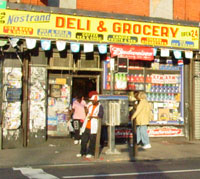 |
|
Corner deli on Nostrand and Macon. |
Bed-Stuy could go
different ways. The community is getting increasingly polarized
economically, with at one end public projects and at the other
beautifully renovated brownstones. As the neighborhood keeps developing,
more higher-income households will come in, accelerating upscale
development further. Diversity is a source of innovation and evolution,
so newcomers should be welcome, whatever their income levels and skin
colors. Newcomers have a responsibility to integrate the current
residents of the neighborhood to their vision. Attitude matters. The
history of the neighborhood, its people and brownstones should be
respected.
To successfully integrate
the new Bed-Stuy and the old one, spaces where the two meet should be
multiplied. These spaces are: public spaces, parks, commercial strips,
cultural centers, and schools. A particular effort should be made on
schools since they will determine the future of the neighborhood.
Moreover, schools are places were all social classes could meet. If they
do not improve, parents who can afford it will keep putting their
children in private schools and some children living in the same
neighborhood will never meet. Much of the misery of the neighborhood was
caused by segregation. Everything should be done to promote integration,
in the respect of differences.
In five years time Bed-Stuy will be just like Clinton Hill and Fort
Green. I would prefer to say that newcomers will not push current
residents out, that they will mesh up with the current population, and
respect and sustain the fragile, incrementally developing economy of the
neighborhood. But that will most probably not happen. As more
middle-class newcomers seize the opportunity of owning a brownstone at
discounted ghetto price, more will follow. The first middle-class
newcomers will think of themselves as “pioneers”, as if before their
arrival there was nothing. As they move in and chase the undesirables,
the neighborhood will get “cleaner”, but it will also lose some of its
spices. The period of mutation from the ghetto to the “decent” community
is beautiful, though. It is often in the chaos of change that hybrid
creatures, such as the music of
Noble Society, emerge with the strength of life.
Footnotes :
1 “The largest ghetto in the country is the Bedford-Stuyvesant section
of Brooklyn in New York City”. This is the opening sentence of Barry
Stein’s Rebuilding Bedford-Stuyvesant, Community Economic Development in
the Ghetto, Center for Community Development, Cambridge, Massachussetts,
1975
2 Mary H. Monomi, Bedford Stuyvesant the Anatomy of a Central City
Community, Quadrangle, The New York Times Book Co., New York 1973, p. 1
3 35.2% of household have an annual income of less than $10,000
according to Dr Moon Wha Lee’s Housing New York City 1999, Department of
Housing Preservation & Development, New York 2002
4 “Institutions are the rules of the game in a society, or more
formally, are the humanly devised constraints that shape human
interaction. In consequence they structure incentives in human exchange,
whether political, social, or economic. Institutional change shapes the
way societies evolve through time and hence is the key to understanding
historical change.”, Douglass C. North, Institutions, Institutional
Change and Economic Performance, Cambridge University Press, Cambridge,
1990, p. 3
5
6 Douglass C. North, Institutions, Institutional Change and Economic
Performance, Cambridge University Press, Cambridge, 1990, p. vii
7 As we will see however, Weeksville and Carsville, two small black
communities established in the 1830s, were instrumental in opening the
way to more black immigrants.
8 Jessica Hohnson, Bedford-Stuyvesant Renaissance Hailed, Daily News
(New York), June 20, 2002
9 David Ment & Mary Donovan, The People of Brooklyn; A History of Two
Neighborhoods, Brooklyn Educational Cultural Alliance, New York 1980
10 The Draft Riots occurred in March 1863, during the Civil War, after
Abraham Lincoln issued the Enrollment Act of Conscription, drafting
young citizens to defend the Union against the South. The Union Act was
criticized all over the country for being unfair. The wealthier citizen
could for instance buy out exemptions. Democrat Governor Horatio Seymor
of New York declared the act unconstitutional, encouraging the masses to
take on the streets. Many citizens banded across the city, terrorizing
neighborhoods and looming stores. Among them, many Irish immigrants,
poor and already prejudiced against blacks, refused to fight on their
behalf, and targeted them, forcing them to take refuge in Brooklyn.
11 David Ment & Mary Donovan, The People of Brooklyn; A History of Two
Neighborhoods, Brooklyn Educational Cultural Alliance, New York 1980
12 idem p. 27
13 idem p. 32
14 idem p. 32
15 idem p.36
16 Mary H. Monomi, Bedford Stuyvesant the Anatomy of a Central City
Community, Quadrangle, The New York Times Book Co., New York 1973, p.4
17 The Center for Urban Education, Community Attitude in
Bedford-Stuyvesant, New York 1967
18 Barry Stein, Rebuilding Bedford-Stuyvesant, Community Economic
Development in the Ghetto, Center for Community Development, Cambridge,
Massachusetts, 1975 p. 2
19 David Ment & Mary Donovan, The People of Brooklyn; A History of Two
Neighborhood, Brooklyn Educational 7 Cultural Alliance, New York 1980 p.
40
20 idem p. 41
21 The Center for Urban Education, Community Attitude in
Bedford-Stuyvesant, New York 1967 p. 33
22 Henry Etzkowitz and Gerald M. Schaflander, Ghetto Crisis: Riots or
Reconciliation? , Little, Brown and Company, Boston 1969, p. 151
23 Center for Urban Education, Community Attitudes in
Bedford-Stuyvesant: An Area Study, Summer, New York, 1967, p.22
24 Barry Stein, Rebuilding Bedford-Stuyvesant, Community Economic
Development in the Ghetto, Center for Community Development, Cambridge,
Massachusetts, 1975 p. 11
25 David Rusk, Inside Game, Outside Game, Brooking Institution Press,
Washington DC 1999, p. 49
26 Margaret E. Dewar, Why State and Local Economic Development Programs
Cause so Little Development, in Economic Development Quarterly, Vol. 12
No. 1, Sage Publication, February 1998, pp. 68-87
27 Linking capital refers to connection to people in power. It is
typically used to leverage resources.
28 Michael Woolcock, The Place of Social Capital in Understanding Social
And Economic Outcomes, Isuma, Vol. 2 No. 1, Spring 2001, www.isuma.net
29 William Wilson, The Two Nations of Black America, Frontline, PBS
Video 1998
30 Eliot Asinof, People vs. Blutcher,, Viking Press Inc. New York, 1970,
p. xii
31 idem, p. xii
32 David Rusk, Inside Game, Outside Game, Brooking Institution Press,
Washington DC 1999, p. 123
33 Lipsey & Chrystal, Positive Economics
34 Ross J. Gittell, Community organizing : building social capital as a
development strategy, Thousand Oaks, CA : Sage Publications, c1998 p. 25
35 “Bonding refers to relations amongst people who are like each other:
families, language and ethnic groups, members of the same social and
economic class or religious affiliation ? Bridging refers to relations
built up between and amongst people who initially might be strangers to
each other: perhaps divided by culture, religion and most potently by
the social and economic means at their disposal.”, Ken Boston,
http://www.det.nsw.edu.au/viewpoints/bonding.htm
36 Term used by Roland Burt in Structural Holes. Chicago: University of
Chicago Press, 1992
37 Real Estate Solutions, LLC, Economic, Demographic and Real Estate
Development Trends, Brooklyn a³ prepared for the Brooklyn Chamber of
Commerce. The report defines Bedford-Stuyvesant as the area “bounded by
Flushing Avenue to the north, Atlantic and New York Avenues to the
south, Broadway to the east, and Classon Avenue to the west”
38 Community Board No. 3, District Need
39 New York City Police Department, www.ci.nyc.ny.us/html/nypd
Statement, Brooklyn 2000
40 Mary H. Monomi, Bedford Stuyvesant the Anatomy of a Central City
Community, Quadrangle, The New York Times Book Co., New York 1973, p.16
41 idem, p.16
42 Interview with Greg Donaldson, Professor of English at the Brooklyn
Tech and author of The Ville : cops and kids in urban America, New York
: Ticknor & Fields, 1993
43 Statistics compiled by myself from the Census data
44 “Averse to answer the Census form because of their illegal status,
undocumented immigrants’ non-responses are greater among Latinos than
among blacks. But blacks in New York City, including middle income
blacks, seem to have developed a greater degree of mistrust over time.
The citywide response in black neighborhoods is down 5% in 2000 to below
40%.” Emanuel Tobier, In the News: Census Slackers, GothamGazette.com,
2000 www.gothamgazette.com/demographics/jun.00.shtml
45 Herbet Giersch, Economic Aspects of International Migration,
Spinger-Verlag, Berlin, 1994, p. 229
46 Slobodan Djajic in Slobodan Djajic, International Migration Trends,
Policies and Economic Impact, Routledge, London, New York 2001, p. 156
47 Herbet Giersch, Economic Aspects of International Migration,
Spinger-Verlag, Berlin, 1994, p. 233
48 The Economist, A modest contribution, Survey: Migration, October 2002
49 Herbet Giersch, Economic Aspects of International Migration,
Spinger-Verlag, Berlin, 1994, p. 229
50 idem p.239
51 SmaG¸n Laacher, Comment les “papiers” peuvent changer la vie, Le
Monde Diplomatique, ManiÅre de Voir 62, April-March 2002, p. 65
52 Julian L. Simon, The Economic Consequences of Immigration, University
of Michigan Press, 1999, p. 207
53 Slobodan Djajic in Slobodan Djajic, International Migration Trends,
Policies and Economic Impact, Routledge, London, New York 2001, p. 154
54 The Economist, A modest contribution, Survey: Migration, October 2002
55 Saskia Sassen, New York City’s Informal Economy, Institute for Social
Science & Research, Volume IV. 1988_89
56 Idem
57 Community Board No. 3, District Needs Statement , Brooklyn 2000
58 Real Estate Solutions, LLC, Economic, Demographic and Real Estate
Development Trends, Brooklyn a³ prepared for the Brooklyn Chamber of
Commerce.
59 idem
60 Fiscal Policy Institute, Labor Day 2002 report,
http://www.fiscalpolicy.org
61 Manuel Castells, Alexandro Portes, Lauren A. Benton, The Informal
Economy : studies in advanced and less developed countries, Baltimore,
Md. : Johns Hopkins University Press, c1989, p. 29
62 Baye McNeil, FIRST Things First: Fulton Street Initiative Promises
Economic Revitalization, Bed-Stuy online,
http://bedstuyonline.com/Economy/FultonFIRST-frames.htm
63 Idem
64 The Columbia Encyclopedia, Sixth Edition, Columbia University Press,
2002
65 Manuel Castells, Alexandro Portes, Lauren A. Benton, The Informal
Economy : studies in advanced and less developed countries, Baltimore,
Md. : Johns Hopkins University Press, c1989, p. 13. By “ideal”, the
authors do not mean that the absence of any regulations is desirable,
but rather that market is “perfect” in the economic sense of the term.
66 Edwards O. Welles, It’s Not the Same America, Inc., May 1994, p.85,
quoted in Michael Porter, New Strategies for Inner-City Economic
Development, Economic Development Quarterly, Vol. 11 No. 1 February 1997
11-27, Sage Publication, 1997, p. 22
67 Saskia Sassen, New York City’s Informal Economy, Institute for Social
Science & Research, Volume IV. 1988_89
68 Saskia Sassen, New York City’s Informal Economy, Institute for Social
Science & Research, Volume IV. 1988_89
69 Idem
70
71 http://web.mit.edu/krugman/www/bionomic.html
72 Saskia Sassen, New York City’s Informal Economy, Institute for Social
Science & Research, Volume IV. 1988_89
73 Baye McNeil, Gentrifying The Stuy, Our Time Press, July 2001,
http://www.ourtimepress.com/community/GentrifyingStuy.html
74 Carol Steinbach, Community Development Corporations in US Civil
Society, www.ids.ac.uk/ids/civsoc/final/usa/USA2.doc
75 Dr Moon Wha Lee, Housing New York City 1999, Department of Housing
Preservation & Development, New York 2002
76 Kerry Burke, Michele Mcphee and Bill Hutchinson, Toy Draws Deadly
Fire: Cops shoot vagrant waving fake gun on B’klyn street, Daily News
(New York), Wednesday August 28, 2002
77 Real Estate Solutions, LLC, Economic, Demographic and Real Estate
Development Trends, Brooklyn a³to be published
78 Richard Florida, The Rise of the Creative Class, Basic Books, New
York, 2002
79 Real Estate Solutions, LLC, Economic, Demographic and Real Estate
Development Trends, Brooklyn a³ prepared for the Brooklyn Chamber of
Commerce.
80 Neighborhood Economic Development Advocacy Project, Home Mortgage
Lending and Foreclosures in Three New York City Neighborhoods: Bedford
Stuyvesant, Brooklyn; Cypress Hill, Brooklyn; Jamaica, Queens, Summary
of Findings 1998-2000
81 Idem
82 Leaflet distributed by the South Brooklyn Legal Services entitled: A
New Crisis in Homeownership: FHA Fraud and Property Flipping, 2001
83 Real Estate Solutions, LLC, Economic, Demographic and Real Estate
Development Trends, Brooklyn a³ prepared for the Brooklyn Chamber of
Commerce
84 Statistics compiled by myself from the Census data
85 Baye McNeil, Gentrifying The Stuy, Our Time Press, July 2001,
http://www.ourtimepress.com/community/GentrifyingStuy.html
86 All data from Real Estate Solutions, LLC, Economic, Demographic and
Real Estate Development Trends, Brooklyn a³ prepared for the Brooklyn
Chamber of Commerce
87 Nada El Sawy, Atlantic Men’s Shelter, gothamgazette.com,
http://www.gothamgazette.com/commentary/115.elsawy.shtml
88 Whyte, William Hollingsworth, City : rediscovering the center, New
York : Anchor Books/Doubleday, 1990, pp. 338-339
89 Real Estate Solutions, LLC, Economic, Demographic and Real Estate
Development Trends, Brooklyn
90 The State Of American Cities 1999
91 Thomas Faulkner is president of the Brownstoners of
Bedford-Stuyvesant and Sharonnie Perry is chairwoman of Community Board
3, Joyce Shelby, Spotlight on Stuyvesant Heights, Daily News (New York),
April 28, 2002
92 Real Estate Solutions, LLC, Economic, Demographic and Real Estate
Development Trends, Brooklyn
93 Real Estate Solutions, LLC, Retail Recommendation, Brooklyn
94 31.2% of the population of Community District 3 was under 18 in 2000
according to the U.S. Census Bureau, 2000 Census PL file and SF1,
Population Division a³ NYC Department of City Planning (Oct 2001)
95 Our Time, 24th Annual Brownstoners of Bed-Stuy House Tour is Set for
Oct. 19, VOL. 7, NO.10, Brooklyn, New York, October 2002
96 Jane Jacobs, Cities and the Wealth of Nations: Principles of Economic
Life, First Vintage Books Edition, New York, 1985, pp. 150-51
97 Jane Jacobs, Cities and the Wealth of Nations: Principles of Economic
Life, First Vintage Books Edition, New York, 1985, pp. 150
98 Baye McNeil, FIRST Things First: Fulton Street Initiative Promises
Economic Revitalization, Bed-Stuy online,
http://bedstuyonline.com/Economy/FultonFIRST-frames.htm
99 Baye McNeil, FIRST Things First: Fulton Street Initiative Promises
Economic Revitalization, Bed-Stuy online,
http://bedstuyonline.com/Economy/FultonFIRST-frames.htm
100 Lee Romney, Los Angeles Times, March 18, 2002
101 Andrew Beveridge, Politics and the Undercount, GothamGazette.com,
May 2001
102 Idem
103 SmaG¸n Laacher, Comment les “papiers” peuvent changer la vie, Le
Monde Diplomatique, ManiÅre de Voir 62, April-March 2002, p. 66
104 Frank F. DeGiovanni in Gentrification, Displacement and Neighborhood
Revitalization, SUNY series on urban public policy, Albany : State
University of New York Press, c1984, p. 68
Bibliography
z´ Eliot Asinof, People vs. Blutcher,, Viking Press Inc. New York, 1970
z´ Kerry Burke, Michele Mcphee and Bill Hutchinson, Toy Draws Deadly
Fire: Cops shoot vagrant waving fake gun on B’klyn street, Daily News
(New York), Wednesday August 28, 2002
z´ Manuel Castells, Alexandro Portes, Lauren A. Benton, The Informal
Economy: studies in advanced and less developed countries, Baltimore,
Md.: Johns Hopkins University Press, c1989
z´ The Center for Urban Education, Community Attitudes in
Bedford-Stuyvesant: An Area Study, Summer, New York, 1967
z´ Census data, 1990, 2000
z´ Community Board No. 3, District Need Statement, Brooklyn 2000
z´ Frank F. DeGiovanni in Gentrification, Displacement and Neighborhood
Revitalization, SUNY series on urban public policy, Albany State
University of New York Press, c1984
z´ Emily DeNitto, A Neighborhood Grows in Brooklyn, Crain’s New York
Business, January 1, 2001
z´ Margaret E. Dewar, Why State and Local Economic Development Programs
Cause so Little Development, in Economic Development Quarterly, Vol. 12
No. 1, Sage Publication, February 1998
z´ Slobodan Djajic in Slobodan Djajic, International Migration Trends,
Policies and Economic Impact, Routledge, London, New York 2001
z´ Greg Donaldson, The Ville : cops and kids in urban America, New York
: Ticknor & Fields, 1993
z´ The Economist, A modest contribution, Survey: Migration, October 2002
z´ Henry Etzkowitz and Gerald M. Schaflander, Ghetto Crisis: Riots or
Reconciliation? , Little, Brown and Company, Boston 1969
z´ Fiscal Policy Institute, Labor Day 2002 report,
http://www.fiscalpolicy.org
z´ Richard Florida, The Rise of the Creative Class, Basic Books, New
York, 2002
z´ Herbet Giersch, Economic Aspects of International Migration,
Spinger-Verlag, Berlin, 1994
z´ Ross J. Gittell, Community organizing: building social capital as a
development strategy, Thousand Oaks, CA: Sage Publications, c1998
z´ Jessica Hohnson, Bedford-Stuyvesant Renaissance Hailed, Daily News
(New York), June 20, 2002
z´ Jane Jacobs, Cities and the Wealth of Nations: Principles of Economic
Life, First Vintage Books Edition, New York, 1985
z´ Baye McNeil, FIRST Things First: Fulton Street Initiative Promises
Economic Revitalization, Bed-Stuy online,
http://bedstuyonline.com/Economy/FultonFIRST-frames.htm
z´ Baye McNeil, Gentrifying The Stuy, Our Time Press, July 2001.
http://www.ourtimepress.com/community/GentrifyingStuy.html
z´ SmaG¸n Laacher, Comment les “papiers” peuvent changer la vie, Le
Monde Diplomatique, ManiÅre de Voir 62, April-March 2002
z´ Dr Moon Wha Lee, Housing New York City 1999, Department of Housing
Preservation & Development, New York 2002
z´ Lipsey & Chrystal, Positive Economics
z´ David Ment & Mary Donovan, The People of Brooklyn; A History of Two
Neighborhoods, Brooklyn Educational Cultural Alliance, New York 1980
z´ Mary H. Monomi, Bedford Stuyvesant the Anatomy of a Central City
Community, Quadrangle, The New York Times Book Co., New York 1973
z´ Neighborhood Economic Development Advocacy Project, Home Mortgage
Lending and Foreclosures in Three New York City Neighborhoods: Bedford
Stuyvesant, Brooklyn; Cypress Hill, Brooklyn; Jamaica, Queens, Summary
of Findings 1998-2000
z´ Douglass C. North, Institutions, Institutional Change and Economic
Performance, Cambridge University Press, Cambridge, 1990
z´ Our Time, 24th Annual Brownstoners of Bed-Stuy House Tour is Set for
Oct. 19, VOL. 7, NO.10, Brooklyn, New York, October 2002
z´ Michael E. Porter, New Strategies for Inner-City Economic
Development, Economic Development Quarterly, Vol. 11 No. 1, Febuary 1997
z´ Real Estate Solutions, LLC, Economic, Demographic and Real Estate
Development Trends, Brooklyn a³to be published by the Brooklyn Chamber
of Commerce
z´ Real Estate Solutions, LLC, Retail Recommendation, Brooklyn a³to be
published by the Brooklyn Chamber of Commerce
z´ David Rusk, Inside Game, Outside Game, Brooking Institution Press,
Washington DC 1999
z´ Saskia Sassen, New York City’s Informal Economy, Institute for Social
Science & Research, Volume IV. 1988_89
z´ Nada El Sawy, Atlantic Men’s Shelter, gothamgazette.com,
http://www.gothamgazette.com/commentary/115.elsawy.shtml
z´ Joyce Shelby, Spotlight on Stuyvesant Heights, Daily News (New York),
April 28, 2002
z´ Julian L. Simon, The Economic Consequences of Immigration, University
of Michigan Press, 1999
z´ The State Of American Cities 1999
z´ Barry Stein, Rebuilding Bedford-Stuyvesant, Community Economic
Development in the Ghetto, Center for Community Development, Cambridge,
Massachusetts, 1975
z´ Carol Steinbach, Community Development Corporations in US Civil
Society, http://www.ids.ac.uk/ids/civsoc/final/usa/USA2.doc
z´ Emanuel Tobier, In the News: Census Slackers, GothamGazette.com, 2000
http://www.gothamgazette.com/demographics/jun.00.shtml
z´ William Wilson, The Two Nations of Black America, Frontline, PBS
Video 1998
z´ Whyte, William Hollingsworth, City: rediscovering the center, New
York: Anchor Books/Doubleday, 1990
z´ Michael Woolcock, The Place of Social Capital in Understanding Social
And Economic Outcomes, Isuma, Vol. 2 No. 1, Spring 2001,
http://www.isuma.net
Websites:
z´ Alliance for Nonprofit Governance, http://www.ANGonline.org
z´ American Facts Finder, http://factfinder.census.gov/
z´ Bed-Stuy Online, http://www.bedstuyonline.com
z´ Bedford-Stuyvestant Restoration Corporation,
http://www.restorationplaza.org/
z´ Bridge Street Development Corporation, http://www.bsdc.org/
z´ Brooklyn Economic Development Corporation, http://www.bedc.org/
z´ Capital Xchange,
http://www.brook.edu/dybdocroot/es/urban/capitalxchange/article5.htm
z´ New York History http://www.nyhistory.org/teachers/41.html
z´ New York City Police Department, http://www.ci.nyc.ny.us/html/nypd
z´ Our Times Press,
http://www.ourtimepress.com/community/GentrifyingStuy.html
z´ Park Slope Food Coop,
http://www.foodcoop.com/linewaiters/bed_sty.html
z´ Pratt Area Community Council, http://www.prattarea.org/
z´ The Village Voice, Close-Up On: Bedford-Stuyvesant,
http://www.villagevoice.com/issues/0219/ince.php
z´ U.S. Small Business Administration, http://www.sba.gov/
Interviews (all interviews were conducted between October and December
2002)
z´ Celine, NGO worker and resident, Bedford-Stuyvesant
z´ Charles Willis, Homeowner and resident, Bedford-Stuyvesant
z´ Crystal Bobb-Semple, Bookstore owner and resident, Bedford-Stuyvesant
z´ Delie, Singer and resident, Bedford-Stuyvesant
z´ Diego Campo, Composer and resident, Bedford-Stuyvesant
z´ Eric Coles, Designer and resident, Bedford-Stuyvesant
z´ Erica McHall, Urban planner at the Pratt Area Community Council,
Bedford-Stuyvesant
z´ Gabriel, Urban planner at the Pratt Area Community Council, Fort
Green
z´ Greg Donaldson, Author and Professor, Brooklyn Technical High School
z´ Jahdan, Singer and resident, Bedford-Stuyvesant
z´ Jasper, Shop owner and resident, Bedford-Stuyvesant
z´ Malik, CD vendor, Bedford-Stuyvesant
z´ Salomon, Homeowner, Bedford-Stuyvesant