|
|
 |
|
|
|
|
| New York
Architecture Images-New York Architects Ludwig Mies van der Rohe |
|
|
(b. Aachen, Germany 1886; d.
Chicago, Illinois 1969)
Ludwig Mies Van der Rohe was born in Aachen, Germany in 1886. He worked in the family stone-carving business before he joined the office of Bruno Paul in Berlin. He entered the studio of Peter Behrens in 1908 and remained until 1912. Under Behrens' influence, Mies developed a design approach based on advanced structural techniques and Prussian Classicism. He also developed a sympathy for the aesthetic credos of both Russian Constructivism and the Dutch De Stijl group. He borrowed from the post and lintel construction of Karl Friedrich Schinkel for his designs in steel and glass. Mies worked with the magazine G which started in July 1923. He made major contributions to the architectural philosophies of the late 1920s and 1930s as artistic director of the Werkbund-sponsored Weissenhof project and as Director of the Bauhaus. Famous for his dictum 'Less is More', Mies attempted to create contemplative, neutral spaces through an architecture based on material honesty and structural integrity. Over the last twenty years of his life, Mies achieved his vision of a monumental 'skin and bone' architecture. His later works provide a fitting denouement to a life dedicated to the idea of a universal, simplified architecture Mies died in Chicago, Illinois in 1969. References Recipient of the American Institute of Architects Gold Medal, 1960 |
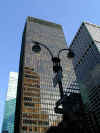
| 002-Seagram Building | |